

Articles


Animals display many remarkable behaviours. To better appreciate their talents, how often have we wished that these creatures could communicate with us? We would love to know where they go during migrations, for example. In recent years however, animal ecologists have developed techniques to allow us to track some of these creatures. As a result, these animals communicate with us simply by doing what comes naturally, during the course of which our little espionage devices report where the animals have gone. Read the rest of this entry »

It was in 1909 that Charles Walcott of the Smithsonian Institution, noticed an unusual fossil in Canada’s Rocky Mountains in Yoho National Park. It was the discoloured, extremely thin remains of a soft-bodied marine creature. Now wait a minute, he must have thought! What we normally find as fossils are the hard parts such as shell or bone from once living creatures. Naturally intrigued, Walcott returned to British Columbia for several summers. He found a whole collection of soft bodied creatures previously unknown to science. Read the rest of this entry »

Book Review of Guide to Animals
The author, Frank Sherwin has organized his introduction to animals in interesting ways. The message is conveyed partly by the text, partly by his organization of topics, but also by the amazing variety of beautiful illustrations. In style, this book closely resembles its sister publication Guide to Creation Basics. Read the rest of this entry »
Manatees (family Trichechidae, genus Trichechus), often called sea cows, are large, fully aquatic, mostly herbivorous marine mammals. Three living species exist, the Amazonian, West Indian, and the West African manatee. These are huge animals weighing from 400 to 550 kilograms (880 to 1,210 lb), and 2.8 to 3.0 metres (9.2 to 9.8 ft) long. The females tend to be both larger and heavier.
In many ways manatees are unique compared to all other life forms, a fact that poses major problems for evolutionists. It is almost like a designer selected their traits from a wide variety of existing life forms, from reptiles to fish to mammals. For example, manatees feed almost entirely on aquatic plants and that is “unique among living marine mammals” (Berta, 2012. Return to the Sea: The Life and Evolutionary Times of Marine Mammals. University of California Press. Berkeley p. 127). Read the rest of this entry »
People came from hundreds of kilometres away to hear Dr. Steven Ausin speak at CSAA’s Creation Weekend in Edmonton in October. His first lecture on Friday evening, October 24 was on the global flood model, also known as catastrophic plate tectonics. This model provides an explanation for how the earth came to its present state (as a result of a worldwide flood). The model was first proposed in a paper in 1994. There were six authors, Drs. Steven Austin, John Baumgardner, Hubert Humphreys, Andrew Snelling, Larry Vardiman and Kurt Wise (each representing different relevant technical areas of expertise). Read the rest of this entry »
Launched in 1977, the two Voyager probes have seen some strange and unexpected sights as they cruised through our solar system. After passing the planets, the probes have continued outward towards the farthest reaches of the solar system. In the summer of 2012, Voyager I was now 18.2 billion km away from us, more than three times the distance between the sun and Pluto. The solar system however by definition consists not only of the planets, but of the volume in space to which the sun’s particles extend, or in other words the volume in space which is impacted by the sun. The question everybody was asking, was how long would it take Voyager I to leave the solar system and enter interstellar space? And what would Voyager find when it got to interstellar space? Read the rest of this entry »
During the 1960s and 1970s, improved strains of wheat and rice resulted in a doubling of crop yields. Despite predictions of disaster from some environmentalists, the world continued to feed quickly growing human populations. This green revolution, kick-started by the research of American plant scientist Norman Borlaug and Indian rice geneticist M. S. Swaminathan, provided much higher yielding crops. However for optimum growth, these crops require the widespread application of nitrogen fertilizers and other chemicals. As a byproduct of this practice, a significant amount of fertilizer ends up in natural waterways. As a result, scientists now consider the application of such chemicals as “so last century!” (Nature October 30, 2014 p. S52). The hunt is now on for crops that do not require chemical inputs and yet produce high yields. Read the rest of this entry »
The ball arcs into the air, and then downward. A player rushes forward. Whew!! Another save made. The player’s strategy was to move to intercept the ball as it follows a predictable trajectory downward. We are happy the ball was caught, but the situation was not complicated. This is called a “constant bearing strategy” in pursuit of a target moving in a predictable arc. The strategy becomes more serious however when we learn that many animals similarly catch their prey by converging on the straightforward escape route of the hapless victim. Read the rest of this entry »
Armadillos (Spanish for little armoured one) are New World nocturnal mammals covered by a leathery armour shell overlaid by horn. Of all living animals, “few are as amazing … as the armadillos” (Storrs, 1982). Even Carolus Linnaeus, the father of taxonomy, was puzzled about how to classify this “strange-looking mammal” (Smith and Doughty, 1984, p. 2). They are shy, timid mammals that mammalogist David Lamp calls bizarre (1977, p. 36). They look nothing like any other living animal, appearing much more like a fierce miniature dinosaur. These nearly blind and deaf animals must use their keen sense of smell to locate food. Read the rest of this entry »
Review of Evolution’s Achilles’ Heels (book)
Like Alice of Wonderland fame (in Through the Looking Glass), who found that she had to run extremely fast just to stay in the same place, so also it is hard to maintain an up-to-date understanding in science. The scientific journals constantly churn out new articles with new information and arguments. Keeping up to date is hard work! But it is extremely helpful to have an understanding of current issues in science and their significance. This makes the new book Evolution’s Achilles’ Heels (Robert Carter, Editor) and its companion DVD of the same title, extremely relevant. Read the rest of this entry »
Creation Weekend 2015
October 23 & 24, 2015
It is not very often that an Edmonton audience has the opportunity to hear a world class expert tie together medical research, technology and Christian faith. Read the rest of this entry »
It is not just the Bible believing Christians who base their interpretations of nature on their worldview, so too do the secular scientists. It so happens however that the worldviews of these two groups, and thus the assumptions used in interpreting nature, are totally different. The most obvious assumption of the Christians is that God’s work and character are evident in nature. Mainstream scientists alternatively assume that God will never be revealed in nature, but only matter and processes. Read the rest of this entry »
There are some useful and visually attractive programs available on YouTube. For example, Privileged Species (previously reviewed in Dialogue) at 32 minutes, has already recorded 33,300 views. However for better quality display, a DVD is required which CSAA sells for $15.00 each.
Several years ago CSAA distributed free copies of the DVD Programming of Life which runs 44 minutes and is produced by LaBarge Media (with Don Johnson). We distributed this to high school and university students, teachers, and pastors. This program examines mathematical issues concerning the living cell. In this context, information is a critical feature of living cells. The kind of information required (proscriptive) involves instructions. From that discussion we proceed to protein manufacturing which is illustrated with beautiful graphics. We then learn the essential features of a computer and how the cell demonstrates these capacities. Read the rest of this entry »
The ability of fireflies to glow in the dark, delights those who have seen these insects in action. It really seems like a special talent. However a recent issue of National Geographic (March 2015) declared about bioluminescence: “Evolving to make light seems to be relatively easy — it has happened independently in at least 40 different lineages.” (p. 84) Just because we find a special talent in a number of very different creatures, does not mean that the talent was easily developed by chance. National Geographic is not aware that this unusual ability is much more reasonably explained as the choice of God, the creator. There are many examples where we can see the problem for evolution of special talents in very different creatures. And the camera eye is an ideal example. Read the rest of this entry »
Secular scientists usually do not like to mention discoveries or achievements of people who support Biblical creation. Recently however, some creation supporters have come to the attention of many scientists and even the secular media.
Mark Armitage, for example, recently published an article on soft un-fossilized tissue in one of the largest Triceratops horns ever found in Montana. Mr. Armitage had found the dinosaur fossil himself in 2012. Then in February 2013 he, along with biologist Kevin Lee Anderson of Arkansas State University-Beebe, published a technical article on this find in a mainstream European scientific journal Acta Histochemica (115, 603-608, 2013). Entitled “Soft sheets of fibrillary bone from a fossil of the supraorbital horn of the dinosaur Triceratops horridus.” The article established this find as “the first report of sheets of soft tissues from Triceratops horn bearing layers of osteocytes [bone forming cells], and extends the range and type of dinosaur specimens known to contain non-fossilized material in bone matrix.” (p. 603) Read the rest of this entry »
FEATURED BOOKS AND DVDS

Paperback / $6.00 / 55 Pages
Secular scientists usually do not like to mention discoveries or achievements of people who support Biblical creation. Recently however, some creation supporters have come to the attention of many scientists and even the secular media.
Mark Armitage, for example, recently published an article on soft un-fossilized tissue in one of the largest Triceratops horns ever found in Montana. Mr. Armitage had found the dinosaur fossil himself in 2012. Then in February 2013 he, along with biologist Kevin Lee Anderson of Arkansas State University-Beebe, published a technical article on this find in a mainstream European scientific journal Acta Histochemica (115, 603-608, 2013). Entitled “Soft sheets of fibrillary bone from a fossil of the supraorbital horn of the dinosaur Triceratops horridus.” The article established this find as “the first report of sheets of soft tissues from Triceratops horn bearing layers of osteocytes [bone forming cells], and extends the range and type of dinosaur specimens known to contain non-fossilized material in bone matrix.” (p. 603) Read the rest of this entry »
Order Online
Paperback / $10.00 / 111 Pages / full colour
Secular scientists usually do not like to mention discoveries or achievements of people who support Biblical creation. Recently however, some creation supporters have come to the attention of many scientists and even the secular media.
Mark Armitage, for example, recently published an article on soft un-fossilized tissue in one of the largest Triceratops horns ever found in Montana. Mr. Armitage had found the dinosaur fossil himself in 2012. Then in February 2013 he, along with biologist Kevin Lee Anderson of Arkansas State University-Beebe, published a technical article on this find in a mainstream European scientific journal Acta Histochemica (115, 603-608, 2013). Entitled “Soft sheets of fibrillary bone from a fossil of the supraorbital horn of the dinosaur Triceratops horridus.” The article established this find as “the first report of sheets of soft tissues from Triceratops horn bearing layers of osteocytes [bone forming cells], and extends the range and type of dinosaur specimens known to contain non-fossilized material in bone matrix.” (p. 603) Read the rest of this entry »
Order Online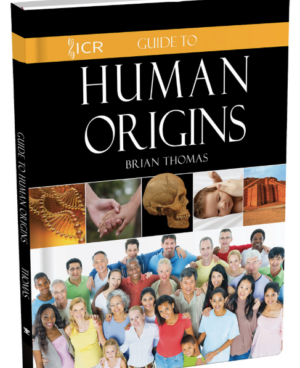
Hardcover / $18.00 / 117 Pages / Full colour
Secular scientists usually do not like to mention discoveries or achievements of people who support Biblical creation. Recently however, some creation supporters have come to the attention of many scientists and even the secular media.
Mark Armitage, for example, recently published an article on soft un-fossilized tissue in one of the largest Triceratops horns ever found in Montana. Mr. Armitage had found the dinosaur fossil himself in 2012. Then in February 2013 he, along with biologist Kevin Lee Anderson of Arkansas State University-Beebe, published a technical article on this find in a mainstream European scientific journal Acta Histochemica (115, 603-608, 2013). Entitled “Soft sheets of fibrillary bone from a fossil of the supraorbital horn of the dinosaur Triceratops horridus.” The article established this find as “the first report of sheets of soft tissues from Triceratops horn bearing layers of osteocytes [bone forming cells], and extends the range and type of dinosaur specimens known to contain non-fossilized material in bone matrix.” (p. 603) Read the rest of this entry »
Order Online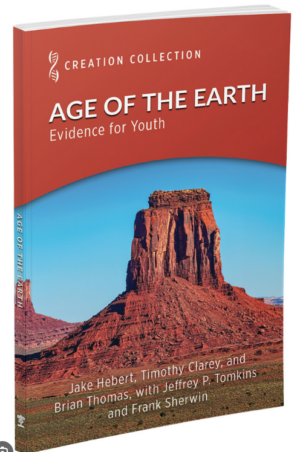
Paperback / $10.00 / 192 Pages / Full colour
Secular scientists usually do not like to mention discoveries or achievements of people who support Biblical creation. Recently however, some creation supporters have come to the attention of many scientists and even the secular media.
Mark Armitage, for example, recently published an article on soft un-fossilized tissue in one of the largest Triceratops horns ever found in Montana. Mr. Armitage had found the dinosaur fossil himself in 2012. Then in February 2013 he, along with biologist Kevin Lee Anderson of Arkansas State University-Beebe, published a technical article on this find in a mainstream European scientific journal Acta Histochemica (115, 603-608, 2013). Entitled “Soft sheets of fibrillary bone from a fossil of the supraorbital horn of the dinosaur Triceratops horridus.” The article established this find as “the first report of sheets of soft tissues from Triceratops horn bearing layers of osteocytes [bone forming cells], and extends the range and type of dinosaur specimens known to contain non-fossilized material in bone matrix.” (p. 603) Read the rest of this entry »
Order Online