

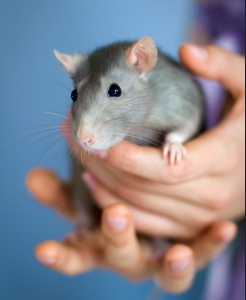

Rats have the worst reputation of any known mammal. The reasons are many. Rats are often found in filthy places such as garbage dumps or sewers where they come to search for food. Worse, rats serve as disease vectors, causing the plague, more accurately, the fleas on them cause disease. The Black Death killed as many as 50 million persons in Europe in the 1600s, wiping out as much as 60 percent of the existing population. Not surprisingly, people often demonstrate a visceral reaction to a rat’s hairless tail and feet.
Rats are fast-moving, agile creatures that are excellent climbers. They are also rapid learners and quick to solve problems. A common example is that they can be taught to run through a maze to reach food. Their talent in this area makes them excellent animals to use for many kinds of scientific experiments. A 2021 Nature Magazine study determined that over 100 million mice and rats were used in U.S. research laboratories annually, making them by far the dominant lab mammal.[i] When I was doing biomedical research at a medical school, we used only white rats for all of our research.[ii] For this reason biologists know a great deal about them including their genetics.
Rats as Pets
Rats have co-existed alongside humans since very early in recorded history. In America, they have been kept as pets back to the 1800s, where they made affectionate, intelligent pets for the upper classes. A white rat named Sammy belonged to Beatrix Potter, the author of the Peter Rabbit stories. Sammy was often featured in her novels.
Most large cities have rat clubs and even rat shows where owners and potential owners can become acquainted with other owners. This allows owners to witness the enormous variety of rats. Their colors alone, besides white, include black, cinnamon, chocolate, gray-blue, and silver.
Because rats are naturally gregarious, they do much better in the company of other rats. Many owners buy rats in pairs of the same sex to ensure they have a cage mate. Opposed sex mates often end up producing a litter of pups. This may not be a problem if one is part of a rat club and can sell the pups to other members.
Not in Alberta
When it comes to rats however, the province of Alberta is very different from most jurisdictions. Except for white rats kept in laboratories of educational or research institutions, possession of these creatures in the province is strictly illegal. Prior to 1950, there were no wild (Norwegian) rats in the province. They had been approaching however at a rate of about 24 km per year from the east. Initially introduced to the continent in the east about 1775, these animals reached the Alberta border through Saskatchewan about 1950. Since agriculture is so important in Alberta, the province promptly introduced the Rat Control Program. Continuous surveillance and extermination have ensured that Alberta remains happily rat-free.
Their Intelligent Design
The rat is nevertheless a super well-designed creature. This includes even their ugly tail. The tail has three functions besides helping them balance as they traverse across a tree branch. These include thermoregulation to maintain their body heat within a certain narrow temperature range. They do this by dilating or constricting their tail blood vessels. When the rat’s body temperature rises by a few degrees, the tail vessels (especially the veins) swell, causing vasodilation allowing warm blood to flow through the tail to facilitate cooling.[iii] This system works very well to regulate their temperature.
Rats have poor vision but their other senses are highly developed. Especially the sense of smell, touch, and hearing are highly developed. Their complex nervous system and brain gift them sophisticated cognitive skills, including empathy, abstract rule learning, and advanced problem-solving. Rats also effectively communicate with each other by using body language like humans. Rat brains are structurally so similar to human brains that, for centuries, researchers have studied rat brains to understand the details of the workings of human brains.
They navigate primarily by using their sense of smell, which responds, not only to the common scents that all mammals rely on, but also can sense many chemicals that exist in the air. Rats breathe through their noses, causing the air to move past a patch of skin rich with smell receptors and olfactory neurons. Smell particles called odorants then bind to the olfactory neuron cilia, triggering a neural response. Rodents’ olfactory lobes are much more pronounced than in humans, making rodents’ sense of smell their most important sense organ. Specifically, rats have 1,207 olfactory receptor genes, ranking them far above humans’ tiny 396 olfactory receptors. Dogs have only 811 olfactory receptors.
Rats 1,207 olfactory receptor genes make them critical in clearing landmines during human wars. Rats do not weigh enough to set off the landmines, but they accurately locate where the landmines are so they can be safely detonated. Rats are also now used to sniff for tuberculosis disease in humans. They are both more efficient and accurate than microscopic evaluations. Rats can successfully sense tuberculosis in 70 percent of cases in patients with HIV infections, whereas microscope laboratory testing is only 20 percent effective. Chemicals called pheromones are also a critical means of rat communication, emitting them as warnings of danger or when scent marking to let other rats know they were here.
Rats also explore using their whiskers to interact with their environment. They also have a second smell organ, the vomeronasal organ. This organ is set in a thin, ovoid space in the lower portion of the nasal passage beside the septum. When rats sniff and taste, scent molecules dissolve in their mucus, which is evaluated by the vomeronasal organ receptors.
Evolutionary History
The evolutionary history of rodents in North America, evolutionists claim, extends back to the Late Paleocene Epoch, which evolutionists postulate was 56 million years ago. Fossil evidence of modern rats has been found as far back as the Pliocene Era.[iv] After decades of looking by paleontologists, as is true of most mammals, the fossil record has failed to reveal any evidence of their evolution from some putative non-rat precursors.
The explanation for this problem is: “the fossil record supporting rat evolution is poor” meaning the fossils proving their evolution exist, we just have yet to find them. In spite of over a century we have yet to find any evidence for their evolution from some putative non-rat. Paleontologists claim the reason we have no evidence of rat evolution is not only because of “the gaps in the fossil record” but also because of “the wide variations in dating.”[v] Therefore, the “lack of fossil evidence prior to the Late Paleocene makes the understanding of evolutionary relationships between rodents above the familial level a continuing quest.”[vi] The reason we have no evidence of rat evolution is because they never evolved from some non-rat ancestor. It is clear that they are marvelous creatures even though many are forced to rely on digging through garbage to survive. This is not their fault, but the fault of living in a fallen world.
[i] Grimm, David. 2021. How many mice and rats are used in U.S. labs? https://www.science.org/content/article/how-many-mice-and-rats-are-used-us-labs-controversial-study-says-more-100-million.
[ii] Bergman, Jerry. 2022. How naked mole-rats avoid mutations. Naked mole-rat research eloquently supports the creationists’ position that mutations are the dominant cause of disease, aging, and, eventually, death. https://crev.info/2022/08/naked-mole-rat/.
[iii] The rat’s tail. 2004.
[iv] Donaldson, Henry. 1915. The Rat. Philadelphia, PA: The Wistar Institute of Anatomy and Biology, p. 10.
[v] Burt. Jonathan 2006. Rat. London, UK: Reaktion Books, pp.21, 28.
[vi] Musser, Guy. 2025. Evolution and classification. https://www.britannica.com/animal/rodent/Evolution-and-classification.
Jerry Bergman
August 2026
Subscribe to Dialogue
FEATURED BOOKS AND DVDS


Paperback / $6.00 / 55 Pages
Rats have the worst reputation of any known mammal. The reasons are many. Rats are often found in filthy places such as garbage dumps or sewers where they come to search for food. Worse, rats serve as disease vectors, causing the plague, more accurately, the fleas on them cause disease. The Black Death killed as many as 50 million persons in Europe in the 1600s, wiping out as much as 60 percent of the existing population. Not surprisingly, people often demonstrate a visceral reaction to a rat’s hairless tail and feet.
Rats are fast-moving, agile creatures that are excellent climbers. They are also rapid learners and quick to solve problems. A common example is that they can be taught to run through a maze to reach food. Their talent in this area makes them excellent animals to use for many kinds of scientific experiments. A 2021 Nature Magazine study determined that over 100 million mice and rats were used in U.S. research laboratories annually, making them by far the dominant lab mammal.[i] When I was doing biomedical research at a medical school, we used only white rats for all of our research.[ii] For this reason biologists know a great deal about them including their genetics.
Rats as Pets
Rats have co-existed alongside humans since very early in recorded history. In America, they have been kept as pets back to the 1800s, where they made affectionate, intelligent pets for the upper classes. A white rat named Sammy belonged to Beatrix Potter, the author of the Peter Rabbit stories. Sammy was often featured in her novels.
Most large cities have rat clubs and even rat shows where owners and potential owners can become acquainted with other owners. This allows owners to witness the enormous variety of rats. Their colors alone, besides white, include black, cinnamon, chocolate, gray-blue, and silver.
Because rats are naturally gregarious, they do much better in the company of other rats. Many owners buy rats in pairs of the same sex to ensure they have a cage mate. Opposed sex mates often end up producing a litter of pups. This may not be a problem if one is part of a rat club and can sell the pups to other members.
Not in Alberta
When it comes to rats however, the province of Alberta is very different from most jurisdictions. Except for white rats kept in laboratories of educational or research institutions, possession of these creatures in the province is strictly illegal. Prior to 1950, there were no wild (Norwegian) rats in the province. They had been approaching however at a rate of about 24 km per year from the east. Initially introduced to the continent in the east about 1775, these animals reached the Alberta border through Saskatchewan about 1950. Since agriculture is so important in Alberta, the province promptly introduced the Rat Control Program. Continuous surveillance and extermination have ensured that Alberta remains happily rat-free.
Their Intelligent Design
The rat is nevertheless a super well-designed creature. This includes even their ugly tail. The tail has three functions besides helping them balance as they traverse across a tree branch. These include thermoregulation to maintain their body heat within a certain narrow temperature range. They do this by dilating or constricting their tail blood vessels. When the rat’s body temperature rises by a few degrees, the tail vessels (especially the veins) swell, causing vasodilation allowing warm blood to flow through the tail to facilitate cooling.[iii] This system works very well to regulate their temperature.
Rats have poor vision but their other senses are highly developed. Especially the sense of smell, touch, and hearing are highly developed. Their complex nervous system and brain gift them sophisticated cognitive skills, including empathy, abstract rule learning, and advanced problem-solving. Rats also effectively communicate with each other by using body language like humans. Rat brains are structurally so similar to human brains that, for centuries, researchers have studied rat brains to understand the details of the workings of human brains.
They navigate primarily by using their sense of smell, which responds, not only to the common scents that all mammals rely on, but also can sense many chemicals that exist in the air. Rats breathe through their noses, causing the air to move past a patch of skin rich with smell receptors and olfactory neurons. Smell particles called odorants then bind to the olfactory neuron cilia, triggering a neural response. Rodents’ olfactory lobes are much more pronounced than in humans, making rodents’ sense of smell their most important sense organ. Specifically, rats have 1,207 olfactory receptor genes, ranking them far above humans’ tiny 396 olfactory receptors. Dogs have only 811 olfactory receptors.
Rats 1,207 olfactory receptor genes make them critical in clearing landmines during human wars. Rats do not weigh enough to set off the landmines, but they accurately locate where the landmines are so they can be safely detonated. Rats are also now used to sniff for tuberculosis disease in humans. They are both more efficient and accurate than microscopic evaluations. Rats can successfully sense tuberculosis in 70 percent of cases in patients with HIV infections, whereas microscope laboratory testing is only 20 percent effective. Chemicals called pheromones are also a critical means of rat communication, emitting them as warnings of danger or when scent marking to let other rats know they were here.
Rats also explore using their whiskers to interact with their environment. They also have a second smell organ, the vomeronasal organ. This organ is set in a thin, ovoid space in the lower portion of the nasal passage beside the septum. When rats sniff and taste, scent molecules dissolve in their mucus, which is evaluated by the vomeronasal organ receptors.
Evolutionary History
The evolutionary history of rodents in North America, evolutionists claim, extends back to the Late Paleocene Epoch, which evolutionists postulate was 56 million years ago. Fossil evidence of modern rats has been found as far back as the Pliocene Era.[iv] After decades of looking by paleontologists, as is true of most mammals, the fossil record has failed to reveal any evidence of their evolution from some putative non-rat precursors.
The explanation for this problem is: “the fossil record supporting rat evolution is poor” meaning the fossils proving their evolution exist, we just have yet to find them. In spite of over a century we have yet to find any evidence for their evolution from some putative non-rat. Paleontologists claim the reason we have no evidence of rat evolution is not only because of “the gaps in the fossil record” but also because of “the wide variations in dating.”[v] Therefore, the “lack of fossil evidence prior to the Late Paleocene makes the understanding of evolutionary relationships between rodents above the familial level a continuing quest.”[vi] The reason we have no evidence of rat evolution is because they never evolved from some non-rat ancestor. It is clear that they are marvelous creatures even though many are forced to rely on digging through garbage to survive. This is not their fault, but the fault of living in a fallen world.
[i] Grimm, David. 2021. How many mice and rats are used in U.S. labs? https://www.science.org/content/article/how-many-mice-and-rats-are-used-us-labs-controversial-study-says-more-100-million.
[ii] Bergman, Jerry. 2022. How naked mole-rats avoid mutations. Naked mole-rat research eloquently supports the creationists’ position that mutations are the dominant cause of disease, aging, and, eventually, death. https://crev.info/2022/08/naked-mole-rat/.
[iii] The rat’s tail. 2004.
[iv] Donaldson, Henry. 1915. The Rat. Philadelphia, PA: The Wistar Institute of Anatomy and Biology, p. 10.
[v] Burt. Jonathan 2006. Rat. London, UK: Reaktion Books, pp.21, 28.
[vi] Musser, Guy. 2025. Evolution and classification. https://www.britannica.com/animal/rodent/Evolution-and-classification.
Order Online

Paperback / $10.00 / 111 Pages / full colour
Rats have the worst reputation of any known mammal. The reasons are many. Rats are often found in filthy places such as garbage dumps or sewers where they come to search for food. Worse, rats serve as disease vectors, causing the plague, more accurately, the fleas on them cause disease. The Black Death killed as many as 50 million persons in Europe in the 1600s, wiping out as much as 60 percent of the existing population. Not surprisingly, people often demonstrate a visceral reaction to a rat’s hairless tail and feet.
Rats are fast-moving, agile creatures that are excellent climbers. They are also rapid learners and quick to solve problems. A common example is that they can be taught to run through a maze to reach food. Their talent in this area makes them excellent animals to use for many kinds of scientific experiments. A 2021 Nature Magazine study determined that over 100 million mice and rats were used in U.S. research laboratories annually, making them by far the dominant lab mammal.[i] When I was doing biomedical research at a medical school, we used only white rats for all of our research.[ii] For this reason biologists know a great deal about them including their genetics.
Rats as Pets
Rats have co-existed alongside humans since very early in recorded history. In America, they have been kept as pets back to the 1800s, where they made affectionate, intelligent pets for the upper classes. A white rat named Sammy belonged to Beatrix Potter, the author of the Peter Rabbit stories. Sammy was often featured in her novels.
Most large cities have rat clubs and even rat shows where owners and potential owners can become acquainted with other owners. This allows owners to witness the enormous variety of rats. Their colors alone, besides white, include black, cinnamon, chocolate, gray-blue, and silver.
Because rats are naturally gregarious, they do much better in the company of other rats. Many owners buy rats in pairs of the same sex to ensure they have a cage mate. Opposed sex mates often end up producing a litter of pups. This may not be a problem if one is part of a rat club and can sell the pups to other members.
Not in Alberta
When it comes to rats however, the province of Alberta is very different from most jurisdictions. Except for white rats kept in laboratories of educational or research institutions, possession of these creatures in the province is strictly illegal. Prior to 1950, there were no wild (Norwegian) rats in the province. They had been approaching however at a rate of about 24 km per year from the east. Initially introduced to the continent in the east about 1775, these animals reached the Alberta border through Saskatchewan about 1950. Since agriculture is so important in Alberta, the province promptly introduced the Rat Control Program. Continuous surveillance and extermination have ensured that Alberta remains happily rat-free.
Their Intelligent Design
The rat is nevertheless a super well-designed creature. This includes even their ugly tail. The tail has three functions besides helping them balance as they traverse across a tree branch. These include thermoregulation to maintain their body heat within a certain narrow temperature range. They do this by dilating or constricting their tail blood vessels. When the rat’s body temperature rises by a few degrees, the tail vessels (especially the veins) swell, causing vasodilation allowing warm blood to flow through the tail to facilitate cooling.[iii] This system works very well to regulate their temperature.
Rats have poor vision but their other senses are highly developed. Especially the sense of smell, touch, and hearing are highly developed. Their complex nervous system and brain gift them sophisticated cognitive skills, including empathy, abstract rule learning, and advanced problem-solving. Rats also effectively communicate with each other by using body language like humans. Rat brains are structurally so similar to human brains that, for centuries, researchers have studied rat brains to understand the details of the workings of human brains.
They navigate primarily by using their sense of smell, which responds, not only to the common scents that all mammals rely on, but also can sense many chemicals that exist in the air. Rats breathe through their noses, causing the air to move past a patch of skin rich with smell receptors and olfactory neurons. Smell particles called odorants then bind to the olfactory neuron cilia, triggering a neural response. Rodents’ olfactory lobes are much more pronounced than in humans, making rodents’ sense of smell their most important sense organ. Specifically, rats have 1,207 olfactory receptor genes, ranking them far above humans’ tiny 396 olfactory receptors. Dogs have only 811 olfactory receptors.
Rats 1,207 olfactory receptor genes make them critical in clearing landmines during human wars. Rats do not weigh enough to set off the landmines, but they accurately locate where the landmines are so they can be safely detonated. Rats are also now used to sniff for tuberculosis disease in humans. They are both more efficient and accurate than microscopic evaluations. Rats can successfully sense tuberculosis in 70 percent of cases in patients with HIV infections, whereas microscope laboratory testing is only 20 percent effective. Chemicals called pheromones are also a critical means of rat communication, emitting them as warnings of danger or when scent marking to let other rats know they were here.
Rats also explore using their whiskers to interact with their environment. They also have a second smell organ, the vomeronasal organ. This organ is set in a thin, ovoid space in the lower portion of the nasal passage beside the septum. When rats sniff and taste, scent molecules dissolve in their mucus, which is evaluated by the vomeronasal organ receptors.
Evolutionary History
The evolutionary history of rodents in North America, evolutionists claim, extends back to the Late Paleocene Epoch, which evolutionists postulate was 56 million years ago. Fossil evidence of modern rats has been found as far back as the Pliocene Era.[iv] After decades of looking by paleontologists, as is true of most mammals, the fossil record has failed to reveal any evidence of their evolution from some putative non-rat precursors.
The explanation for this problem is: “the fossil record supporting rat evolution is poor” meaning the fossils proving their evolution exist, we just have yet to find them. In spite of over a century we have yet to find any evidence for their evolution from some putative non-rat. Paleontologists claim the reason we have no evidence of rat evolution is not only because of “the gaps in the fossil record” but also because of “the wide variations in dating.”[v] Therefore, the “lack of fossil evidence prior to the Late Paleocene makes the understanding of evolutionary relationships between rodents above the familial level a continuing quest.”[vi] The reason we have no evidence of rat evolution is because they never evolved from some non-rat ancestor. It is clear that they are marvelous creatures even though many are forced to rely on digging through garbage to survive. This is not their fault, but the fault of living in a fallen world.
[i] Grimm, David. 2021. How many mice and rats are used in U.S. labs? https://www.science.org/content/article/how-many-mice-and-rats-are-used-us-labs-controversial-study-says-more-100-million.
[ii] Bergman, Jerry. 2022. How naked mole-rats avoid mutations. Naked mole-rat research eloquently supports the creationists’ position that mutations are the dominant cause of disease, aging, and, eventually, death. https://crev.info/2022/08/naked-mole-rat/.
[iii] The rat’s tail. 2004.
[iv] Donaldson, Henry. 1915. The Rat. Philadelphia, PA: The Wistar Institute of Anatomy and Biology, p. 10.
[v] Burt. Jonathan 2006. Rat. London, UK: Reaktion Books, pp.21, 28.
[vi] Musser, Guy. 2025. Evolution and classification. https://www.britannica.com/animal/rodent/Evolution-and-classification.
Order Online
Hardcover / $18.00 / 117 Pages / Full colour
Rats have the worst reputation of any known mammal. The reasons are many. Rats are often found in filthy places such as garbage dumps or sewers where they come to search for food. Worse, rats serve as disease vectors, causing the plague, more accurately, the fleas on them cause disease. The Black Death killed as many as 50 million persons in Europe in the 1600s, wiping out as much as 60 percent of the existing population. Not surprisingly, people often demonstrate a visceral reaction to a rat’s hairless tail and feet.
Rats are fast-moving, agile creatures that are excellent climbers. They are also rapid learners and quick to solve problems. A common example is that they can be taught to run through a maze to reach food. Their talent in this area makes them excellent animals to use for many kinds of scientific experiments. A 2021 Nature Magazine study determined that over 100 million mice and rats were used in U.S. research laboratories annually, making them by far the dominant lab mammal.[i] When I was doing biomedical research at a medical school, we used only white rats for all of our research.[ii] For this reason biologists know a great deal about them including their genetics.
Rats as Pets
Rats have co-existed alongside humans since very early in recorded history. In America, they have been kept as pets back to the 1800s, where they made affectionate, intelligent pets for the upper classes. A white rat named Sammy belonged to Beatrix Potter, the author of the Peter Rabbit stories. Sammy was often featured in her novels.
Most large cities have rat clubs and even rat shows where owners and potential owners can become acquainted with other owners. This allows owners to witness the enormous variety of rats. Their colors alone, besides white, include black, cinnamon, chocolate, gray-blue, and silver.
Because rats are naturally gregarious, they do much better in the company of other rats. Many owners buy rats in pairs of the same sex to ensure they have a cage mate. Opposed sex mates often end up producing a litter of pups. This may not be a problem if one is part of a rat club and can sell the pups to other members.
Not in Alberta
When it comes to rats however, the province of Alberta is very different from most jurisdictions. Except for white rats kept in laboratories of educational or research institutions, possession of these creatures in the province is strictly illegal. Prior to 1950, there were no wild (Norwegian) rats in the province. They had been approaching however at a rate of about 24 km per year from the east. Initially introduced to the continent in the east about 1775, these animals reached the Alberta border through Saskatchewan about 1950. Since agriculture is so important in Alberta, the province promptly introduced the Rat Control Program. Continuous surveillance and extermination have ensured that Alberta remains happily rat-free.
Their Intelligent Design
The rat is nevertheless a super well-designed creature. This includes even their ugly tail. The tail has three functions besides helping them balance as they traverse across a tree branch. These include thermoregulation to maintain their body heat within a certain narrow temperature range. They do this by dilating or constricting their tail blood vessels. When the rat’s body temperature rises by a few degrees, the tail vessels (especially the veins) swell, causing vasodilation allowing warm blood to flow through the tail to facilitate cooling.[iii] This system works very well to regulate their temperature.
Rats have poor vision but their other senses are highly developed. Especially the sense of smell, touch, and hearing are highly developed. Their complex nervous system and brain gift them sophisticated cognitive skills, including empathy, abstract rule learning, and advanced problem-solving. Rats also effectively communicate with each other by using body language like humans. Rat brains are structurally so similar to human brains that, for centuries, researchers have studied rat brains to understand the details of the workings of human brains.
They navigate primarily by using their sense of smell, which responds, not only to the common scents that all mammals rely on, but also can sense many chemicals that exist in the air. Rats breathe through their noses, causing the air to move past a patch of skin rich with smell receptors and olfactory neurons. Smell particles called odorants then bind to the olfactory neuron cilia, triggering a neural response. Rodents’ olfactory lobes are much more pronounced than in humans, making rodents’ sense of smell their most important sense organ. Specifically, rats have 1,207 olfactory receptor genes, ranking them far above humans’ tiny 396 olfactory receptors. Dogs have only 811 olfactory receptors.
Rats 1,207 olfactory receptor genes make them critical in clearing landmines during human wars. Rats do not weigh enough to set off the landmines, but they accurately locate where the landmines are so they can be safely detonated. Rats are also now used to sniff for tuberculosis disease in humans. They are both more efficient and accurate than microscopic evaluations. Rats can successfully sense tuberculosis in 70 percent of cases in patients with HIV infections, whereas microscope laboratory testing is only 20 percent effective. Chemicals called pheromones are also a critical means of rat communication, emitting them as warnings of danger or when scent marking to let other rats know they were here.
Rats also explore using their whiskers to interact with their environment. They also have a second smell organ, the vomeronasal organ. This organ is set in a thin, ovoid space in the lower portion of the nasal passage beside the septum. When rats sniff and taste, scent molecules dissolve in their mucus, which is evaluated by the vomeronasal organ receptors.
Evolutionary History
The evolutionary history of rodents in North America, evolutionists claim, extends back to the Late Paleocene Epoch, which evolutionists postulate was 56 million years ago. Fossil evidence of modern rats has been found as far back as the Pliocene Era.[iv] After decades of looking by paleontologists, as is true of most mammals, the fossil record has failed to reveal any evidence of their evolution from some putative non-rat precursors.
The explanation for this problem is: “the fossil record supporting rat evolution is poor” meaning the fossils proving their evolution exist, we just have yet to find them. In spite of over a century we have yet to find any evidence for their evolution from some putative non-rat. Paleontologists claim the reason we have no evidence of rat evolution is not only because of “the gaps in the fossil record” but also because of “the wide variations in dating.”[v] Therefore, the “lack of fossil evidence prior to the Late Paleocene makes the understanding of evolutionary relationships between rodents above the familial level a continuing quest.”[vi] The reason we have no evidence of rat evolution is because they never evolved from some non-rat ancestor. It is clear that they are marvelous creatures even though many are forced to rely on digging through garbage to survive. This is not their fault, but the fault of living in a fallen world.
[i] Grimm, David. 2021. How many mice and rats are used in U.S. labs? https://www.science.org/content/article/how-many-mice-and-rats-are-used-us-labs-controversial-study-says-more-100-million.
[ii] Bergman, Jerry. 2022. How naked mole-rats avoid mutations. Naked mole-rat research eloquently supports the creationists’ position that mutations are the dominant cause of disease, aging, and, eventually, death. https://crev.info/2022/08/naked-mole-rat/.
[iii] The rat’s tail. 2004.
[iv] Donaldson, Henry. 1915. The Rat. Philadelphia, PA: The Wistar Institute of Anatomy and Biology, p. 10.
[v] Burt. Jonathan 2006. Rat. London, UK: Reaktion Books, pp.21, 28.
[vi] Musser, Guy. 2025. Evolution and classification. https://www.britannica.com/animal/rodent/Evolution-and-classification.
Order Online
Paperback / $10.00 / 192 Pages / Full colour
Rats have the worst reputation of any known mammal. The reasons are many. Rats are often found in filthy places such as garbage dumps or sewers where they come to search for food. Worse, rats serve as disease vectors, causing the plague, more accurately, the fleas on them cause disease. The Black Death killed as many as 50 million persons in Europe in the 1600s, wiping out as much as 60 percent of the existing population. Not surprisingly, people often demonstrate a visceral reaction to a rat’s hairless tail and feet.
Rats are fast-moving, agile creatures that are excellent climbers. They are also rapid learners and quick to solve problems. A common example is that they can be taught to run through a maze to reach food. Their talent in this area makes them excellent animals to use for many kinds of scientific experiments. A 2021 Nature Magazine study determined that over 100 million mice and rats were used in U.S. research laboratories annually, making them by far the dominant lab mammal.[i] When I was doing biomedical research at a medical school, we used only white rats for all of our research.[ii] For this reason biologists know a great deal about them including their genetics.
Rats as Pets
Rats have co-existed alongside humans since very early in recorded history. In America, they have been kept as pets back to the 1800s, where they made affectionate, intelligent pets for the upper classes. A white rat named Sammy belonged to Beatrix Potter, the author of the Peter Rabbit stories. Sammy was often featured in her novels.
Most large cities have rat clubs and even rat shows where owners and potential owners can become acquainted with other owners. This allows owners to witness the enormous variety of rats. Their colors alone, besides white, include black, cinnamon, chocolate, gray-blue, and silver.
Because rats are naturally gregarious, they do much better in the company of other rats. Many owners buy rats in pairs of the same sex to ensure they have a cage mate. Opposed sex mates often end up producing a litter of pups. This may not be a problem if one is part of a rat club and can sell the pups to other members.
Not in Alberta
When it comes to rats however, the province of Alberta is very different from most jurisdictions. Except for white rats kept in laboratories of educational or research institutions, possession of these creatures in the province is strictly illegal. Prior to 1950, there were no wild (Norwegian) rats in the province. They had been approaching however at a rate of about 24 km per year from the east. Initially introduced to the continent in the east about 1775, these animals reached the Alberta border through Saskatchewan about 1950. Since agriculture is so important in Alberta, the province promptly introduced the Rat Control Program. Continuous surveillance and extermination have ensured that Alberta remains happily rat-free.
Their Intelligent Design
The rat is nevertheless a super well-designed creature. This includes even their ugly tail. The tail has three functions besides helping them balance as they traverse across a tree branch. These include thermoregulation to maintain their body heat within a certain narrow temperature range. They do this by dilating or constricting their tail blood vessels. When the rat’s body temperature rises by a few degrees, the tail vessels (especially the veins) swell, causing vasodilation allowing warm blood to flow through the tail to facilitate cooling.[iii] This system works very well to regulate their temperature.
Rats have poor vision but their other senses are highly developed. Especially the sense of smell, touch, and hearing are highly developed. Their complex nervous system and brain gift them sophisticated cognitive skills, including empathy, abstract rule learning, and advanced problem-solving. Rats also effectively communicate with each other by using body language like humans. Rat brains are structurally so similar to human brains that, for centuries, researchers have studied rat brains to understand the details of the workings of human brains.
They navigate primarily by using their sense of smell, which responds, not only to the common scents that all mammals rely on, but also can sense many chemicals that exist in the air. Rats breathe through their noses, causing the air to move past a patch of skin rich with smell receptors and olfactory neurons. Smell particles called odorants then bind to the olfactory neuron cilia, triggering a neural response. Rodents’ olfactory lobes are much more pronounced than in humans, making rodents’ sense of smell their most important sense organ. Specifically, rats have 1,207 olfactory receptor genes, ranking them far above humans’ tiny 396 olfactory receptors. Dogs have only 811 olfactory receptors.
Rats 1,207 olfactory receptor genes make them critical in clearing landmines during human wars. Rats do not weigh enough to set off the landmines, but they accurately locate where the landmines are so they can be safely detonated. Rats are also now used to sniff for tuberculosis disease in humans. They are both more efficient and accurate than microscopic evaluations. Rats can successfully sense tuberculosis in 70 percent of cases in patients with HIV infections, whereas microscope laboratory testing is only 20 percent effective. Chemicals called pheromones are also a critical means of rat communication, emitting them as warnings of danger or when scent marking to let other rats know they were here.
Rats also explore using their whiskers to interact with their environment. They also have a second smell organ, the vomeronasal organ. This organ is set in a thin, ovoid space in the lower portion of the nasal passage beside the septum. When rats sniff and taste, scent molecules dissolve in their mucus, which is evaluated by the vomeronasal organ receptors.
Evolutionary History
The evolutionary history of rodents in North America, evolutionists claim, extends back to the Late Paleocene Epoch, which evolutionists postulate was 56 million years ago. Fossil evidence of modern rats has been found as far back as the Pliocene Era.[iv] After decades of looking by paleontologists, as is true of most mammals, the fossil record has failed to reveal any evidence of their evolution from some putative non-rat precursors.
The explanation for this problem is: “the fossil record supporting rat evolution is poor” meaning the fossils proving their evolution exist, we just have yet to find them. In spite of over a century we have yet to find any evidence for their evolution from some putative non-rat. Paleontologists claim the reason we have no evidence of rat evolution is not only because of “the gaps in the fossil record” but also because of “the wide variations in dating.”[v] Therefore, the “lack of fossil evidence prior to the Late Paleocene makes the understanding of evolutionary relationships between rodents above the familial level a continuing quest.”[vi] The reason we have no evidence of rat evolution is because they never evolved from some non-rat ancestor. It is clear that they are marvelous creatures even though many are forced to rely on digging through garbage to survive. This is not their fault, but the fault of living in a fallen world.
[i] Grimm, David. 2021. How many mice and rats are used in U.S. labs? https://www.science.org/content/article/how-many-mice-and-rats-are-used-us-labs-controversial-study-says-more-100-million.
[ii] Bergman, Jerry. 2022. How naked mole-rats avoid mutations. Naked mole-rat research eloquently supports the creationists’ position that mutations are the dominant cause of disease, aging, and, eventually, death. https://crev.info/2022/08/naked-mole-rat/.
[iii] The rat’s tail. 2004.
[iv] Donaldson, Henry. 1915. The Rat. Philadelphia, PA: The Wistar Institute of Anatomy and Biology, p. 10.
[v] Burt. Jonathan 2006. Rat. London, UK: Reaktion Books, pp.21, 28.
[vi] Musser, Guy. 2025. Evolution and classification. https://www.britannica.com/animal/rodent/Evolution-and-classification.
Order Online