

Articles

Suppose you were to discover something new, maybe a piece of art, or a delicious dessert, a new book, a piece of furniture or even a building. One of the first things you might want to know is, who made it? It has been ever thus. Even ancient peoples noticed and made observations concerning what they saw around them. And they reflected on these issues. They studied the motions of the stars (and planets), the seasons and weather, and even plants and animals. For example, the prophet Isaiah wrote concerning God: “I made the earth and created man on it, it was my hands that stretched out the heavens, and I commanded all their host.” Other ancient peoples attributed natural phenomoena to terrible pagan gods, never to the one true and benevolent God. For example in Psalm 96: 5-6 we read “For all the gods of the peoples are worthless idols, but the Lord made the heavens. Splendor and majesty are before him; strength and beauty are in his sanctuary.”
Read the rest of this entry »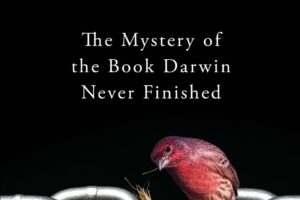

Book Review –
Darwin’s Bluff: The Mystery of the Book Darwin Never Finished
Reviewed by Margaret Helder
A project which has produced a delightful read on Darwin’s life, views and impact, began many years ago when an undergraduate student, out of curiosity, dipped into a new volume in his university library. This volume was the first in a lengthy series from Cambridge University Press. These volumes contained the correspondence, both to and from, of Charles Darwin. Thus hooked on these communications, Robert Shedinger, who was majoring in a general arts degree, began a 40 years long research project on Charles Darwin’s thoughts and actions. Astonished by what he found, Robert Shedinger now shares the results of his research. His book, Darwin’s Bluff, can’t fail to interest everyone.
Read the rest of this entry »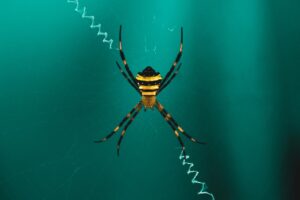
Many people are afraid of spiders, but they are excellent examples of God’s engineering design in nature, especially in the production and use of their silk. Spider silk starts as a “liquid crystal”—a highly concentrated water-based solution containing rod-shaped molecules. This means it both flows like a liquid and has its molecules oriented and ordered like a crystal. The silk solution is produced and stored in a group of silk glands until it is drawn out through the silk ducts for use. Evolutionists cannot decide whether the liquid crystal structure is an “accident of Nature” or a necessary requirement, but they think it may help to control crystallization. If the silk crystallized prematurely, it would block the ducts and kill the spider. (De Luca & Rey) Creationists would call it a design feature.
Read the rest of this entry »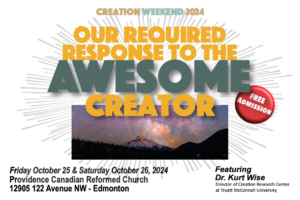
For many years, in sponsoring Creation Weekend, our local association (CSAA or Creation Science Association of Alberta) has provided inspiration and information to audiences of all ages. The benefit from these weekends is training on how to be informed and enthusiastic, able to enjoy the insights that we hear, and to share those with others.
Read the rest of this entry »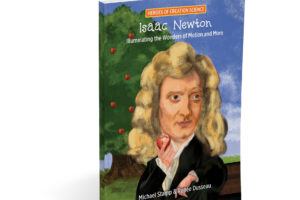

Are your kids, grandkids, or friends looking for a new book to read? Well, this book will do. It is great for all ages and is written from a creationist point of view.
Many will enjoy this book, for many reasons. One great thing about this book is that it has many photos, illustrations and little fun facts along the way. This helps the book be more interesting, for your younger readers. Plus, with the chapter breaks, and topic sections, you can easily read as small or as large sections as you want. As well as being written in an easy to understand way, it is also very engaging for your older kids. With many facts most people don’t know, all kids will enjoy the read.
Read the rest of this entry » Order Online
The common perception of the Arctic is that it is a frozen, uninhabited wasteland. Truthfully, most of it is. Evolutionists claim it has been like this for millions of years but that there is evidence that it was warmer and wetter in the past. In 1985, Paul Tudge of the Geological Survey of Canada spotted tree stumps on the Canadian Arctic island of Axel Heiberg while conducting a helicopter survey. A year later, a team of geologists, paleobotanists, and graduate students returned and found enormous tree stumps they interpreted as being still rooted in the soil they grew in (Basinger, 1987).
Read the rest of this entry »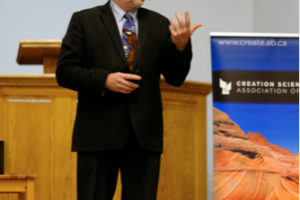
The people who came to Creation Weekend, October 25 and 26, 2024 were greatly impressed by Dr. Kurt Wise’s passion, depth of information and quality of his arguments. His topics ranged firstly from the nature of dinosaur fossils and what these tell us about their lives and fate, and secondly to God’s dealing with His Creation and how this impacts our estimates of the age of the universe, and thirdly how Christians can interact with our modern society. Specifically we have no need to introduce the reality of God to anyone because everyone actually already perceives the existence of the Creator of Heaven and Earth, whether they admit it or not.
Read the rest of this entry »
A chicken egg appears to be a simple structure consisting of a hard shell enclosing the egg white with a yellow yolk at the centre. In fact, it is an exceedingly complex structure described as a “miracle of engineering.” Other accolades for the egg include “Nature’s Perfect Package” (1) and “Life’s Perfect Invention… nature’s most perfect life support system.” (2) David Attenborough in his documentary revealed the wonder behind what he calls these “incredible miracles of nature.”
Read the rest of this entry »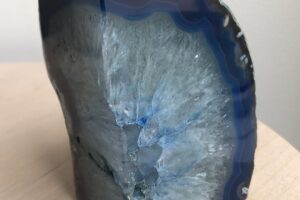
When I started university, I worked as an administrative assistant for an oil and gas laboratory company. Originally, I thought I would focus on chemistry. The university didn’t have a chemistry major in their science programs, so I enrolled in the general science degree program. Later, as a full-time student, I decided to explore other fields of science and became fascinated with astronomy, but God had other plans. It took a while for me to admit that math and physics are not my strongest subjects. Geology, on the other hand, was easy for me. Halfway through my degree, I decided I like rocks!
Read the rest of this entry »
Sugar gliders look like chipmunks, glide like flying squirrels, and their young (called joeys like kangaroos), can live for several weeks after birth in their mother’s pouch like opossums, and amazingly they belong in the same family as kangaroos. No wonder their origin has stymied evolutionists. The three types of gliders are so different that evolutionists propose that they “evolved at least three times independently in closely related glider species, including sugar gliders. But the question lingers as to how it evolved.” [i]
Read the rest of this entry »
From time to time, CSAA adds relevant new discussions to HeadStart, our amazing information resource (headstart.create.ab.ca). While many online discussions provide definitions and current views on an issue, HeadStart typically provides the history of how this science-related discipline came to be developed and what that means for us today. For example, within the past year we have added new topics related to dinosaurs and fossils, all written at the introductory level. All these items are posted under the Investigate Further banner. These topics include dinosaurs; extinct Alberta creatures (marine reptiles); record in sedimentary rock; geological column; and fossils.
Read the rest of this entry »
Challenges, Motivation and Hope
Featuring
Dr. Brian Thomas
Research Scientist at the Institute for Creation Research, Dallas, Texas
Location:
Providence Canadian Reformed Church
12905 122 Avenue NW Edmonton, AB
SCHEDULE
Friday, Oct 24 @ 7:00 p.m.
Fresh Fossils from Four Continents
(especially family friendly) Have you heard about the blood vessels from dinosaur bones? It turns out that’s just the beginning of fresh features from all kinds of fossils. In this presentation, Dr. Thomas explains how we can know that these proteins are relatively young and how these exciting new finds fit with the Bible’s history of the world.
Saturday, Oct 25 @ 10:00 a.m.
The Beginning of Life
(design features extraordinaire) Using information you won’t find in secular biology textbooks, Dr. Thomas demonstrates the complete failure of natural processes to explain how life began. He critiques evolutionary speculations about the beginning of life and illustrates engineered precision in cellular machines that credit the Creator, not nature, with creating life.
Saturday, Oct 25 @ 11:30 a.m. – 12:15 p.m.
Annual General Meeting
Saturday, Oct 25 @ 12:15 p.m. – 1:15 p.m.
Noon Break
Saturday, Oct 25 @ 1:15 p.m.
How Creatures Adapt
(why Darwin’s explanatons don’t work) New studies into the nuts and bolts of creature adaptation keep refuting Charles Darwin’s old ideas about how creatures change. From finches to fishes, stunning animal adaptations revel new hallmarks of handiwork.
Free Admission
www.create.ab.ca
In the early years of the existence of Creation Science Association of Alberta, CSAA brought in many excellent speakers from the Institute for Creation Research. All these speakers were scientists with excellent experience and credentials. These included biochemist Dr. Duane Gish, geologist Dr. Steve Austin and biologist Dr. Gary Parker. In more recent years, ICR moved from California to Texas and set about becoming established in a new region. Now once again, CSAA is delighted that one of ICR’s research scientists, Dr. Brian Thomas, has agreed to be our featured speaker for Creation Weekend on October 24 and 25, 2025. The sessions are scheduled to take place at Providence Canadian Reformed Church which hosted the event in spectacular fashion in October 2024 (12905 122 Avenue NW in Edmonton).
Read the rest of this entry »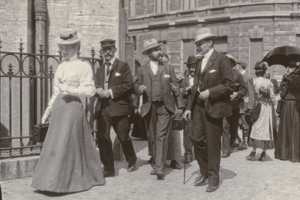
Some scientific words come from what was originally everyday language, but the concept has long been almost forgotten. Take the word ‘chaperone’ for example. Until recent times, a chaperone was a respectable mature lady who needed to be present on any social occasion to ensure that courting couples conducted themselves in a sedate and appropriate fashion. That certainly sounds old fashioned, doesn’t it? There was even a play written, called Charley’s Aunt, by Brandon Thomas (about 1890), that lampooned the efforts of two young Englishmen to entertain some young ladies to tea. In order to do this, they needed a chaperone to be present. They therefore persuaded another male friend to masquerade as a rich aunt from Brazil so that the tea party could take place. Hilarious escapades and disasters followed (including the real aunt showing up).
Read the rest of this entry »
Small boys love stories about large earth moving equipment. They love to look at the pictures, identify the types of machine and hear the stories again and again. Other children love to identify dinosaur pictures or birds. Even long after the children have grown up, they value these books as important mementos.
Read the rest of this entry »
The importance of the mineral calcium phosphate to living organisms can hardly be overstated. It is used by many organisms, including humans, to build their bones and skeletons. This is especially true for fish, crustaceans, and some brachiopods. Besides that, and even more importantly, phosphate ions are required for major building blocks of life, such as DNA and RNA. It is also required for the production of adenosine triphosphate (ATP)—the molecular fuel of living cells (Brady, Tostevin and Tosca 2022).
Evolutionists struggle to explain how life could have arisen from non-life—a concept known as “abiogenesis” or “spontaneous generation.” One of the problems is the importance of phosphate ions for biological molecules and the prohibitively low concentrations of phosphates in nature for those molecules to form spontaneously. There just isn’t enough phosphate. Phosphate minerals tend to be insoluble under most conditions, so only trace amounts exist as dissolved minerals in seawater. In fact, on average, seawater contains only about 0.071 parts per million of phosphorous (Simandl, Paradis and Fajber 2012).
Read the rest of this entry »FEATURED BOOKS AND DVDS

Paperback / $6.00 / 55 Pages
The importance of the mineral calcium phosphate to living organisms can hardly be overstated. It is used by many organisms, including humans, to build their bones and skeletons. This is especially true for fish, crustaceans, and some brachiopods. Besides that, and even more importantly, phosphate ions are required for major building blocks of life, such as DNA and RNA. It is also required for the production of adenosine triphosphate (ATP)—the molecular fuel of living cells (Brady, Tostevin and Tosca 2022).
Evolutionists struggle to explain how life could have arisen from non-life—a concept known as “abiogenesis” or “spontaneous generation.” One of the problems is the importance of phosphate ions for biological molecules and the prohibitively low concentrations of phosphates in nature for those molecules to form spontaneously. There just isn’t enough phosphate. Phosphate minerals tend to be insoluble under most conditions, so only trace amounts exist as dissolved minerals in seawater. In fact, on average, seawater contains only about 0.071 parts per million of phosphorous (Simandl, Paradis and Fajber 2012).
Read the rest of this entry » Order Online
Paperback / $10.00 / 111 Pages / full colour
The importance of the mineral calcium phosphate to living organisms can hardly be overstated. It is used by many organisms, including humans, to build their bones and skeletons. This is especially true for fish, crustaceans, and some brachiopods. Besides that, and even more importantly, phosphate ions are required for major building blocks of life, such as DNA and RNA. It is also required for the production of adenosine triphosphate (ATP)—the molecular fuel of living cells (Brady, Tostevin and Tosca 2022).
Evolutionists struggle to explain how life could have arisen from non-life—a concept known as “abiogenesis” or “spontaneous generation.” One of the problems is the importance of phosphate ions for biological molecules and the prohibitively low concentrations of phosphates in nature for those molecules to form spontaneously. There just isn’t enough phosphate. Phosphate minerals tend to be insoluble under most conditions, so only trace amounts exist as dissolved minerals in seawater. In fact, on average, seawater contains only about 0.071 parts per million of phosphorous (Simandl, Paradis and Fajber 2012).
Read the rest of this entry » Order Online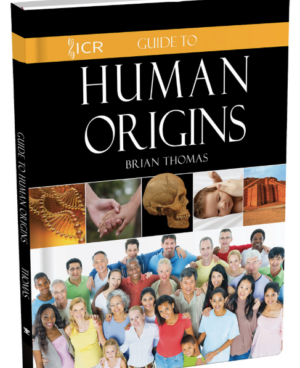
Hardcover / $18.00 / 117 Pages / Full colour
The importance of the mineral calcium phosphate to living organisms can hardly be overstated. It is used by many organisms, including humans, to build their bones and skeletons. This is especially true for fish, crustaceans, and some brachiopods. Besides that, and even more importantly, phosphate ions are required for major building blocks of life, such as DNA and RNA. It is also required for the production of adenosine triphosphate (ATP)—the molecular fuel of living cells (Brady, Tostevin and Tosca 2022).
Evolutionists struggle to explain how life could have arisen from non-life—a concept known as “abiogenesis” or “spontaneous generation.” One of the problems is the importance of phosphate ions for biological molecules and the prohibitively low concentrations of phosphates in nature for those molecules to form spontaneously. There just isn’t enough phosphate. Phosphate minerals tend to be insoluble under most conditions, so only trace amounts exist as dissolved minerals in seawater. In fact, on average, seawater contains only about 0.071 parts per million of phosphorous (Simandl, Paradis and Fajber 2012).
Read the rest of this entry » Order Online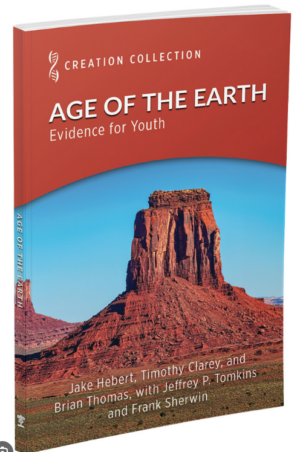
Paperback / $10.00 / 192 Pages / Full colour
The importance of the mineral calcium phosphate to living organisms can hardly be overstated. It is used by many organisms, including humans, to build their bones and skeletons. This is especially true for fish, crustaceans, and some brachiopods. Besides that, and even more importantly, phosphate ions are required for major building blocks of life, such as DNA and RNA. It is also required for the production of adenosine triphosphate (ATP)—the molecular fuel of living cells (Brady, Tostevin and Tosca 2022).
Evolutionists struggle to explain how life could have arisen from non-life—a concept known as “abiogenesis” or “spontaneous generation.” One of the problems is the importance of phosphate ions for biological molecules and the prohibitively low concentrations of phosphates in nature for those molecules to form spontaneously. There just isn’t enough phosphate. Phosphate minerals tend to be insoluble under most conditions, so only trace amounts exist as dissolved minerals in seawater. In fact, on average, seawater contains only about 0.071 parts per million of phosphorous (Simandl, Paradis and Fajber 2012).
Read the rest of this entry » Order Online