

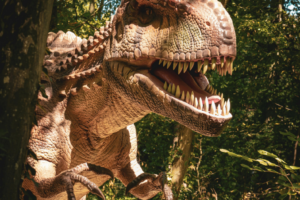

Most youngsters are enthusiastic about dinosaurs such as Stegosaurus, Triceratops and the gigantic four-footed sauropods like Camarasaurus. However, of course, it is T. rex that everybody loves! But grown up scientists (palaeontologists) love T. rex too. Many have published studies on this dinosaur. These works include ideas about species diversity, ecological networks, biogeography and other issues such as what caused the extinction of dinosaurs.
Since T. rex specimens were so massive [over 8000 kg and 12 m long (40 ft) and 4 m (12 ft) tall ] their fossils, especially articulated skeletons, are rare and valuable. Naturally everyone wants to find an almost complete skeleton. Black Beauty (only 28 % complete) found in 1981 near Crowsnest Pass in Alberta, is displayed as a whole skeleton at the Royal Tyrrell Museum in Drumheller. This was the first T. rex skeleton that was assigned a name. Soon there were more famous finds. “Stan” (65% complete) was found in 1987 in South Dakota. It sold in 2020 for 31.8 million dollars and is now (as of 2025) on display in a museum in Abu Dhabi.
“Sue” is probably the most controversial T. rex specimen. Discovered in 1990 on private land in the Cheyenne River Reservation, there was conflict almost immediately over who owned this 90% complete skeleton. After a lengthy court battle, the specimen was sold for over 8 million dollars, ending up in the Field Museum in Chicago. Canadians have no such conflicts over rights since provincial governments long since have declared that they own all such artifacts. “Scotty” is the name for a T. rex discovered in Saskatchewan in 1991. It may be larger and more complete even than Sue. It is displayed in a museum near Saskatoon.
Despite the fact that T. rex is so well studied, there are nevertheless still points of controversy. A scientific article, for example has just been printed in Nature (December 11, 2025 vol. 648 pp. 357-367) which declares that the identity of certain tyrannosaur specimens is a “hot button issue” often involving intensive arguments. Indeed, says the article, if the identification of certain specimens with T. rex is in fact wrong, then “so too is much of what we know about one of the most thoroughly studied extinct vertebrates, a keystone taxon for palaeoecological investigations”. Not only that, these authors say, but these results should prompt a reevaluation of dozens of existing hypotheses based on currently indefensible ontogenetic [developmental] trajectories.” [ 357] In short, declare authors Zanno and Napoli, their “results undermine a nearly uniform consensus among theropod [carnivorous dinosaur] specialists and rectify [correct] a significant taxonomic error underpinning decades of research.” [365] All italics mine.
What Zanno and Napoli are saying is that the experts in this popular and prestigious field of study, are wrong and they have been wrong for decades. Wow! How did this happen and why are the implications so significant? The issue involves the identity of certain skeletons that have been considered as juvenile (immature) T. rex individuals. This article however declares that the smaller specimens are not T. rex at all, but rather two species of quite different creatures.
Apparently, a skull labelled CMNH7541, similar to those of T. rex but much smaller, was found in Montana in 1946. Since that time, other specimens of the smaller type have been found. Differences between these skulls and those of T. rex have been observed. In 1988 such smaller skulls were declared to be a different species (Nanotyrannus), but by 1999 most specialists changed their minds and Nanotyrannus became Tyrannosaurus again. A significantly more complete specimen dubbed “Jane” (BMRP) was found in 2001 but few paid much attention to it. Then in 2006, NCSM 40000 was discovered in Montana. It attracted lots of attention as it was one of two Duelling Dinosaurs (the other was a Triceratops). The tyrannosaurid was a complete articulated skeleton, the first complete small tyrannosaur specimen with forelimb and tail “both of which differ considerably from those of T. rex.”
Lawrence Witmer, a commentator on the article in Nature, wonders why the dinosaur experts decided so quickly that the smaller specimens were merely young T. rex. Witmer points out that there were a number of differences between the smaller skulls and the T. rex skulls. This should have encouraged reflection before jumping so quickly on the bandwagon of juvenile identification. Now since 2006 one could also discern major differences between the whole skeletons of T. rex and the smaller version.
Zanno and Napoli compared the small forms (Nanotyrannus) with the massive well known T. rex forms. They found there were far more teeth in Nanotyrannus, and that the back bone of the small form exhibited too few vertebrae (backbone components) and that the forelimbs and hands of Nanotyrannus were proportionately and absolutely longer than in T. rex. Of these comparisons of the small (Nanotyrannus) versus the larger T. rex, they declared that the smaller form could not develop into the larger form. For a start 1) “no evidence exists of a postnatal [since birth] tooth count reduction “ (p. 363); and 2) “a postnatal 15% increase in vertebral [backbone] count in a large-bodied terrestrial archosaurian during ontogeny [growth and development] is unknown.” (p. 363); and 3) “we are unaware of any extant taxon in which limbs shrink in absolute dimensions” [during growth and development]. (p. 364)
Thus Zanno and Napoli, authors of this study, declare that the popular position which identifies all tyrannosaur finds as T. rex, is wrong. And these people further state: “Our results prompt a re-evaluation of dozens of existing hypotheses based on currently indefensible ontogenetic [growth and development] trajectories.” (p. 357)
One might wonder why it took so long for the community of T. rex specialists to reconsider the designation of the smaller skulls made in 1999. A new, much more complete small specimen “Jane” BMRP2002.4.1 was discovered in 2001. Then in 2006, the famous Duelling Dinosaurs were found. This featured an almost complete smaller tyrannosaur skeleton and a Triceratops victim. [This was similar to a specimen found in Mongolia in 1971 which featured a carnivorous Velociraptor attacking a horned dinosaur Protoceratops.]
The tyrannosaur specimen from the Duelling Dinosaurs was called NCSM 40000. Thus there were two skeletons to compare with T. rex, Jane (found in 2001) and NCSM 40000 found in 2006. Why did Zanno and Napoli’s 2025 study reassigning the “juvenile” T. rex to Nanotyrannus, not come a lot sooner?
Alternatively, what does it matter if a new genus, and actually a new family of theropod (predator), is described. It all boils down to ethics and integrity and vested interests! Lawrence Witmer, comments in Nature on the whole issue of the conflict. Of course, the experts want to protect their legacy of pronouncements about T. rex and it is a fact that “these analyses will all need revision.” [p. 283). Nevertheless Dr. Witmer astonishingly shares with us: “some advocates for the validity of Nanotyrannus do not have advanced degrees or are not employed by universities or museums, raising the spectre of the role of influence, elitism and the protective ivory tower of academia.” And further he says: “The ethics policies of some professional societies and journals oppose publication of studies about specimens in private collection.” (p. 383) This may be reasonable, he says in some cases concerning validity of the data, but such a stance may also be a handy strategy to avoid having to confront data one does not like. Thus, possibly we should develop an “ethical concern about wilfully ignoring relevant scientific data.” (p. 283) [A little investigation will show that in the case of these dinosaur studies, all too often the people and institutions ignored turn out to be critical of evolution.]
This shocking example of how the T. rex specialists managed to delay confronting unwanted information for a quarter of a century, should wake up many members of the public. Just because most “experts” agree on an issue, does not mean that it is true. Our best approach to scientific information is to be cautious and critical.
“Tyrannosaurus rex ranks among the most comprehensively studied extinct vertebrates and is a model system for dinosaur paleobiology.” (p. 357) But much of what scientists have been telling us about it may be all wrong! Let us not forget this famous case.
Lyndsay E. Zanno and James G. Napoli. 2025. Nanotyrannus and Tyrannosaurus coexisted at the close of the Cretaceous. Nature 648: 357-367. [Cover story for December 11 issue]
Lawrence M. Witmer. 2025. Debated fossils aren’t of T. rex but a smaller rival. Nature 648: 282-283.
“Jane” BMRP2002.4.1. Burpee Museum of Natural History; CMNH7541 Cleveland Museum of Natural History; NCSM 40000 North Carolina Museum of Natural Sciences
Margaret Helder
April 2026
Subscribe to Dialogue
FEATURED BOOKS AND DVDS


Paperback / $6.00 / 55 Pages
Most youngsters are enthusiastic about dinosaurs such as Stegosaurus, Triceratops and the gigantic four-footed sauropods like Camarasaurus. However, of course, it is T. rex that everybody loves! But grown up scientists (palaeontologists) love T. rex too. Many have published studies on this dinosaur. These works include ideas about species diversity, ecological networks, biogeography and other issues such as what caused the extinction of dinosaurs.
Since T. rex specimens were so massive [over 8000 kg and 12 m long (40 ft) and 4 m (12 ft) tall ] their fossils, especially articulated skeletons, are rare and valuable. Naturally everyone wants to find an almost complete skeleton. Black Beauty (only 28 % complete) found in 1981 near Crowsnest Pass in Alberta, is displayed as a whole skeleton at the Royal Tyrrell Museum in Drumheller. This was the first T. rex skeleton that was assigned a name. Soon there were more famous finds. “Stan” (65% complete) was found in 1987 in South Dakota. It sold in 2020 for 31.8 million dollars and is now (as of 2025) on display in a museum in Abu Dhabi.
“Sue” is probably the most controversial T. rex specimen. Discovered in 1990 on private land in the Cheyenne River Reservation, there was conflict almost immediately over who owned this 90% complete skeleton. After a lengthy court battle, the specimen was sold for over 8 million dollars, ending up in the Field Museum in Chicago. Canadians have no such conflicts over rights since provincial governments long since have declared that they own all such artifacts. “Scotty” is the name for a T. rex discovered in Saskatchewan in 1991. It may be larger and more complete even than Sue. It is displayed in a museum near Saskatoon.
Despite the fact that T. rex is so well studied, there are nevertheless still points of controversy. A scientific article, for example has just been printed in Nature (December 11, 2025 vol. 648 pp. 357-367) which declares that the identity of certain tyrannosaur specimens is a “hot button issue” often involving intensive arguments. Indeed, says the article, if the identification of certain specimens with T. rex is in fact wrong, then “so too is much of what we know about one of the most thoroughly studied extinct vertebrates, a keystone taxon for palaeoecological investigations”. Not only that, these authors say, but these results should prompt a reevaluation of dozens of existing hypotheses based on currently indefensible ontogenetic [developmental] trajectories.” [ 357] In short, declare authors Zanno and Napoli, their “results undermine a nearly uniform consensus among theropod [carnivorous dinosaur] specialists and rectify [correct] a significant taxonomic error underpinning decades of research.” [365] All italics mine.
What Zanno and Napoli are saying is that the experts in this popular and prestigious field of study, are wrong and they have been wrong for decades. Wow! How did this happen and why are the implications so significant? The issue involves the identity of certain skeletons that have been considered as juvenile (immature) T. rex individuals. This article however declares that the smaller specimens are not T. rex at all, but rather two species of quite different creatures.
Apparently, a skull labelled CMNH7541, similar to those of T. rex but much smaller, was found in Montana in 1946. Since that time, other specimens of the smaller type have been found. Differences between these skulls and those of T. rex have been observed. In 1988 such smaller skulls were declared to be a different species (Nanotyrannus), but by 1999 most specialists changed their minds and Nanotyrannus became Tyrannosaurus again. A significantly more complete specimen dubbed “Jane” (BMRP) was found in 2001 but few paid much attention to it. Then in 2006, NCSM 40000 was discovered in Montana. It attracted lots of attention as it was one of two Duelling Dinosaurs (the other was a Triceratops). The tyrannosaurid was a complete articulated skeleton, the first complete small tyrannosaur specimen with forelimb and tail “both of which differ considerably from those of T. rex.”
Lawrence Witmer, a commentator on the article in Nature, wonders why the dinosaur experts decided so quickly that the smaller specimens were merely young T. rex. Witmer points out that there were a number of differences between the smaller skulls and the T. rex skulls. This should have encouraged reflection before jumping so quickly on the bandwagon of juvenile identification. Now since 2006 one could also discern major differences between the whole skeletons of T. rex and the smaller version.
Zanno and Napoli compared the small forms (Nanotyrannus) with the massive well known T. rex forms. They found there were far more teeth in Nanotyrannus, and that the back bone of the small form exhibited too few vertebrae (backbone components) and that the forelimbs and hands of Nanotyrannus were proportionately and absolutely longer than in T. rex. Of these comparisons of the small (Nanotyrannus) versus the larger T. rex, they declared that the smaller form could not develop into the larger form. For a start 1) “no evidence exists of a postnatal [since birth] tooth count reduction “ (p. 363); and 2) “a postnatal 15% increase in vertebral [backbone] count in a large-bodied terrestrial archosaurian during ontogeny [growth and development] is unknown.” (p. 363); and 3) “we are unaware of any extant taxon in which limbs shrink in absolute dimensions” [during growth and development]. (p. 364)
Thus Zanno and Napoli, authors of this study, declare that the popular position which identifies all tyrannosaur finds as T. rex, is wrong. And these people further state: “Our results prompt a re-evaluation of dozens of existing hypotheses based on currently indefensible ontogenetic [growth and development] trajectories.” (p. 357)
One might wonder why it took so long for the community of T. rex specialists to reconsider the designation of the smaller skulls made in 1999. A new, much more complete small specimen “Jane” BMRP2002.4.1 was discovered in 2001. Then in 2006, the famous Duelling Dinosaurs were found. This featured an almost complete smaller tyrannosaur skeleton and a Triceratops victim. [This was similar to a specimen found in Mongolia in 1971 which featured a carnivorous Velociraptor attacking a horned dinosaur Protoceratops.]
The tyrannosaur specimen from the Duelling Dinosaurs was called NCSM 40000. Thus there were two skeletons to compare with T. rex, Jane (found in 2001) and NCSM 40000 found in 2006. Why did Zanno and Napoli’s 2025 study reassigning the “juvenile” T. rex to Nanotyrannus, not come a lot sooner?
Alternatively, what does it matter if a new genus, and actually a new family of theropod (predator), is described. It all boils down to ethics and integrity and vested interests! Lawrence Witmer, comments in Nature on the whole issue of the conflict. Of course, the experts want to protect their legacy of pronouncements about T. rex and it is a fact that “these analyses will all need revision.” [p. 283). Nevertheless Dr. Witmer astonishingly shares with us: “some advocates for the validity of Nanotyrannus do not have advanced degrees or are not employed by universities or museums, raising the spectre of the role of influence, elitism and the protective ivory tower of academia.” And further he says: “The ethics policies of some professional societies and journals oppose publication of studies about specimens in private collection.” (p. 383) This may be reasonable, he says in some cases concerning validity of the data, but such a stance may also be a handy strategy to avoid having to confront data one does not like. Thus, possibly we should develop an “ethical concern about wilfully ignoring relevant scientific data.” (p. 283) [A little investigation will show that in the case of these dinosaur studies, all too often the people and institutions ignored turn out to be critical of evolution.]
This shocking example of how the T. rex specialists managed to delay confronting unwanted information for a quarter of a century, should wake up many members of the public. Just because most “experts” agree on an issue, does not mean that it is true. Our best approach to scientific information is to be cautious and critical.
“Tyrannosaurus rex ranks among the most comprehensively studied extinct vertebrates and is a model system for dinosaur paleobiology.” (p. 357) But much of what scientists have been telling us about it may be all wrong! Let us not forget this famous case.
Lyndsay E. Zanno and James G. Napoli. 2025. Nanotyrannus and Tyrannosaurus coexisted at the close of the Cretaceous. Nature 648: 357-367. [Cover story for December 11 issue]
Lawrence M. Witmer. 2025. Debated fossils aren’t of T. rex but a smaller rival. Nature 648: 282-283.
“Jane” BMRP2002.4.1. Burpee Museum of Natural History; CMNH7541 Cleveland Museum of Natural History; NCSM 40000 North Carolina Museum of Natural Sciences
Order Online

Paperback / $10.00 / 111 Pages / full colour
Most youngsters are enthusiastic about dinosaurs such as Stegosaurus, Triceratops and the gigantic four-footed sauropods like Camarasaurus. However, of course, it is T. rex that everybody loves! But grown up scientists (palaeontologists) love T. rex too. Many have published studies on this dinosaur. These works include ideas about species diversity, ecological networks, biogeography and other issues such as what caused the extinction of dinosaurs.
Since T. rex specimens were so massive [over 8000 kg and 12 m long (40 ft) and 4 m (12 ft) tall ] their fossils, especially articulated skeletons, are rare and valuable. Naturally everyone wants to find an almost complete skeleton. Black Beauty (only 28 % complete) found in 1981 near Crowsnest Pass in Alberta, is displayed as a whole skeleton at the Royal Tyrrell Museum in Drumheller. This was the first T. rex skeleton that was assigned a name. Soon there were more famous finds. “Stan” (65% complete) was found in 1987 in South Dakota. It sold in 2020 for 31.8 million dollars and is now (as of 2025) on display in a museum in Abu Dhabi.
“Sue” is probably the most controversial T. rex specimen. Discovered in 1990 on private land in the Cheyenne River Reservation, there was conflict almost immediately over who owned this 90% complete skeleton. After a lengthy court battle, the specimen was sold for over 8 million dollars, ending up in the Field Museum in Chicago. Canadians have no such conflicts over rights since provincial governments long since have declared that they own all such artifacts. “Scotty” is the name for a T. rex discovered in Saskatchewan in 1991. It may be larger and more complete even than Sue. It is displayed in a museum near Saskatoon.
Despite the fact that T. rex is so well studied, there are nevertheless still points of controversy. A scientific article, for example has just been printed in Nature (December 11, 2025 vol. 648 pp. 357-367) which declares that the identity of certain tyrannosaur specimens is a “hot button issue” often involving intensive arguments. Indeed, says the article, if the identification of certain specimens with T. rex is in fact wrong, then “so too is much of what we know about one of the most thoroughly studied extinct vertebrates, a keystone taxon for palaeoecological investigations”. Not only that, these authors say, but these results should prompt a reevaluation of dozens of existing hypotheses based on currently indefensible ontogenetic [developmental] trajectories.” [ 357] In short, declare authors Zanno and Napoli, their “results undermine a nearly uniform consensus among theropod [carnivorous dinosaur] specialists and rectify [correct] a significant taxonomic error underpinning decades of research.” [365] All italics mine.
What Zanno and Napoli are saying is that the experts in this popular and prestigious field of study, are wrong and they have been wrong for decades. Wow! How did this happen and why are the implications so significant? The issue involves the identity of certain skeletons that have been considered as juvenile (immature) T. rex individuals. This article however declares that the smaller specimens are not T. rex at all, but rather two species of quite different creatures.
Apparently, a skull labelled CMNH7541, similar to those of T. rex but much smaller, was found in Montana in 1946. Since that time, other specimens of the smaller type have been found. Differences between these skulls and those of T. rex have been observed. In 1988 such smaller skulls were declared to be a different species (Nanotyrannus), but by 1999 most specialists changed their minds and Nanotyrannus became Tyrannosaurus again. A significantly more complete specimen dubbed “Jane” (BMRP) was found in 2001 but few paid much attention to it. Then in 2006, NCSM 40000 was discovered in Montana. It attracted lots of attention as it was one of two Duelling Dinosaurs (the other was a Triceratops). The tyrannosaurid was a complete articulated skeleton, the first complete small tyrannosaur specimen with forelimb and tail “both of which differ considerably from those of T. rex.”
Lawrence Witmer, a commentator on the article in Nature, wonders why the dinosaur experts decided so quickly that the smaller specimens were merely young T. rex. Witmer points out that there were a number of differences between the smaller skulls and the T. rex skulls. This should have encouraged reflection before jumping so quickly on the bandwagon of juvenile identification. Now since 2006 one could also discern major differences between the whole skeletons of T. rex and the smaller version.
Zanno and Napoli compared the small forms (Nanotyrannus) with the massive well known T. rex forms. They found there were far more teeth in Nanotyrannus, and that the back bone of the small form exhibited too few vertebrae (backbone components) and that the forelimbs and hands of Nanotyrannus were proportionately and absolutely longer than in T. rex. Of these comparisons of the small (Nanotyrannus) versus the larger T. rex, they declared that the smaller form could not develop into the larger form. For a start 1) “no evidence exists of a postnatal [since birth] tooth count reduction “ (p. 363); and 2) “a postnatal 15% increase in vertebral [backbone] count in a large-bodied terrestrial archosaurian during ontogeny [growth and development] is unknown.” (p. 363); and 3) “we are unaware of any extant taxon in which limbs shrink in absolute dimensions” [during growth and development]. (p. 364)
Thus Zanno and Napoli, authors of this study, declare that the popular position which identifies all tyrannosaur finds as T. rex, is wrong. And these people further state: “Our results prompt a re-evaluation of dozens of existing hypotheses based on currently indefensible ontogenetic [growth and development] trajectories.” (p. 357)
One might wonder why it took so long for the community of T. rex specialists to reconsider the designation of the smaller skulls made in 1999. A new, much more complete small specimen “Jane” BMRP2002.4.1 was discovered in 2001. Then in 2006, the famous Duelling Dinosaurs were found. This featured an almost complete smaller tyrannosaur skeleton and a Triceratops victim. [This was similar to a specimen found in Mongolia in 1971 which featured a carnivorous Velociraptor attacking a horned dinosaur Protoceratops.]
The tyrannosaur specimen from the Duelling Dinosaurs was called NCSM 40000. Thus there were two skeletons to compare with T. rex, Jane (found in 2001) and NCSM 40000 found in 2006. Why did Zanno and Napoli’s 2025 study reassigning the “juvenile” T. rex to Nanotyrannus, not come a lot sooner?
Alternatively, what does it matter if a new genus, and actually a new family of theropod (predator), is described. It all boils down to ethics and integrity and vested interests! Lawrence Witmer, comments in Nature on the whole issue of the conflict. Of course, the experts want to protect their legacy of pronouncements about T. rex and it is a fact that “these analyses will all need revision.” [p. 283). Nevertheless Dr. Witmer astonishingly shares with us: “some advocates for the validity of Nanotyrannus do not have advanced degrees or are not employed by universities or museums, raising the spectre of the role of influence, elitism and the protective ivory tower of academia.” And further he says: “The ethics policies of some professional societies and journals oppose publication of studies about specimens in private collection.” (p. 383) This may be reasonable, he says in some cases concerning validity of the data, but such a stance may also be a handy strategy to avoid having to confront data one does not like. Thus, possibly we should develop an “ethical concern about wilfully ignoring relevant scientific data.” (p. 283) [A little investigation will show that in the case of these dinosaur studies, all too often the people and institutions ignored turn out to be critical of evolution.]
This shocking example of how the T. rex specialists managed to delay confronting unwanted information for a quarter of a century, should wake up many members of the public. Just because most “experts” agree on an issue, does not mean that it is true. Our best approach to scientific information is to be cautious and critical.
“Tyrannosaurus rex ranks among the most comprehensively studied extinct vertebrates and is a model system for dinosaur paleobiology.” (p. 357) But much of what scientists have been telling us about it may be all wrong! Let us not forget this famous case.
Lyndsay E. Zanno and James G. Napoli. 2025. Nanotyrannus and Tyrannosaurus coexisted at the close of the Cretaceous. Nature 648: 357-367. [Cover story for December 11 issue]
Lawrence M. Witmer. 2025. Debated fossils aren’t of T. rex but a smaller rival. Nature 648: 282-283.
“Jane” BMRP2002.4.1. Burpee Museum of Natural History; CMNH7541 Cleveland Museum of Natural History; NCSM 40000 North Carolina Museum of Natural Sciences
Order Online
Hardcover / $18.00 / 117 Pages / Full colour
Most youngsters are enthusiastic about dinosaurs such as Stegosaurus, Triceratops and the gigantic four-footed sauropods like Camarasaurus. However, of course, it is T. rex that everybody loves! But grown up scientists (palaeontologists) love T. rex too. Many have published studies on this dinosaur. These works include ideas about species diversity, ecological networks, biogeography and other issues such as what caused the extinction of dinosaurs.
Since T. rex specimens were so massive [over 8000 kg and 12 m long (40 ft) and 4 m (12 ft) tall ] their fossils, especially articulated skeletons, are rare and valuable. Naturally everyone wants to find an almost complete skeleton. Black Beauty (only 28 % complete) found in 1981 near Crowsnest Pass in Alberta, is displayed as a whole skeleton at the Royal Tyrrell Museum in Drumheller. This was the first T. rex skeleton that was assigned a name. Soon there were more famous finds. “Stan” (65% complete) was found in 1987 in South Dakota. It sold in 2020 for 31.8 million dollars and is now (as of 2025) on display in a museum in Abu Dhabi.
“Sue” is probably the most controversial T. rex specimen. Discovered in 1990 on private land in the Cheyenne River Reservation, there was conflict almost immediately over who owned this 90% complete skeleton. After a lengthy court battle, the specimen was sold for over 8 million dollars, ending up in the Field Museum in Chicago. Canadians have no such conflicts over rights since provincial governments long since have declared that they own all such artifacts. “Scotty” is the name for a T. rex discovered in Saskatchewan in 1991. It may be larger and more complete even than Sue. It is displayed in a museum near Saskatoon.
Despite the fact that T. rex is so well studied, there are nevertheless still points of controversy. A scientific article, for example has just been printed in Nature (December 11, 2025 vol. 648 pp. 357-367) which declares that the identity of certain tyrannosaur specimens is a “hot button issue” often involving intensive arguments. Indeed, says the article, if the identification of certain specimens with T. rex is in fact wrong, then “so too is much of what we know about one of the most thoroughly studied extinct vertebrates, a keystone taxon for palaeoecological investigations”. Not only that, these authors say, but these results should prompt a reevaluation of dozens of existing hypotheses based on currently indefensible ontogenetic [developmental] trajectories.” [ 357] In short, declare authors Zanno and Napoli, their “results undermine a nearly uniform consensus among theropod [carnivorous dinosaur] specialists and rectify [correct] a significant taxonomic error underpinning decades of research.” [365] All italics mine.
What Zanno and Napoli are saying is that the experts in this popular and prestigious field of study, are wrong and they have been wrong for decades. Wow! How did this happen and why are the implications so significant? The issue involves the identity of certain skeletons that have been considered as juvenile (immature) T. rex individuals. This article however declares that the smaller specimens are not T. rex at all, but rather two species of quite different creatures.
Apparently, a skull labelled CMNH7541, similar to those of T. rex but much smaller, was found in Montana in 1946. Since that time, other specimens of the smaller type have been found. Differences between these skulls and those of T. rex have been observed. In 1988 such smaller skulls were declared to be a different species (Nanotyrannus), but by 1999 most specialists changed their minds and Nanotyrannus became Tyrannosaurus again. A significantly more complete specimen dubbed “Jane” (BMRP) was found in 2001 but few paid much attention to it. Then in 2006, NCSM 40000 was discovered in Montana. It attracted lots of attention as it was one of two Duelling Dinosaurs (the other was a Triceratops). The tyrannosaurid was a complete articulated skeleton, the first complete small tyrannosaur specimen with forelimb and tail “both of which differ considerably from those of T. rex.”
Lawrence Witmer, a commentator on the article in Nature, wonders why the dinosaur experts decided so quickly that the smaller specimens were merely young T. rex. Witmer points out that there were a number of differences between the smaller skulls and the T. rex skulls. This should have encouraged reflection before jumping so quickly on the bandwagon of juvenile identification. Now since 2006 one could also discern major differences between the whole skeletons of T. rex and the smaller version.
Zanno and Napoli compared the small forms (Nanotyrannus) with the massive well known T. rex forms. They found there were far more teeth in Nanotyrannus, and that the back bone of the small form exhibited too few vertebrae (backbone components) and that the forelimbs and hands of Nanotyrannus were proportionately and absolutely longer than in T. rex. Of these comparisons of the small (Nanotyrannus) versus the larger T. rex, they declared that the smaller form could not develop into the larger form. For a start 1) “no evidence exists of a postnatal [since birth] tooth count reduction “ (p. 363); and 2) “a postnatal 15% increase in vertebral [backbone] count in a large-bodied terrestrial archosaurian during ontogeny [growth and development] is unknown.” (p. 363); and 3) “we are unaware of any extant taxon in which limbs shrink in absolute dimensions” [during growth and development]. (p. 364)
Thus Zanno and Napoli, authors of this study, declare that the popular position which identifies all tyrannosaur finds as T. rex, is wrong. And these people further state: “Our results prompt a re-evaluation of dozens of existing hypotheses based on currently indefensible ontogenetic [growth and development] trajectories.” (p. 357)
One might wonder why it took so long for the community of T. rex specialists to reconsider the designation of the smaller skulls made in 1999. A new, much more complete small specimen “Jane” BMRP2002.4.1 was discovered in 2001. Then in 2006, the famous Duelling Dinosaurs were found. This featured an almost complete smaller tyrannosaur skeleton and a Triceratops victim. [This was similar to a specimen found in Mongolia in 1971 which featured a carnivorous Velociraptor attacking a horned dinosaur Protoceratops.]
The tyrannosaur specimen from the Duelling Dinosaurs was called NCSM 40000. Thus there were two skeletons to compare with T. rex, Jane (found in 2001) and NCSM 40000 found in 2006. Why did Zanno and Napoli’s 2025 study reassigning the “juvenile” T. rex to Nanotyrannus, not come a lot sooner?
Alternatively, what does it matter if a new genus, and actually a new family of theropod (predator), is described. It all boils down to ethics and integrity and vested interests! Lawrence Witmer, comments in Nature on the whole issue of the conflict. Of course, the experts want to protect their legacy of pronouncements about T. rex and it is a fact that “these analyses will all need revision.” [p. 283). Nevertheless Dr. Witmer astonishingly shares with us: “some advocates for the validity of Nanotyrannus do not have advanced degrees or are not employed by universities or museums, raising the spectre of the role of influence, elitism and the protective ivory tower of academia.” And further he says: “The ethics policies of some professional societies and journals oppose publication of studies about specimens in private collection.” (p. 383) This may be reasonable, he says in some cases concerning validity of the data, but such a stance may also be a handy strategy to avoid having to confront data one does not like. Thus, possibly we should develop an “ethical concern about wilfully ignoring relevant scientific data.” (p. 283) [A little investigation will show that in the case of these dinosaur studies, all too often the people and institutions ignored turn out to be critical of evolution.]
This shocking example of how the T. rex specialists managed to delay confronting unwanted information for a quarter of a century, should wake up many members of the public. Just because most “experts” agree on an issue, does not mean that it is true. Our best approach to scientific information is to be cautious and critical.
“Tyrannosaurus rex ranks among the most comprehensively studied extinct vertebrates and is a model system for dinosaur paleobiology.” (p. 357) But much of what scientists have been telling us about it may be all wrong! Let us not forget this famous case.
Lyndsay E. Zanno and James G. Napoli. 2025. Nanotyrannus and Tyrannosaurus coexisted at the close of the Cretaceous. Nature 648: 357-367. [Cover story for December 11 issue]
Lawrence M. Witmer. 2025. Debated fossils aren’t of T. rex but a smaller rival. Nature 648: 282-283.
“Jane” BMRP2002.4.1. Burpee Museum of Natural History; CMNH7541 Cleveland Museum of Natural History; NCSM 40000 North Carolina Museum of Natural Sciences
Order Online
Paperback / $10.00 / 192 Pages / Full colour
Most youngsters are enthusiastic about dinosaurs such as Stegosaurus, Triceratops and the gigantic four-footed sauropods like Camarasaurus. However, of course, it is T. rex that everybody loves! But grown up scientists (palaeontologists) love T. rex too. Many have published studies on this dinosaur. These works include ideas about species diversity, ecological networks, biogeography and other issues such as what caused the extinction of dinosaurs.
Since T. rex specimens were so massive [over 8000 kg and 12 m long (40 ft) and 4 m (12 ft) tall ] their fossils, especially articulated skeletons, are rare and valuable. Naturally everyone wants to find an almost complete skeleton. Black Beauty (only 28 % complete) found in 1981 near Crowsnest Pass in Alberta, is displayed as a whole skeleton at the Royal Tyrrell Museum in Drumheller. This was the first T. rex skeleton that was assigned a name. Soon there were more famous finds. “Stan” (65% complete) was found in 1987 in South Dakota. It sold in 2020 for 31.8 million dollars and is now (as of 2025) on display in a museum in Abu Dhabi.
“Sue” is probably the most controversial T. rex specimen. Discovered in 1990 on private land in the Cheyenne River Reservation, there was conflict almost immediately over who owned this 90% complete skeleton. After a lengthy court battle, the specimen was sold for over 8 million dollars, ending up in the Field Museum in Chicago. Canadians have no such conflicts over rights since provincial governments long since have declared that they own all such artifacts. “Scotty” is the name for a T. rex discovered in Saskatchewan in 1991. It may be larger and more complete even than Sue. It is displayed in a museum near Saskatoon.
Despite the fact that T. rex is so well studied, there are nevertheless still points of controversy. A scientific article, for example has just been printed in Nature (December 11, 2025 vol. 648 pp. 357-367) which declares that the identity of certain tyrannosaur specimens is a “hot button issue” often involving intensive arguments. Indeed, says the article, if the identification of certain specimens with T. rex is in fact wrong, then “so too is much of what we know about one of the most thoroughly studied extinct vertebrates, a keystone taxon for palaeoecological investigations”. Not only that, these authors say, but these results should prompt a reevaluation of dozens of existing hypotheses based on currently indefensible ontogenetic [developmental] trajectories.” [ 357] In short, declare authors Zanno and Napoli, their “results undermine a nearly uniform consensus among theropod [carnivorous dinosaur] specialists and rectify [correct] a significant taxonomic error underpinning decades of research.” [365] All italics mine.
What Zanno and Napoli are saying is that the experts in this popular and prestigious field of study, are wrong and they have been wrong for decades. Wow! How did this happen and why are the implications so significant? The issue involves the identity of certain skeletons that have been considered as juvenile (immature) T. rex individuals. This article however declares that the smaller specimens are not T. rex at all, but rather two species of quite different creatures.
Apparently, a skull labelled CMNH7541, similar to those of T. rex but much smaller, was found in Montana in 1946. Since that time, other specimens of the smaller type have been found. Differences between these skulls and those of T. rex have been observed. In 1988 such smaller skulls were declared to be a different species (Nanotyrannus), but by 1999 most specialists changed their minds and Nanotyrannus became Tyrannosaurus again. A significantly more complete specimen dubbed “Jane” (BMRP) was found in 2001 but few paid much attention to it. Then in 2006, NCSM 40000 was discovered in Montana. It attracted lots of attention as it was one of two Duelling Dinosaurs (the other was a Triceratops). The tyrannosaurid was a complete articulated skeleton, the first complete small tyrannosaur specimen with forelimb and tail “both of which differ considerably from those of T. rex.”
Lawrence Witmer, a commentator on the article in Nature, wonders why the dinosaur experts decided so quickly that the smaller specimens were merely young T. rex. Witmer points out that there were a number of differences between the smaller skulls and the T. rex skulls. This should have encouraged reflection before jumping so quickly on the bandwagon of juvenile identification. Now since 2006 one could also discern major differences between the whole skeletons of T. rex and the smaller version.
Zanno and Napoli compared the small forms (Nanotyrannus) with the massive well known T. rex forms. They found there were far more teeth in Nanotyrannus, and that the back bone of the small form exhibited too few vertebrae (backbone components) and that the forelimbs and hands of Nanotyrannus were proportionately and absolutely longer than in T. rex. Of these comparisons of the small (Nanotyrannus) versus the larger T. rex, they declared that the smaller form could not develop into the larger form. For a start 1) “no evidence exists of a postnatal [since birth] tooth count reduction “ (p. 363); and 2) “a postnatal 15% increase in vertebral [backbone] count in a large-bodied terrestrial archosaurian during ontogeny [growth and development] is unknown.” (p. 363); and 3) “we are unaware of any extant taxon in which limbs shrink in absolute dimensions” [during growth and development]. (p. 364)
Thus Zanno and Napoli, authors of this study, declare that the popular position which identifies all tyrannosaur finds as T. rex, is wrong. And these people further state: “Our results prompt a re-evaluation of dozens of existing hypotheses based on currently indefensible ontogenetic [growth and development] trajectories.” (p. 357)
One might wonder why it took so long for the community of T. rex specialists to reconsider the designation of the smaller skulls made in 1999. A new, much more complete small specimen “Jane” BMRP2002.4.1 was discovered in 2001. Then in 2006, the famous Duelling Dinosaurs were found. This featured an almost complete smaller tyrannosaur skeleton and a Triceratops victim. [This was similar to a specimen found in Mongolia in 1971 which featured a carnivorous Velociraptor attacking a horned dinosaur Protoceratops.]
The tyrannosaur specimen from the Duelling Dinosaurs was called NCSM 40000. Thus there were two skeletons to compare with T. rex, Jane (found in 2001) and NCSM 40000 found in 2006. Why did Zanno and Napoli’s 2025 study reassigning the “juvenile” T. rex to Nanotyrannus, not come a lot sooner?
Alternatively, what does it matter if a new genus, and actually a new family of theropod (predator), is described. It all boils down to ethics and integrity and vested interests! Lawrence Witmer, comments in Nature on the whole issue of the conflict. Of course, the experts want to protect their legacy of pronouncements about T. rex and it is a fact that “these analyses will all need revision.” [p. 283). Nevertheless Dr. Witmer astonishingly shares with us: “some advocates for the validity of Nanotyrannus do not have advanced degrees or are not employed by universities or museums, raising the spectre of the role of influence, elitism and the protective ivory tower of academia.” And further he says: “The ethics policies of some professional societies and journals oppose publication of studies about specimens in private collection.” (p. 383) This may be reasonable, he says in some cases concerning validity of the data, but such a stance may also be a handy strategy to avoid having to confront data one does not like. Thus, possibly we should develop an “ethical concern about wilfully ignoring relevant scientific data.” (p. 283) [A little investigation will show that in the case of these dinosaur studies, all too often the people and institutions ignored turn out to be critical of evolution.]
This shocking example of how the T. rex specialists managed to delay confronting unwanted information for a quarter of a century, should wake up many members of the public. Just because most “experts” agree on an issue, does not mean that it is true. Our best approach to scientific information is to be cautious and critical.
“Tyrannosaurus rex ranks among the most comprehensively studied extinct vertebrates and is a model system for dinosaur paleobiology.” (p. 357) But much of what scientists have been telling us about it may be all wrong! Let us not forget this famous case.
Lyndsay E. Zanno and James G. Napoli. 2025. Nanotyrannus and Tyrannosaurus coexisted at the close of the Cretaceous. Nature 648: 357-367. [Cover story for December 11 issue]
Lawrence M. Witmer. 2025. Debated fossils aren’t of T. rex but a smaller rival. Nature 648: 282-283.
“Jane” BMRP2002.4.1. Burpee Museum of Natural History; CMNH7541 Cleveland Museum of Natural History; NCSM 40000 North Carolina Museum of Natural Sciences
Order Online