

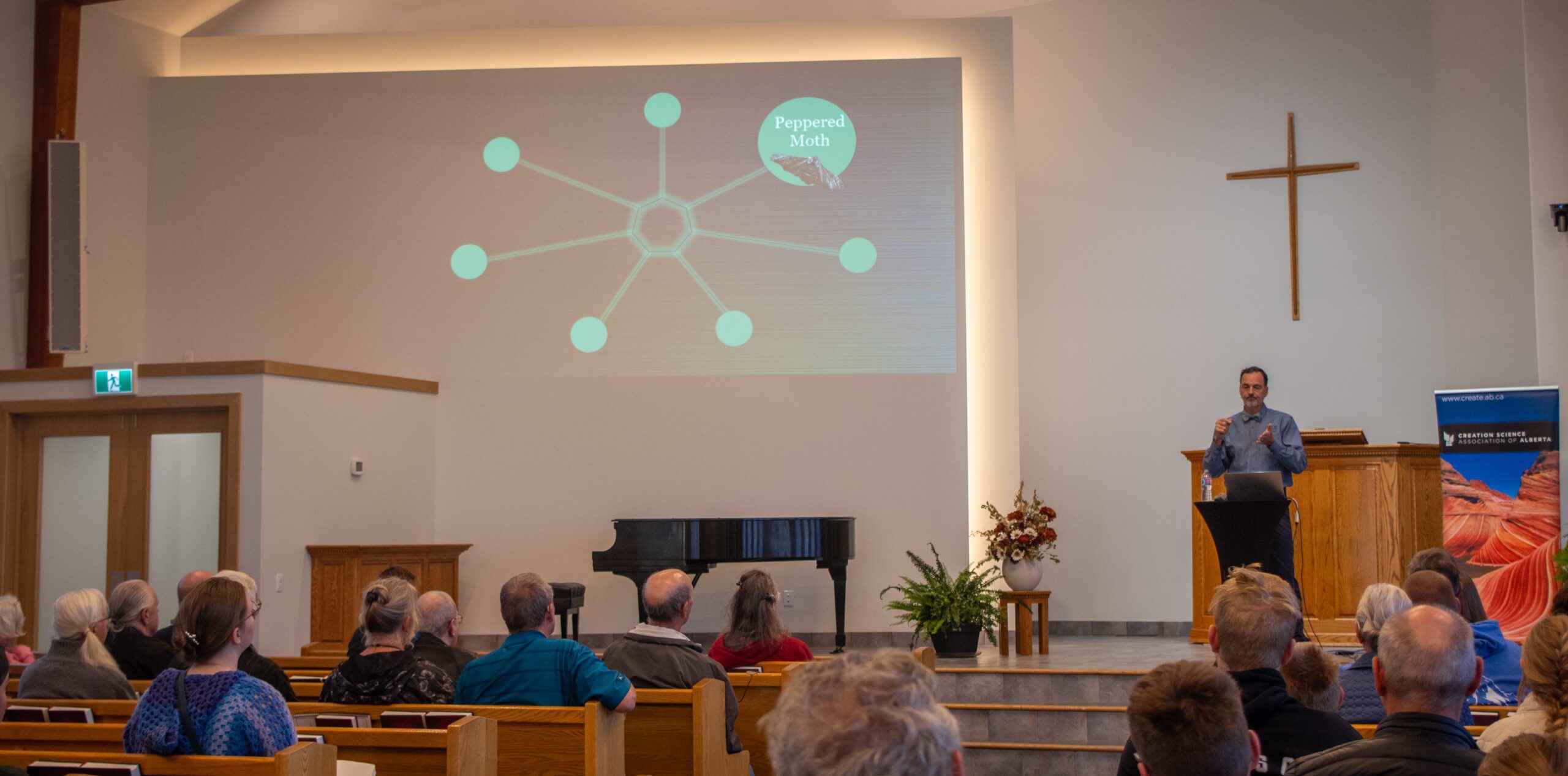

Once a qualified and interesting scientist has agreed to headline our next Creation Weekend, the members of CSAA’s executive have the fun task to choose which presentations will be featured. Every speaker has a menu of titles, but not all of them can be accommodated in one weekend. Choosing the line up of presentations is no easy task. Each member has different preferences and some choices were more recently presented than others. Nevertheless, year after year, the actual material presented fits together beautifully and seems to be the best of possible choices. So it was again this year that our speaker’s three lectures were stimulating, upbuilding and interesting.
Dr. Brian Thomas, research scientist from Institute for Creation Research, presented first his special research focus: entitled “Fresh fossils from four continents” Dr. Thomas pointed out that skin in animals is 96% collagen. It is the most abundant protein in the body. It provides structural support for skin, bones, tendons and other connective tissues. This organic compound can last 1000s of years, as we well know from ancient parchments (made from animal skins).
In view of the fact that collagen has been found in connection with a variety of fossils, the question comes up how long that organic matter could have lasted before being lost to decay. Apparently, said Dr. Thomas, it depends upon the temperature and pressure of the fossil environment. Dr. Thomas and colleagues conducted tests in the laboratory and from these results they calculated how long, in a best case scenario, any collagen could last when it is connected with a fossil. The answer that they derived was at most a half million years. This may seem like a long time, but it is nowhere near enough time to allow for collagen to still be connected to fossils that have been buried 70 million or so years.
Among the fossil creatures mentioned by Dr. Thomas with non-decayed organic material was a horned dinosaur specimen Pittacosaurus from China, a slight frisky dinosaur Caudipteryx with actual chromosomes, a tyrannosaurid Tarbosaurus with red blood cells from Poland, Nothosaurus, a marine reptile with blood vessels from Poland, and a collagen containing duck bill dinosaur Edmontosaurus from Western Canada.
On every continent young appearing proteins and structures are found in association with fossils which are assumed by most scientists to be many millions of years old. Dr. Thomas has collected scientific references to similar instances, 130 of them from around the world. All of these indicate that these fossils are young in age since their contents decay way too fast to be millions of years old. But of this information and of the implications, said Dr. Thomas, these scientists are “willingly ignorant.” If they do not like a piece of information, they ignore it.
Dr. Thomas tied these fossil finds in to the flood of Noah just thousands of years ago. This was an event that could have trapped many creatures in water borne sediment and left them there until modern times. Thus, in this presentation Dr. Thomas explained how we can know that these proteins are relatively young and how these exciting new finds fit with the Bible’s history of the world.
Dr. Thomas’ second presentation was on many extreme chemical barriers that exist to prevent spontaneous chemical processes from coming together to form a living cell. Thus the engineered precision that we see in cellular machines in fact credits the Creator, not nature with bringing about life.
Lastly Dr. Thomas discussed the life histories of many creatures which demonstrate that Darwin’s speculations on how creatures adapt to changed environmental conditions, in fact were in error and in any case adaptations do not lead to long term major modifications. The change in topic from chemical details in the previous talk to large creatures and their life histories, demonstrated the variety of information that is relevant to creation. These presentations sent us home reflecting on everything from large dinosaur fossils, to tiny cell components and to the histories of finches and mosquitos and to prairie deer mice and how all these features dovetail so nicely with the Biblical account of origins.
January 2026
Subscribe to Dialogue
FEATURED BOOKS AND DVDS
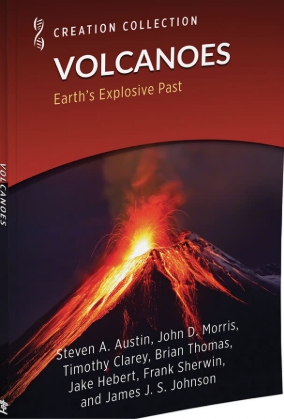
Paperback / $10.00 / 159 Pages / Full colour
Once a qualified and interesting scientist has agreed to headline our next Creation Weekend, the members of CSAA’s executive have the fun task to choose which presentations will be featured. Every speaker has a menu of titles, but not all of them can be accommodated in one weekend. Choosing the line up of presentations is no easy task. Each member has different preferences and some choices were more recently presented than others. Nevertheless, year after year, the actual material presented fits together beautifully and seems to be the best of possible choices. So it was again this year that our speaker’s three lectures were stimulating, upbuilding and interesting.
Dr. Brian Thomas, research scientist from Institute for Creation Research, presented first his special research focus: entitled “Fresh fossils from four continents” Dr. Thomas pointed out that skin in animals is 96% collagen. It is the most abundant protein in the body. It provides structural support for skin, bones, tendons and other connective tissues. This organic compound can last 1000s of years, as we well know from ancient parchments (made from animal skins).
In view of the fact that collagen has been found in connection with a variety of fossils, the question comes up how long that organic matter could have lasted before being lost to decay. Apparently, said Dr. Thomas, it depends upon the temperature and pressure of the fossil environment. Dr. Thomas and colleagues conducted tests in the laboratory and from these results they calculated how long, in a best case scenario, any collagen could last when it is connected with a fossil. The answer that they derived was at most a half million years. This may seem like a long time, but it is nowhere near enough time to allow for collagen to still be connected to fossils that have been buried 70 million or so years.
Among the fossil creatures mentioned by Dr. Thomas with non-decayed organic material was a horned dinosaur specimen Pittacosaurus from China, a slight frisky dinosaur Caudipteryx with actual chromosomes, a tyrannosaurid Tarbosaurus with red blood cells from Poland, Nothosaurus, a marine reptile with blood vessels from Poland, and a collagen containing duck bill dinosaur Edmontosaurus from Western Canada.
On every continent young appearing proteins and structures are found in association with fossils which are assumed by most scientists to be many millions of years old. Dr. Thomas has collected scientific references to similar instances, 130 of them from around the world. All of these indicate that these fossils are young in age since their contents decay way too fast to be millions of years old. But of this information and of the implications, said Dr. Thomas, these scientists are “willingly ignorant.” If they do not like a piece of information, they ignore it.
Dr. Thomas tied these fossil finds in to the flood of Noah just thousands of years ago. This was an event that could have trapped many creatures in water borne sediment and left them there until modern times. Thus, in this presentation Dr. Thomas explained how we can know that these proteins are relatively young and how these exciting new finds fit with the Bible’s history of the world.
Dr. Thomas’ second presentation was on many extreme chemical barriers that exist to prevent spontaneous chemical processes from coming together to form a living cell. Thus the engineered precision that we see in cellular machines in fact credits the Creator, not nature with bringing about life.
Lastly Dr. Thomas discussed the life histories of many creatures which demonstrate that Darwin’s speculations on how creatures adapt to changed environmental conditions, in fact were in error and in any case adaptations do not lead to long term major modifications. The change in topic from chemical details in the previous talk to large creatures and their life histories, demonstrated the variety of information that is relevant to creation. These presentations sent us home reflecting on everything from large dinosaur fossils, to tiny cell components and to the histories of finches and mosquitos and to prairie deer mice and how all these features dovetail so nicely with the Biblical account of origins.
Order Online

Paperback / $6.00 / 55 Pages
Once a qualified and interesting scientist has agreed to headline our next Creation Weekend, the members of CSAA’s executive have the fun task to choose which presentations will be featured. Every speaker has a menu of titles, but not all of them can be accommodated in one weekend. Choosing the line up of presentations is no easy task. Each member has different preferences and some choices were more recently presented than others. Nevertheless, year after year, the actual material presented fits together beautifully and seems to be the best of possible choices. So it was again this year that our speaker’s three lectures were stimulating, upbuilding and interesting.
Dr. Brian Thomas, research scientist from Institute for Creation Research, presented first his special research focus: entitled “Fresh fossils from four continents” Dr. Thomas pointed out that skin in animals is 96% collagen. It is the most abundant protein in the body. It provides structural support for skin, bones, tendons and other connective tissues. This organic compound can last 1000s of years, as we well know from ancient parchments (made from animal skins).
In view of the fact that collagen has been found in connection with a variety of fossils, the question comes up how long that organic matter could have lasted before being lost to decay. Apparently, said Dr. Thomas, it depends upon the temperature and pressure of the fossil environment. Dr. Thomas and colleagues conducted tests in the laboratory and from these results they calculated how long, in a best case scenario, any collagen could last when it is connected with a fossil. The answer that they derived was at most a half million years. This may seem like a long time, but it is nowhere near enough time to allow for collagen to still be connected to fossils that have been buried 70 million or so years.
Among the fossil creatures mentioned by Dr. Thomas with non-decayed organic material was a horned dinosaur specimen Pittacosaurus from China, a slight frisky dinosaur Caudipteryx with actual chromosomes, a tyrannosaurid Tarbosaurus with red blood cells from Poland, Nothosaurus, a marine reptile with blood vessels from Poland, and a collagen containing duck bill dinosaur Edmontosaurus from Western Canada.
On every continent young appearing proteins and structures are found in association with fossils which are assumed by most scientists to be many millions of years old. Dr. Thomas has collected scientific references to similar instances, 130 of them from around the world. All of these indicate that these fossils are young in age since their contents decay way too fast to be millions of years old. But of this information and of the implications, said Dr. Thomas, these scientists are “willingly ignorant.” If they do not like a piece of information, they ignore it.
Dr. Thomas tied these fossil finds in to the flood of Noah just thousands of years ago. This was an event that could have trapped many creatures in water borne sediment and left them there until modern times. Thus, in this presentation Dr. Thomas explained how we can know that these proteins are relatively young and how these exciting new finds fit with the Bible’s history of the world.
Dr. Thomas’ second presentation was on many extreme chemical barriers that exist to prevent spontaneous chemical processes from coming together to form a living cell. Thus the engineered precision that we see in cellular machines in fact credits the Creator, not nature with bringing about life.
Lastly Dr. Thomas discussed the life histories of many creatures which demonstrate that Darwin’s speculations on how creatures adapt to changed environmental conditions, in fact were in error and in any case adaptations do not lead to long term major modifications. The change in topic from chemical details in the previous talk to large creatures and their life histories, demonstrated the variety of information that is relevant to creation. These presentations sent us home reflecting on everything from large dinosaur fossils, to tiny cell components and to the histories of finches and mosquitos and to prairie deer mice and how all these features dovetail so nicely with the Biblical account of origins.
Order Online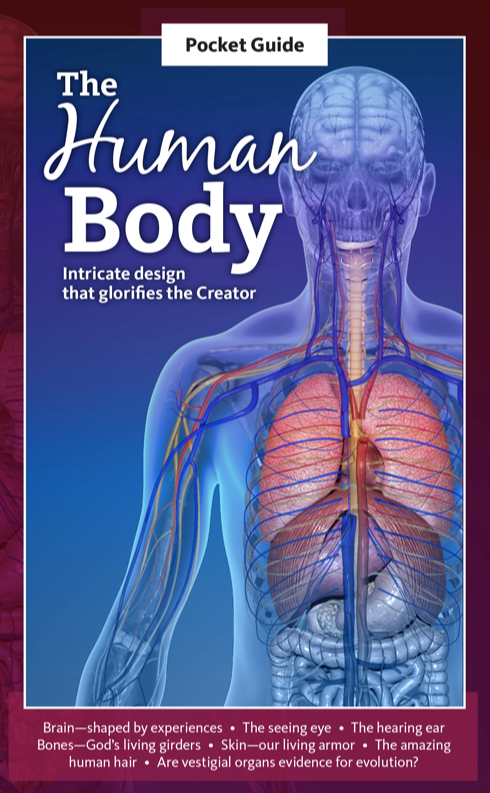
Paperback / $6.00 / 96 Pages / full colour
Once a qualified and interesting scientist has agreed to headline our next Creation Weekend, the members of CSAA’s executive have the fun task to choose which presentations will be featured. Every speaker has a menu of titles, but not all of them can be accommodated in one weekend. Choosing the line up of presentations is no easy task. Each member has different preferences and some choices were more recently presented than others. Nevertheless, year after year, the actual material presented fits together beautifully and seems to be the best of possible choices. So it was again this year that our speaker’s three lectures were stimulating, upbuilding and interesting.
Dr. Brian Thomas, research scientist from Institute for Creation Research, presented first his special research focus: entitled “Fresh fossils from four continents” Dr. Thomas pointed out that skin in animals is 96% collagen. It is the most abundant protein in the body. It provides structural support for skin, bones, tendons and other connective tissues. This organic compound can last 1000s of years, as we well know from ancient parchments (made from animal skins).
In view of the fact that collagen has been found in connection with a variety of fossils, the question comes up how long that organic matter could have lasted before being lost to decay. Apparently, said Dr. Thomas, it depends upon the temperature and pressure of the fossil environment. Dr. Thomas and colleagues conducted tests in the laboratory and from these results they calculated how long, in a best case scenario, any collagen could last when it is connected with a fossil. The answer that they derived was at most a half million years. This may seem like a long time, but it is nowhere near enough time to allow for collagen to still be connected to fossils that have been buried 70 million or so years.
Among the fossil creatures mentioned by Dr. Thomas with non-decayed organic material was a horned dinosaur specimen Pittacosaurus from China, a slight frisky dinosaur Caudipteryx with actual chromosomes, a tyrannosaurid Tarbosaurus with red blood cells from Poland, Nothosaurus, a marine reptile with blood vessels from Poland, and a collagen containing duck bill dinosaur Edmontosaurus from Western Canada.
On every continent young appearing proteins and structures are found in association with fossils which are assumed by most scientists to be many millions of years old. Dr. Thomas has collected scientific references to similar instances, 130 of them from around the world. All of these indicate that these fossils are young in age since their contents decay way too fast to be millions of years old. But of this information and of the implications, said Dr. Thomas, these scientists are “willingly ignorant.” If they do not like a piece of information, they ignore it.
Dr. Thomas tied these fossil finds in to the flood of Noah just thousands of years ago. This was an event that could have trapped many creatures in water borne sediment and left them there until modern times. Thus, in this presentation Dr. Thomas explained how we can know that these proteins are relatively young and how these exciting new finds fit with the Bible’s history of the world.
Dr. Thomas’ second presentation was on many extreme chemical barriers that exist to prevent spontaneous chemical processes from coming together to form a living cell. Thus the engineered precision that we see in cellular machines in fact credits the Creator, not nature with bringing about life.
Lastly Dr. Thomas discussed the life histories of many creatures which demonstrate that Darwin’s speculations on how creatures adapt to changed environmental conditions, in fact were in error and in any case adaptations do not lead to long term major modifications. The change in topic from chemical details in the previous talk to large creatures and their life histories, demonstrated the variety of information that is relevant to creation. These presentations sent us home reflecting on everything from large dinosaur fossils, to tiny cell components and to the histories of finches and mosquitos and to prairie deer mice and how all these features dovetail so nicely with the Biblical account of origins.
Order Online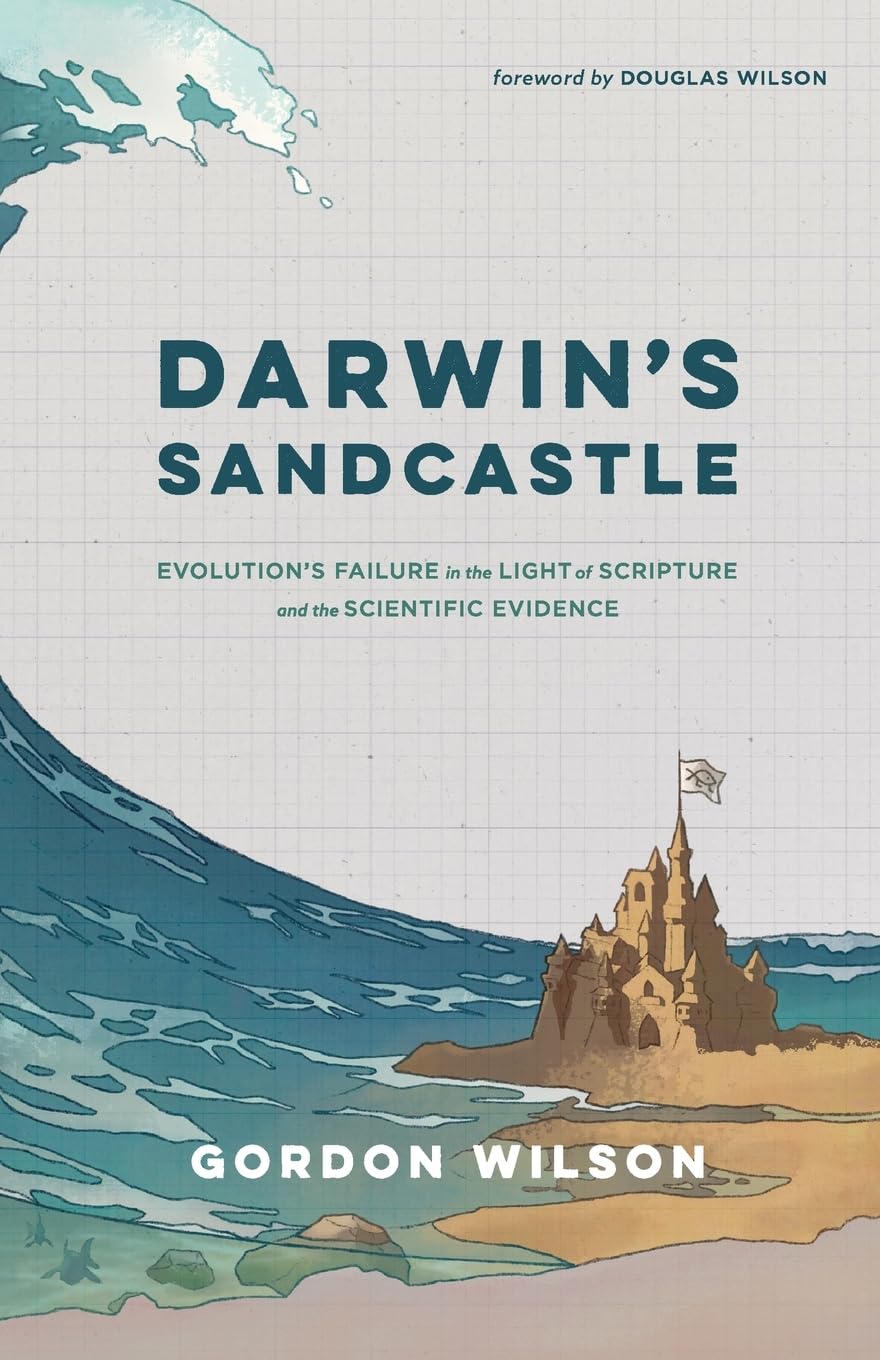
Paperback / $22.00 / 256 Pages
Once a qualified and interesting scientist has agreed to headline our next Creation Weekend, the members of CSAA’s executive have the fun task to choose which presentations will be featured. Every speaker has a menu of titles, but not all of them can be accommodated in one weekend. Choosing the line up of presentations is no easy task. Each member has different preferences and some choices were more recently presented than others. Nevertheless, year after year, the actual material presented fits together beautifully and seems to be the best of possible choices. So it was again this year that our speaker’s three lectures were stimulating, upbuilding and interesting.
Dr. Brian Thomas, research scientist from Institute for Creation Research, presented first his special research focus: entitled “Fresh fossils from four continents” Dr. Thomas pointed out that skin in animals is 96% collagen. It is the most abundant protein in the body. It provides structural support for skin, bones, tendons and other connective tissues. This organic compound can last 1000s of years, as we well know from ancient parchments (made from animal skins).
In view of the fact that collagen has been found in connection with a variety of fossils, the question comes up how long that organic matter could have lasted before being lost to decay. Apparently, said Dr. Thomas, it depends upon the temperature and pressure of the fossil environment. Dr. Thomas and colleagues conducted tests in the laboratory and from these results they calculated how long, in a best case scenario, any collagen could last when it is connected with a fossil. The answer that they derived was at most a half million years. This may seem like a long time, but it is nowhere near enough time to allow for collagen to still be connected to fossils that have been buried 70 million or so years.
Among the fossil creatures mentioned by Dr. Thomas with non-decayed organic material was a horned dinosaur specimen Pittacosaurus from China, a slight frisky dinosaur Caudipteryx with actual chromosomes, a tyrannosaurid Tarbosaurus with red blood cells from Poland, Nothosaurus, a marine reptile with blood vessels from Poland, and a collagen containing duck bill dinosaur Edmontosaurus from Western Canada.
On every continent young appearing proteins and structures are found in association with fossils which are assumed by most scientists to be many millions of years old. Dr. Thomas has collected scientific references to similar instances, 130 of them from around the world. All of these indicate that these fossils are young in age since their contents decay way too fast to be millions of years old. But of this information and of the implications, said Dr. Thomas, these scientists are “willingly ignorant.” If they do not like a piece of information, they ignore it.
Dr. Thomas tied these fossil finds in to the flood of Noah just thousands of years ago. This was an event that could have trapped many creatures in water borne sediment and left them there until modern times. Thus, in this presentation Dr. Thomas explained how we can know that these proteins are relatively young and how these exciting new finds fit with the Bible’s history of the world.
Dr. Thomas’ second presentation was on many extreme chemical barriers that exist to prevent spontaneous chemical processes from coming together to form a living cell. Thus the engineered precision that we see in cellular machines in fact credits the Creator, not nature with bringing about life.
Lastly Dr. Thomas discussed the life histories of many creatures which demonstrate that Darwin’s speculations on how creatures adapt to changed environmental conditions, in fact were in error and in any case adaptations do not lead to long term major modifications. The change in topic from chemical details in the previous talk to large creatures and their life histories, demonstrated the variety of information that is relevant to creation. These presentations sent us home reflecting on everything from large dinosaur fossils, to tiny cell components and to the histories of finches and mosquitos and to prairie deer mice and how all these features dovetail so nicely with the Biblical account of origins.
Order Online