

Articles


We seldom reflect on how interesting skunks can be. The nine identified skunk species are notorious for their scent glands that can accurately shoot noxious oily amber spray as a defensive weapon. Two glands, one on each side of their anus, produce the spray, which is a complex mixture of sulfur-containing chemicals. The pungent spray causes irritation to the skin like pepper spray, even temporary blindness—which may be why skunks often try to target the face (Schuster, 1992, p. 34). Read the rest of this entry »

Ever since the efforts of mankind at the tower of Babel, when the people sought to construct their own society based on their own agenda, the search for the perfect man-devised society has continued through the centuries. Indeed, since the advent of Enlightenment thinking in Europe in the eighteenth century, secular mankind has placed a particularly high value on his ability, based on reason alone, to find solutions to social problems. Recently we saw an example of this attitude in the pronouncements of Neil deGrasse Tyson, director of the Hayden Planetarium in New York City. This man is the philosophical successor of Carl Sagan who declared: “The universe is all there is, or was, or ever will be” (in his famous Cosmos series on the history of the universe). More recently Dr. Tyson has hosted a remake of Sagan’s Cosmos series for public television. Read the rest of this entry »
Many people claim they are not interested in science, but this is not really true. Perhaps they never really studied nature, but there are few people who do not notice how interesting and beautiful the surrounding countryside is. Did you realize for example that magpies are common in the western half of North America, but not in central Canada? Some people say that these distinctive birds are so common in Edmonton that this is the “magpie capital of Western Canada” (a dubious distinction). Read the rest of this entry »
The Octopus is considered a primitive invertebrate, below chordates such as fish, yet it has advanced traits rivaling even those of humans. In the words of one scientist, “With its eight prehensile arms lined with suckers, camera-like eyes, elaborate repertoire of camouflage tricks and spooky intelligence, the octopus is like no other creature on Earth.” (Abbott, 2015, p. 1). He arrived at this conclusion because they “have the largest nervous systems among the invertebrates and present other striking morphological innovations including camera-like eyes, prehensile arms, a highly derived early embryogenesis, and a remarkably sophisticated adaptive coloration system.” (Albertin, at al., 2015, p. 220). In short, the octopus is utterly different from all other animals, even other mollusks. For this reason and other reasons, its origin has stymied Darwinists. Read the rest of this entry »
Creation Science Association of Alberta is delighted to announce two wonderful speakers for Creation Weekend on Friday October 20 and Saturday October 21, 2017.
On Friday evening Carson Lueck B.Sc., B. Ed., is scheduled to speak on “How the Authority of Scripture Impacts Science”. This session will be aimed at youth and young adults. So bring your busloads of students to this event!
On Saturday October 21 come to hear Dr. John Byl, professor emeritus from Trinity Western University in Langley, B.C. His research interests include astronomy, physics, mathematics and the interaction between Christian faith and science, he has lectured in a large number of countries all over the world.
Most people are at least somewhat interested in artifacts left behind by ancient civilizations. That is why tourists flock to the Mayan ruins in Mexico, or to Greece or Rome, or to Stonehenge in the south of England. Dr. Donald Chittick, a physical chemist, turned his attention to some traces of ancient civilizations and what these artifacts tell us about the people who produced them. His book The Puzzle of Ancient Man (third edition 2006) includes many interesting cases including a mechanism from ancient Greece that was in fact an analog computer. This is defined as “a device for calculating quantitative data by means of moving parts –“ (Jones 2017 p. 25). In keeping with Biblical revelation, it perfectly makes sense that the ancient peoples were very clever and inventive. But just how sophisticated was this early computer? Research conducted for more than a century, since this device was discovered in an ancient shipwreck in 1900, demonstrates that the Antikythera Mechanism was astonishingly sophisticated. (See www.create.ab.ca/ancient-computer-astounds-everybody/#more-460 ) Read the rest of this entry »

A place where families can play and learn!
This summer during our annual family camping trip on a gloomy definitely-not-beach-weather kind of day, we discovered the DINOS (Discovery Institute of Nature, Origins and Science) Centre. When someone suggested going to a new facility with a unique combination of indoor mini-golf, laser tag, and a café, as well as a Bible History Museum and an outdoor driving range, everybody agreed! Read the rest of this entry »
The theme of Creation Weekend 2017 was “In Science and Faith, Worldview Matters”. Our speakers Carson Lueck and Dr. John Byl addressed this issue. Many people, in previous years, had indicated in questionnaires that they would be interested in presentations on apologetics. So here we were, considering worldviews. Naturally one might ask “What is a worldview? Why does it matter and how does it apply to our lives?” Read the rest of this entry »
The 2017 award of the Nobel Prize in physiology and medicine to three Americans, Michael Rosbash, Jeffrey Hall and Michael Young, has served to stimulate our interest in a phenomenon that is actually well-known. We all know why people get hungry about the same time of day, or wake up about the same time, or suffer from jet-lag. It is because of biological clocks. So what was so special about the work of these three scientists? The story actually goes back to 1729! Read the rest of this entry »
/ Pages
Jerry Bergman (2017) Joshua Press pp. 312
The best books are those that carry a compelling message and are interesting to read. Dr. Jerry Bergman’s new book How Darwinism Corrodes Morality is such a document. It carries the reader along from story to story. His discussion demonstrates how, in the early twentieth century, certain individuals who were consumed with a passion for Darwinism, managed to transform the values and customs of society from morals based on Judeo-Christian thought to a rejection of standards of any sort. Read the rest of this entry »
Dr. John Byl’s keynote lecture at Creation Weekend on the evening of Saturday, October 21, 2017 was entitled “Has Science Killed God? Christianity vs. Naturalism.” Many people in our modern society, Dr. Byl declared, believe that science can explain everything, so that God is not needed. These people accept that physical laws leave no room for God. Well then, said Dr. Byl, let us evaluate this position. He began by informing us that we must distinguish between the actual facts – the observed data – and scientific theories that are constructed to explain facts. Read the rest of this entry »
The African elephant is the largest living terrestrial mammal, even larger than most dinosaurs. Its mammoth size means their primary enemy is humans, not the major carnivores, such as lions, that inhabit its homeland. The largest recorded African elephant reached 12 feet (four meters) at the shoulder and weighed over ten tons. Called “nature’s masterpiece” and “skilled engineers” elephants are one of “the most intelligent of domesticated animals.” (Redmond, 1993, p. 6). Read the rest of this entry »
People who live in rural regions obviously have an enormous advantage in opportunities to observe and enjoy nature. For a start, they may be able to view the night sky much better than their friends in the city whose view of the stars is dimmed by city lights. Secondly of course there are the animals who make a point of visiting the property. There may be waterfowl in the spring, ducks and geese at least, who come to refresh themselves on your pond. And how about the frogs who deafen the night with their cheerful choruses. Read the rest of this entry »
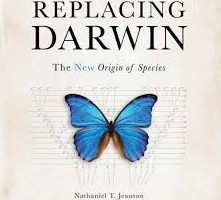
Landmark Work: What’s Wrong with ‘Survival of the Fittest’
An exciting new book was published in the fall of 2017. The author, Nathaniel Jeanson, is a specialist in molecular biology and bioinformatics with a Ph.D. in cell and developmental biology from Harvard University. With such fancy credentials, one might expect his new book to be very difficult and full of technical mumbo-jumbo! Well, Dr. Jeanson does present some very interesting information, but he does undertake to make the discussion accessible to interested readers. Excellent illustrations (some in colour) really help. Nevertheless for reading this book a good background in high school biology at least would be a big help. Read the rest of this entry »
Order OnlineA sign of the maturity of the creation science field is that books on a broader spectrum of topics have begun to appear. Excellent as titles are on such issues as dinosaurs and radiometric dating, it is nice to see some discussion of new issues. So it is then, that Dr. Jerry Bergman’s new book entitled Evolution’s Blunders, Frauds and Forgeries is certain to attract attention. Besides, the information contained therein is certainly fascinating.
Many of us have heard of the Piltdown Man fraud and the unmasking of that fraud which rocked the scientific world in 1953. However the story of how the events unfolded before that is very interesting. Since the deception was so obvious, it is a wonder that the scientific world allowed themselves to be deceived for more than 40 years. Similarly the 1922 ‘discovery’ of Nebraska Man which turned out to be an extinct pig, is also well known. However this book by Jerry Bergman also discusses many other astonishing examples of error or downright fraud. Read the rest of this entry »
Order OnlineFEATURED BOOKS AND DVDS
Paperback / $6.00 / 55 Pages
A sign of the maturity of the creation science field is that books on a broader spectrum of topics have begun to appear. Excellent as titles are on such issues as dinosaurs and radiometric dating, it is nice to see some discussion of new issues. So it is then, that Dr. Jerry Bergman’s new book entitled Evolution’s Blunders, Frauds and Forgeries is certain to attract attention. Besides, the information contained therein is certainly fascinating.
Many of us have heard of the Piltdown Man fraud and the unmasking of that fraud which rocked the scientific world in 1953. However the story of how the events unfolded before that is very interesting. Since the deception was so obvious, it is a wonder that the scientific world allowed themselves to be deceived for more than 40 years. Similarly the 1922 ‘discovery’ of Nebraska Man which turned out to be an extinct pig, is also well known. However this book by Jerry Bergman also discusses many other astonishing examples of error or downright fraud. Read the rest of this entry »
Order Online
Paperback / $10.00 / 111 Pages / full colour
A sign of the maturity of the creation science field is that books on a broader spectrum of topics have begun to appear. Excellent as titles are on such issues as dinosaurs and radiometric dating, it is nice to see some discussion of new issues. So it is then, that Dr. Jerry Bergman’s new book entitled Evolution’s Blunders, Frauds and Forgeries is certain to attract attention. Besides, the information contained therein is certainly fascinating.
Many of us have heard of the Piltdown Man fraud and the unmasking of that fraud which rocked the scientific world in 1953. However the story of how the events unfolded before that is very interesting. Since the deception was so obvious, it is a wonder that the scientific world allowed themselves to be deceived for more than 40 years. Similarly the 1922 ‘discovery’ of Nebraska Man which turned out to be an extinct pig, is also well known. However this book by Jerry Bergman also discusses many other astonishing examples of error or downright fraud. Read the rest of this entry »
Order Online
Hardcover / $18.00 / 117 Pages / Full colour
A sign of the maturity of the creation science field is that books on a broader spectrum of topics have begun to appear. Excellent as titles are on such issues as dinosaurs and radiometric dating, it is nice to see some discussion of new issues. So it is then, that Dr. Jerry Bergman’s new book entitled Evolution’s Blunders, Frauds and Forgeries is certain to attract attention. Besides, the information contained therein is certainly fascinating.
Many of us have heard of the Piltdown Man fraud and the unmasking of that fraud which rocked the scientific world in 1953. However the story of how the events unfolded before that is very interesting. Since the deception was so obvious, it is a wonder that the scientific world allowed themselves to be deceived for more than 40 years. Similarly the 1922 ‘discovery’ of Nebraska Man which turned out to be an extinct pig, is also well known. However this book by Jerry Bergman also discusses many other astonishing examples of error or downright fraud. Read the rest of this entry »
Order Online
Paperback / $10.00 / 192 Pages / Full colour
A sign of the maturity of the creation science field is that books on a broader spectrum of topics have begun to appear. Excellent as titles are on such issues as dinosaurs and radiometric dating, it is nice to see some discussion of new issues. So it is then, that Dr. Jerry Bergman’s new book entitled Evolution’s Blunders, Frauds and Forgeries is certain to attract attention. Besides, the information contained therein is certainly fascinating.
Many of us have heard of the Piltdown Man fraud and the unmasking of that fraud which rocked the scientific world in 1953. However the story of how the events unfolded before that is very interesting. Since the deception was so obvious, it is a wonder that the scientific world allowed themselves to be deceived for more than 40 years. Similarly the 1922 ‘discovery’ of Nebraska Man which turned out to be an extinct pig, is also well known. However this book by Jerry Bergman also discusses many other astonishing examples of error or downright fraud. Read the rest of this entry »
Order Online