

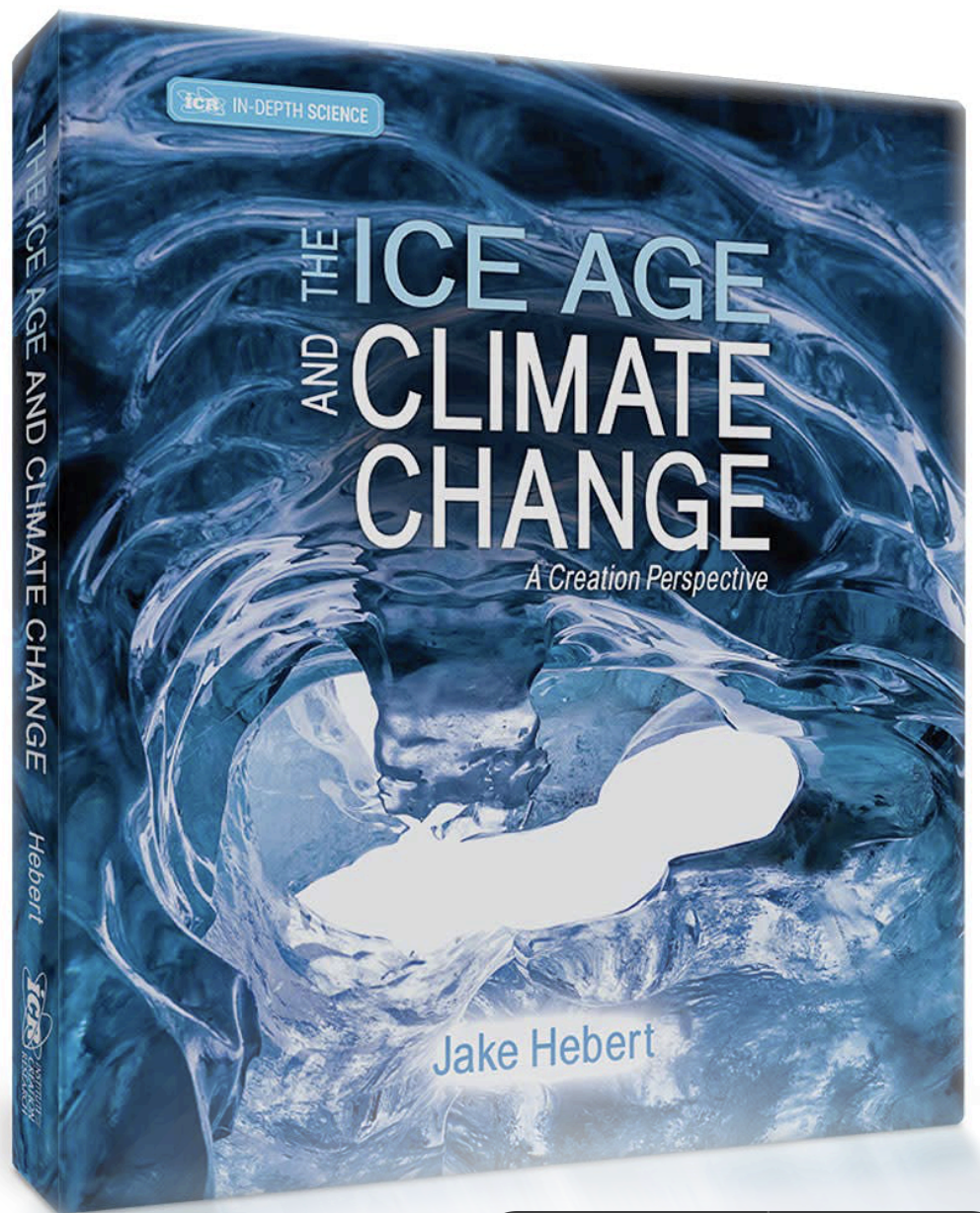

The Ice Age and Climate Change
Reviewed by Andrea Reitan
Climate change alarmism seems to be a cultural obsession these days, among both Christians and non-Christians alike. Much of the hoopla around climate change stems from the claim that there is a scientific consensus and that we need to change our ways, but is this true? Should Christians jump aboard the climate change crusade? In The Ice Age and Climate Change, Jake Hebert aims to examine the evidence commonly used in climate discussions, arguing that a Young-Earth Creation (YEC) framework leads to different conclusions than the mainstream narrative.
This book starts with an explanation of why Christians should care about the climate change debate (chapter 2). Many of the “planet-saving” measures that alarmists have suggested directly relate to biblical moral issues and scientific ethics. In reality, there is no reason for us to live in fear. God promised, in Genesis 8:22, “While the earth remains, seedtime and harvest, cold and heat, winter and summer, and day and night shall not cease.” However, we do have a God-given responsibility to steward the earth (chapter 16).
While the secular view proposes dozens of Ice Ages lasting millions of years, the YEC view proposes that only one Ice Age occurred as a result of the Genesis Flood and lasted only a few centuries. Hebert explains the origins of climate change alarmism and a bit about how Earth’s atmosphere self-regulates. He also provides a summary of the geological evidence for a global Flood (chapter 4), Catastrophic Plate Tectonics (CPT, chapter 5), and the HEAT model for the Ice Age (chapters 10 and 11).
The uniformitarian climate change narrative is primarily based on what is called the Milankovitch Theory or the Astronomical Theory. In chapters 8 and 9, Hebert explains the history of this theory and how changes in Earth’s orbit around the sun supposedly trigger Ice Ages. He also discusses how changes to critical dates in the uniformitarian timescale have affected the correlation of the Milankovitch Cycles with dates from seafloor sediment cores and ice cores that were claimed to support the theory, effectively dissolving the foundation for the uniformitarian narrative. Hebert also raises the issue of whether deep ice cores can truly prove an old Earth (chapter 14) and the evidence for young ice sheets (chapter 15).
I think Hebert has done an excellent job of explaining the uniformitarian climate arguments fairly and accurately, and he presents the evidence clearly in a way that non-scientists can grasp. The Ice Age and Climate Change is an excellent resource for understanding the climate change debate from a YEC viewpoint.
Jake Hebert. The Ice Age and Climate Change. Hardcover. Full colour pp. 295 $35.00 available from CSAA plus $15.00 for shipping.
Order Online
April 2026
Subscribe to Dialogue
FEATURED BOOKS AND DVDS


Paperback / $6.00 / 55 Pages
The Ice Age and Climate Change
Reviewed by Andrea Reitan
Climate change alarmism seems to be a cultural obsession these days, among both Christians and non-Christians alike. Much of the hoopla around climate change stems from the claim that there is a scientific consensus and that we need to change our ways, but is this true? Should Christians jump aboard the climate change crusade? In The Ice Age and Climate Change, Jake Hebert aims to examine the evidence commonly used in climate discussions, arguing that a Young-Earth Creation (YEC) framework leads to different conclusions than the mainstream narrative.
This book starts with an explanation of why Christians should care about the climate change debate (chapter 2). Many of the “planet-saving” measures that alarmists have suggested directly relate to biblical moral issues and scientific ethics. In reality, there is no reason for us to live in fear. God promised, in Genesis 8:22, “While the earth remains, seedtime and harvest, cold and heat, winter and summer, and day and night shall not cease.” However, we do have a God-given responsibility to steward the earth (chapter 16).
While the secular view proposes dozens of Ice Ages lasting millions of years, the YEC view proposes that only one Ice Age occurred as a result of the Genesis Flood and lasted only a few centuries. Hebert explains the origins of climate change alarmism and a bit about how Earth’s atmosphere self-regulates. He also provides a summary of the geological evidence for a global Flood (chapter 4), Catastrophic Plate Tectonics (CPT, chapter 5), and the HEAT model for the Ice Age (chapters 10 and 11).
The uniformitarian climate change narrative is primarily based on what is called the Milankovitch Theory or the Astronomical Theory. In chapters 8 and 9, Hebert explains the history of this theory and how changes in Earth’s orbit around the sun supposedly trigger Ice Ages. He also discusses how changes to critical dates in the uniformitarian timescale have affected the correlation of the Milankovitch Cycles with dates from seafloor sediment cores and ice cores that were claimed to support the theory, effectively dissolving the foundation for the uniformitarian narrative. Hebert also raises the issue of whether deep ice cores can truly prove an old Earth (chapter 14) and the evidence for young ice sheets (chapter 15).
I think Hebert has done an excellent job of explaining the uniformitarian climate arguments fairly and accurately, and he presents the evidence clearly in a way that non-scientists can grasp. The Ice Age and Climate Change is an excellent resource for understanding the climate change debate from a YEC viewpoint.
Jake Hebert. The Ice Age and Climate Change. Hardcover. Full colour pp. 295 $35.00 available from CSAA plus $15.00 for shipping.
Order Online

Paperback / $10.00 / 111 Pages / full colour
The Ice Age and Climate Change
Reviewed by Andrea Reitan
Climate change alarmism seems to be a cultural obsession these days, among both Christians and non-Christians alike. Much of the hoopla around climate change stems from the claim that there is a scientific consensus and that we need to change our ways, but is this true? Should Christians jump aboard the climate change crusade? In The Ice Age and Climate Change, Jake Hebert aims to examine the evidence commonly used in climate discussions, arguing that a Young-Earth Creation (YEC) framework leads to different conclusions than the mainstream narrative.
This book starts with an explanation of why Christians should care about the climate change debate (chapter 2). Many of the “planet-saving” measures that alarmists have suggested directly relate to biblical moral issues and scientific ethics. In reality, there is no reason for us to live in fear. God promised, in Genesis 8:22, “While the earth remains, seedtime and harvest, cold and heat, winter and summer, and day and night shall not cease.” However, we do have a God-given responsibility to steward the earth (chapter 16).
While the secular view proposes dozens of Ice Ages lasting millions of years, the YEC view proposes that only one Ice Age occurred as a result of the Genesis Flood and lasted only a few centuries. Hebert explains the origins of climate change alarmism and a bit about how Earth’s atmosphere self-regulates. He also provides a summary of the geological evidence for a global Flood (chapter 4), Catastrophic Plate Tectonics (CPT, chapter 5), and the HEAT model for the Ice Age (chapters 10 and 11).
The uniformitarian climate change narrative is primarily based on what is called the Milankovitch Theory or the Astronomical Theory. In chapters 8 and 9, Hebert explains the history of this theory and how changes in Earth’s orbit around the sun supposedly trigger Ice Ages. He also discusses how changes to critical dates in the uniformitarian timescale have affected the correlation of the Milankovitch Cycles with dates from seafloor sediment cores and ice cores that were claimed to support the theory, effectively dissolving the foundation for the uniformitarian narrative. Hebert also raises the issue of whether deep ice cores can truly prove an old Earth (chapter 14) and the evidence for young ice sheets (chapter 15).
I think Hebert has done an excellent job of explaining the uniformitarian climate arguments fairly and accurately, and he presents the evidence clearly in a way that non-scientists can grasp. The Ice Age and Climate Change is an excellent resource for understanding the climate change debate from a YEC viewpoint.
Jake Hebert. The Ice Age and Climate Change. Hardcover. Full colour pp. 295 $35.00 available from CSAA plus $15.00 for shipping.
Order Online
Hardcover / $18.00 / 117 Pages / Full colour
The Ice Age and Climate Change
Reviewed by Andrea Reitan
Climate change alarmism seems to be a cultural obsession these days, among both Christians and non-Christians alike. Much of the hoopla around climate change stems from the claim that there is a scientific consensus and that we need to change our ways, but is this true? Should Christians jump aboard the climate change crusade? In The Ice Age and Climate Change, Jake Hebert aims to examine the evidence commonly used in climate discussions, arguing that a Young-Earth Creation (YEC) framework leads to different conclusions than the mainstream narrative.
This book starts with an explanation of why Christians should care about the climate change debate (chapter 2). Many of the “planet-saving” measures that alarmists have suggested directly relate to biblical moral issues and scientific ethics. In reality, there is no reason for us to live in fear. God promised, in Genesis 8:22, “While the earth remains, seedtime and harvest, cold and heat, winter and summer, and day and night shall not cease.” However, we do have a God-given responsibility to steward the earth (chapter 16).
While the secular view proposes dozens of Ice Ages lasting millions of years, the YEC view proposes that only one Ice Age occurred as a result of the Genesis Flood and lasted only a few centuries. Hebert explains the origins of climate change alarmism and a bit about how Earth’s atmosphere self-regulates. He also provides a summary of the geological evidence for a global Flood (chapter 4), Catastrophic Plate Tectonics (CPT, chapter 5), and the HEAT model for the Ice Age (chapters 10 and 11).
The uniformitarian climate change narrative is primarily based on what is called the Milankovitch Theory or the Astronomical Theory. In chapters 8 and 9, Hebert explains the history of this theory and how changes in Earth’s orbit around the sun supposedly trigger Ice Ages. He also discusses how changes to critical dates in the uniformitarian timescale have affected the correlation of the Milankovitch Cycles with dates from seafloor sediment cores and ice cores that were claimed to support the theory, effectively dissolving the foundation for the uniformitarian narrative. Hebert also raises the issue of whether deep ice cores can truly prove an old Earth (chapter 14) and the evidence for young ice sheets (chapter 15).
I think Hebert has done an excellent job of explaining the uniformitarian climate arguments fairly and accurately, and he presents the evidence clearly in a way that non-scientists can grasp. The Ice Age and Climate Change is an excellent resource for understanding the climate change debate from a YEC viewpoint.
Jake Hebert. The Ice Age and Climate Change. Hardcover. Full colour pp. 295 $35.00 available from CSAA plus $15.00 for shipping.
Order Online
Paperback / $10.00 / 192 Pages / Full colour
The Ice Age and Climate Change
Reviewed by Andrea Reitan
Climate change alarmism seems to be a cultural obsession these days, among both Christians and non-Christians alike. Much of the hoopla around climate change stems from the claim that there is a scientific consensus and that we need to change our ways, but is this true? Should Christians jump aboard the climate change crusade? In The Ice Age and Climate Change, Jake Hebert aims to examine the evidence commonly used in climate discussions, arguing that a Young-Earth Creation (YEC) framework leads to different conclusions than the mainstream narrative.
This book starts with an explanation of why Christians should care about the climate change debate (chapter 2). Many of the “planet-saving” measures that alarmists have suggested directly relate to biblical moral issues and scientific ethics. In reality, there is no reason for us to live in fear. God promised, in Genesis 8:22, “While the earth remains, seedtime and harvest, cold and heat, winter and summer, and day and night shall not cease.” However, we do have a God-given responsibility to steward the earth (chapter 16).
While the secular view proposes dozens of Ice Ages lasting millions of years, the YEC view proposes that only one Ice Age occurred as a result of the Genesis Flood and lasted only a few centuries. Hebert explains the origins of climate change alarmism and a bit about how Earth’s atmosphere self-regulates. He also provides a summary of the geological evidence for a global Flood (chapter 4), Catastrophic Plate Tectonics (CPT, chapter 5), and the HEAT model for the Ice Age (chapters 10 and 11).
The uniformitarian climate change narrative is primarily based on what is called the Milankovitch Theory or the Astronomical Theory. In chapters 8 and 9, Hebert explains the history of this theory and how changes in Earth’s orbit around the sun supposedly trigger Ice Ages. He also discusses how changes to critical dates in the uniformitarian timescale have affected the correlation of the Milankovitch Cycles with dates from seafloor sediment cores and ice cores that were claimed to support the theory, effectively dissolving the foundation for the uniformitarian narrative. Hebert also raises the issue of whether deep ice cores can truly prove an old Earth (chapter 14) and the evidence for young ice sheets (chapter 15).
I think Hebert has done an excellent job of explaining the uniformitarian climate arguments fairly and accurately, and he presents the evidence clearly in a way that non-scientists can grasp. The Ice Age and Climate Change is an excellent resource for understanding the climate change debate from a YEC viewpoint.
Jake Hebert. The Ice Age and Climate Change. Hardcover. Full colour pp. 295 $35.00 available from CSAA plus $15.00 for shipping.
Order Online