

Introductory


I remember that when I was a child, we tried to grow date palms from the pits or seeds in the fruit. None ever germinated. But that was then and time has passed. When we had fresh dates (with seeds inside) at Christmas a few years ago, I decided to try again. Accordingly, I took a deep margarine tub, punctured several holes in the bottom to drain out water, and filled it with good potting soil. Then each day, as the dates were consumed, I tucked their seeds into the soil. Maybe twenty or more seeds went into the pot. And nothing happened. But I kept watering. Then after eight weeks or more, a pure white shoot about 2 mm in diameter finally appeared. It looked like a growing shoot from a corn seed, only thicker. Next day another shoot appeared. It took several days for these to turn green. Eventually we had five young seedings, each of which developed a bright green leaf. More leaves followed, one at a time. These plants are monocots, like corn and grasses and bamboo. That is why they send up only a single leaf at first. Read the rest of this entry »
Hippopotamus, called hippos, are monstrous, mostly herbivorous, semiaquatic mammals native to most of Africa. Only in the Sahara Desert are they not found. Their origins have always been a problem for evolution because they are like no other living animal. Only two extant species exist, the Nile hippo (Hippopotamus amphibius), and the pygmy hippopotamus (Choeropisi liberiensis). During the daytime they are aquatic, floating in the water world, and at the nighttime they are land animals consuming mostly grasses, soft plants, and some succulent fruit. (Macdonald,1987, p. 507) They were named from the Greek words for river horse. Read the rest of this entry »
A friend, a while ago, articulated some possible critical arguments concerning advocacy for young earth creation which are based on observations from nature. Here are some reflections on that conversation. Read the rest of this entry »
Insects! Some people give them a wide berth on principle. Nasty, creepy, crawly flying things! Even the magnificent giant moths elicit only screams from some people. But the insects under discussion are guaranteed to cause no such sensation. Initial disbelief, amazement, titillation and delight are the sensations to be expected from an encounter with these exotic ‘bugs’. Read the rest of this entry »
Friday and Saturday – October 25 and 26, 2019
Featuring Dr. Margaret Helder
- Original research in algae, aquatic fungi and freshwater ecology
- Taught biology to university and high school levels, and home school science workshops for all grades
- Science writer for Dialogue and Reformed Perspective and other Christian publications
- Expert witness at a trial on creation/evolution in the United States Read the rest of this entry »
Pangolins are some of the strangest animals you will likely ever see. They are covered with scales like reptiles and look like a cross between anteaters and armadillos (Kierst, 2013). Because they are like no other animal, they were put in their own taxonomic order called Pholidota, Greek for “horny scale” (Benton, 2005, p. 348). Their tough, overlapping, reptile-protective keratin scales cause it to look like a giant pinecone with a long, thin reptilian tail. Its profile looks very much like a miniature dinosaur and nothing like the mammal it is. It is a mammal because they give birth to live young that suckle mammary glands as infants (Johnson, 2001, p. 31).
A careful examination of objects by both telescopes and microscopes reveals a major contrast between human-constructed objects and those designed by the Creator. Human made objects, such as a watch, reveal more imperfections as the magnification by which they are viewed is increased. An old-fashioned gear watch is an object of beauty when viewed by the naked eye. Under the microscope, though, the flaws in the machining process become more apparent until, under high power, a watch looks not only imperfect, but crude.
In contrast, increasing magnification of the natural world reveals new detail and perfection. Read the rest of this entry »
Highly divisive issues are rocking our society today and as Christians, we need insights into where these ideas are coming from, and what they mean for us and our children. There are few issues of greater interest to modern society than the environment. Christians therefore cannot allow themselves to remain ignorant on this topic.
With travel opportunities and wonderful photography from every continent, we cannot fail to be aware of the beauty and diversity in nature. Naturally Christians, like many others, appreciate and value our beautiful surroundings. It is no surprise then, that we hear a lot about the environment. But is the popular message a good one? Journalists, politicians and scientists are promoting big changes to our society in the name of environmental preservation. For example, two individuals from a Canadian think tank dedicated to promoting “climate and social justice”, wrote in a recent opinion piece: “The Green New Deal is capturing people’s imaginations and reframing the climate debate that builds on a ground swell of support for a major social and economic shift.” (Maude Barlow and Dylan Penner. July 12, 2019 Edmonton Journal). Read the rest of this entry »
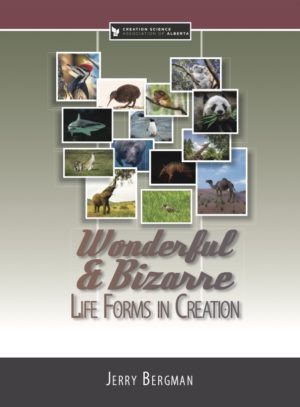
Paperback / $22.00 / 138 Pages / full colour
Discover this collection of amazing creatures that illustrate the enormous variety of God’s
creation. The selection includes some popular animals such as pandas, koala, elephant, giraffe,
camel and penguins as well as some totally weird creatures. Explore the details concerning
each creature as well as the serious problems each presents for evolution theory.
DVD / $20.00 / 84 Minutes
Not only are animals amazingly diverse, but their lifestyles are a source of wonder as well. This video share the significant challenges animals face in order to survive. The message makes nature much more meaningful for the Christian. Suitable for the whole family. Presented by Dr. Gordon Wilson.
Order Online
One family, with one child in high school, one in junior high and one in elementary school, were going to start with just one video clip from Michael Behe. The idea was, like the thin edge of the wedge, to first catch their attention. But everyone was so intrigued, that they watched all five episodes in one sitting! Read the rest of this entry »
Dr. Jerry Bergman, who needs no introduction to readers of Dialogue, is the author of a delightful new book for families and animal-lovers and all who enjoy fascinating details from nature. Readers of Dialogue, for more than fifteen years, have been blessed with little known insights into some well-known creatures. His new book Wonderful and Bizarre Life Forms and Creation is a collection of the “best of Bergman” from Dialogue plus a few completely new chapters. The twenty-three chapters present each creature with pictures and highlights. This is an attractive and well documented book in full colour, which will inspire much reflection and discussion. Many will want to buy several copies, one for personal use, and others for those special people in their lives! Read the rest of this entry »
Order OnlineCreation Science Association of Albert is delighted to present David Coppedge as the featured speaker for our Creation Weekend 2020. Due to the COVID 19 restrictions, Creation Weekend will be a one evening online event this year. David Coppedge was exceptionally well received with his presentations in Edmonton in 2012. Now in 2020, his return promises another tour de force with a presentation entitled Creation is Awe Inspiring! This event will take place on Friday evening, October 23, 2020 at 7:30 pm. To participate in this session, register at www.create.ab.ca/register. Once you register you will receive a confirmation email, and closer to the event you will receive an email with further details. Read the rest of this entry »
Pterosaurs (Greek pteron and sauros, meaning “wing lizard”) are constructed from a combination of the characteristics of mammals, birds and dinosaurs with one of the weirdest looking beaks possible added on. This example points to the problem of taxonomy, the science of classifying life. Pterosaurs fly like birds and can flap their “wings” like a bird. They also can soar like an eagle using bat-like wings made from a flap of skin stretched between their body and a long fourth finger called the wing finger. They also have many body traits like dinosaurs. For this reason, they are often referred to as flying dinosaurs, or dragons of the air (Unwin, 2006, p. 2). Ironically, they are classified as reptiles likely because birds supposedly evolved after them.
Pterosaurs were first discovered in 1784 in the German Solnhofen limestone quarries. This is the same location where another strange creature, Archaeopteryx, originally identified as a pterosaur, was found (Clarey, 2015, p. 66). Twenty-nine pterosaur species, over 26% of the 110 pterosaur species currently known (in about 85 genera), have been found in Solnhofen limestone quarries alone.
It was a surprise to read in the September 17 issue of Nature1 that fruit flies have some interesting things to teach us in the field of technological applications of extremely thin protective coatings.
For this story, we focus on their beautiful red eyes. Like all insects, fruit flies have compound eyes consisting of multiple miniature light receptors which focus on one spot at the back of the eye. We immediately notice that these compound eyes tend to bulge outward, or at least they are highly exposed. There are no eyelids to protect them from damage and/or to protect them from glare. It was back in the 1960s and 1970s that biologists began to notice that insect eyes seem to have some protection after all. Depending upon the lifestyle of the insect, their eyes seem to have anti-reflective or anti-adhesive protection. An anti-reflective coating allows more light to be transmitted through a transparent layer than would normally occur. And an anti-adhesion coating repels water from such a surface. Read the rest of this entry »
FEATURED BOOKS AND DVDS
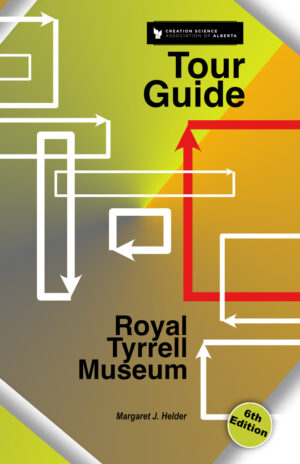

Paperback / $6.00 / 55 Pages
It was a surprise to read in the September 17 issue of Nature1 that fruit flies have some interesting things to teach us in the field of technological applications of extremely thin protective coatings.
For this story, we focus on their beautiful red eyes. Like all insects, fruit flies have compound eyes consisting of multiple miniature light receptors which focus on one spot at the back of the eye. We immediately notice that these compound eyes tend to bulge outward, or at least they are highly exposed. There are no eyelids to protect them from damage and/or to protect them from glare. It was back in the 1960s and 1970s that biologists began to notice that insect eyes seem to have some protection after all. Depending upon the lifestyle of the insect, their eyes seem to have anti-reflective or anti-adhesive protection. An anti-reflective coating allows more light to be transmitted through a transparent layer than would normally occur. And an anti-adhesion coating repels water from such a surface. Read the rest of this entry »
Order Online

Paperback / $10.00 / 111 Pages / full colour
It was a surprise to read in the September 17 issue of Nature1 that fruit flies have some interesting things to teach us in the field of technological applications of extremely thin protective coatings.
For this story, we focus on their beautiful red eyes. Like all insects, fruit flies have compound eyes consisting of multiple miniature light receptors which focus on one spot at the back of the eye. We immediately notice that these compound eyes tend to bulge outward, or at least they are highly exposed. There are no eyelids to protect them from damage and/or to protect them from glare. It was back in the 1960s and 1970s that biologists began to notice that insect eyes seem to have some protection after all. Depending upon the lifestyle of the insect, their eyes seem to have anti-reflective or anti-adhesive protection. An anti-reflective coating allows more light to be transmitted through a transparent layer than would normally occur. And an anti-adhesion coating repels water from such a surface. Read the rest of this entry »
Order Online
Hardcover / $18.00 / 117 Pages / Full colour
It was a surprise to read in the September 17 issue of Nature1 that fruit flies have some interesting things to teach us in the field of technological applications of extremely thin protective coatings.
For this story, we focus on their beautiful red eyes. Like all insects, fruit flies have compound eyes consisting of multiple miniature light receptors which focus on one spot at the back of the eye. We immediately notice that these compound eyes tend to bulge outward, or at least they are highly exposed. There are no eyelids to protect them from damage and/or to protect them from glare. It was back in the 1960s and 1970s that biologists began to notice that insect eyes seem to have some protection after all. Depending upon the lifestyle of the insect, their eyes seem to have anti-reflective or anti-adhesive protection. An anti-reflective coating allows more light to be transmitted through a transparent layer than would normally occur. And an anti-adhesion coating repels water from such a surface. Read the rest of this entry »
Order Online
Paperback / $10.00 / 192 Pages / Full colour
It was a surprise to read in the September 17 issue of Nature1 that fruit flies have some interesting things to teach us in the field of technological applications of extremely thin protective coatings.
For this story, we focus on their beautiful red eyes. Like all insects, fruit flies have compound eyes consisting of multiple miniature light receptors which focus on one spot at the back of the eye. We immediately notice that these compound eyes tend to bulge outward, or at least they are highly exposed. There are no eyelids to protect them from damage and/or to protect them from glare. It was back in the 1960s and 1970s that biologists began to notice that insect eyes seem to have some protection after all. Depending upon the lifestyle of the insect, their eyes seem to have anti-reflective or anti-adhesive protection. An anti-reflective coating allows more light to be transmitted through a transparent layer than would normally occur. And an anti-adhesion coating repels water from such a surface. Read the rest of this entry »
Order Online