

Dinosaurs


I joined the Creation Research Society in 2023 because God put a desire in my heart to do research and publish technical papers. My undergraduate science degree has no major, and I’ve received some criticism for that, but the program I enrolled in allowed me to try a bit of everything and get a well-rounded base of scientific knowledge. Then God gave me a job where I have the freedom to do the things I love. I needed some intellectual stimulation, though, so I told God, “I need some science I can sink my teeth into.” In September 2024, He answered by handing me a paleoanthropology assignment and connecting me to a co-author, Carol Adams. We decided to attend the 2025 CRS Conference at the end of July, and Carol suggested that we submit an abstract and present our work.
Read the rest of this entry »

“Beyond the Bare Bones” is the theme of CSAA’s Creation Weekend October 15 and 16, 2010 with palaeontologist Dr. Marcus Ross. All the events will take place at Mill Woods Assembly, 66 Street and 23 Avenue in Edmonton. Read the rest of this entry »
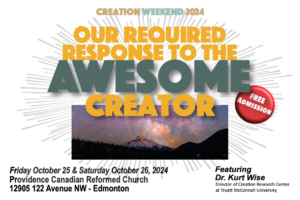
For many years, in sponsoring Creation Weekend, our local association (CSAA or Creation Science Association of Alberta) has provided inspiration and information to audiences of all ages. The benefit from these weekends is training on how to be informed and enthusiastic, able to enjoy the insights that we hear, and to share those with others.
Read the rest of this entry »
Challenges, Motivation and Hope
Featuring
Dr. Brian Thomas
Research Scientist at the Institute for Creation Research, Dallas, Texas
Location:
Providence Canadian Reformed Church
12905 122 Avenue NW Edmonton, AB
SCHEDULE
Friday, Oct 24 @ 7:00 p.m.
Fresh Fossils from Four Continents
(especially family friendly) Have you heard about the blood vessels from dinosaur bones? It turns out that’s just the beginning of fresh features from all kinds of fossils. In this presentation, Dr. Thomas explains how we can know that these proteins are relatively young and how these exciting new finds fit with the Bible’s history of the world.
Saturday, Oct 25 @ 10:00 a.m.
The Beginning of Life
(design features extraordinaire) Using information you won’t find in secular biology textbooks, Dr. Thomas demonstrates the complete failure of natural processes to explain how life began. He critiques evolutionary speculations about the beginning of life and illustrates engineered precision in cellular machines that credit the Creator, not nature, with creating life.
Saturday, Oct 25 @ 11:30 a.m. – 12:15 p.m.
Annual General Meeting
Saturday, Oct 25 @ 12:15 p.m. – 1:15 p.m.
Noon Break
Saturday, Oct 25 @ 1:15 p.m.
How Creatures Adapt
(why Darwin’s explanatons don’t work) New studies into the nuts and bolts of creature adaptation keep refuting Charles Darwin’s old ideas about how creatures change. From finches to fishes, stunning animal adaptations revel new hallmarks of handiwork.
Free Admission
www.create.ab.ca
In the early years of the existence of Creation Science Association of Alberta, CSAA brought in many excellent speakers from the Institute for Creation Research. All these speakers were scientists with excellent experience and credentials. These included biochemist Dr. Duane Gish, geologist Dr. Steve Austin and biologist Dr. Gary Parker. In more recent years, ICR moved from California to Texas and set about becoming established in a new region. Now once again, CSAA is delighted that one of ICR’s research scientists, Dr. Brian Thomas, has agreed to be our featured speaker for Creation Weekend on October 24 and 25, 2025. The sessions are scheduled to take place at Providence Canadian Reformed Church which hosted the event in spectacular fashion in October 2024 (12905 122 Avenue NW in Edmonton).
Read the rest of this entry »It’s not hard to imagine the scene. A lush forest crowds the shores of a glittering lake. Chicken-sized birds perch on tree branches or fly ponderously over the lake. Smaller birds also perch or flit joyously hither and thither through the sky. A frisky bipedal (runs on two feet) dinosaur pursues its own agenda in the adjacent woods. One consumes a small sharp-toothed little mammal, perhaps a type of rodent. Insects buzz lazily over the lake while fish and various tiny crustaceans lurk in the watery depths. It all seems so placid. What could mar this moment? Read the rest of this entry »
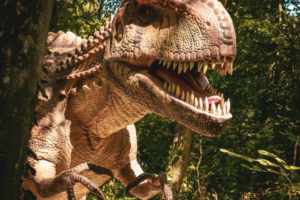
Most youngsters are enthusiastic about dinosaurs such as Stegosaurus, Triceratops and the gigantic four-footed sauropods like Camarasaurus. However, of course, it is T. rex that everybody loves! But grown up scientists (palaeontologists) love T. rex too. Many have published studies on this dinosaur. These works include ideas about species diversity, ecological networks, biogeography and other issues such as what caused the extinction of dinosaurs.
Read the rest of this entry »Since the early 1990s, the Creation Science Association has published an alternative tour guide to the Royal Tyrrell Museum in Drumheller, Alberta. This world class facility was built in large part to display fossils from western Canada, and particularly Alberta. Also a few fossils from the western United States are on display.
The museum has re-invented its displays many times over the years, probably in an effort to maintain public interest. Certainly there are a lot of interesting new fossil finds now on display. Initially many fossilized marine animals without backbones were on display as well as large land (and marine) reptiles. Now most of the beautiful marine creatures are gone. Also a large simulated scene at the far end of the Great Dinosaur Hall has long since been replaced by a presentation on horned dinosaur diversity and relationships. Read the rest of this entry »
Secular scientists usually do not like to mention discoveries or achievements of people who support Biblical creation. Recently however, some creation supporters have come to the attention of many scientists and even the secular media.
Mark Armitage, for example, recently published an article on soft un-fossilized tissue in one of the largest Triceratops horns ever found in Montana. Mr. Armitage had found the dinosaur fossil himself in 2012. Then in February 2013 he, along with biologist Kevin Lee Anderson of Arkansas State University-Beebe, published a technical article on this find in a mainstream European scientific journal Acta Histochemica (115, 603-608, 2013). Entitled “Soft sheets of fibrillary bone from a fossil of the supraorbital horn of the dinosaur Triceratops horridus.” The article established this find as “the first report of sheets of soft tissues from Triceratops horn bearing layers of osteocytes [bone forming cells], and extends the range and type of dinosaur specimens known to contain non-fossilized material in bone matrix.” (p. 603) Read the rest of this entry »
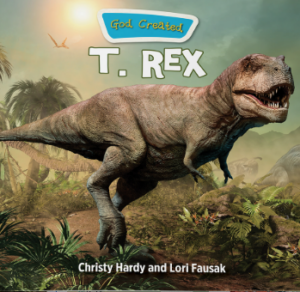

Paperback / $6.00 / 32 Pages / full colour
With imposing illustrations and clear information that young children will dive right into, this book places T. Rex clearly in the pre-flood world, and what a world it was!
Although they may have been a little slow on their feet, it seems safe to say that horned dinosaurs represent a flamboyant and fun group to discuss. Read the rest of this entry »
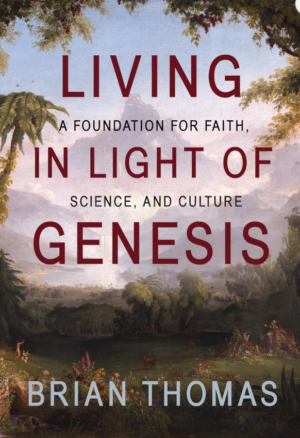
Paperback / $16.00 / 185 Pages / Black and white
This is a personal account of Dr. Brian Thomas’ spiritual and intellectual journey from non-believing science student to Christian conversion, to his intellectual struggle with Genesis, to his later career as a research scientist and communicator of the gospel and wonders of God’s creation. This account takes us to discussions of a wide variety of scientific fields, some less familiar to us than others. It totally broadens our horizons in a non-confrontational way.
Order OnlineIn Nova Scotia, as elsewhere in the Maritimes, we discover that fossils are an exciting part of the landscape. Not the least of our discoveries are the dinosaurs of Parrsboro. Dinosaurs?? We thought western Canada had exclusive claim to such Canadian artifacts. Not quite. West of Truro, along the north shore of the Minas Basin, we find the touristy town of Parrsboro. The scenery is beautiful, with blueberry crops growing on local hummocky hills. Furthermore the beaches along this stretch of coast are famous for fossils, dinosaur fossils to be specific. Read the rest of this entry »
A place where families can play and learn!
This summer during our annual family camping trip on a gloomy definitely-not-beach-weather kind of day, we discovered the DINOS (Discovery Institute of Nature, Origins and Science) Centre. When someone suggested going to a new facility with a unique combination of indoor mini-golf, laser tag, and a café, as well as a Bible History Museum and an outdoor driving range, everybody agreed! Read the rest of this entry »
Pterosaurs (Greek pteron and sauros, meaning “wing lizard”) are constructed from a combination of the characteristics of mammals, birds and dinosaurs with one of the weirdest looking beaks possible added on. This example points to the problem of taxonomy, the science of classifying life. Pterosaurs fly like birds and can flap their “wings” like a bird. They also can soar like an eagle using bat-like wings made from a flap of skin stretched between their body and a long fourth finger called the wing finger. They also have many body traits like dinosaurs. For this reason, they are often referred to as flying dinosaurs, or dragons of the air (Unwin, 2006, p. 2). Ironically, they are classified as reptiles likely because birds supposedly evolved after them.
Pterosaurs were first discovered in 1784 in the German Solnhofen limestone quarries. This is the same location where another strange creature, Archaeopteryx, originally identified as a pterosaur, was found (Clarey, 2015, p. 66). Twenty-nine pterosaur species, over 26% of the 110 pterosaur species currently known (in about 85 genera), have been found in Solnhofen limestone quarries alone.
Imagine a dinosaur being swept far out to sea. It might seem like a crazy idea, but it appears that such an event happened in many places. The story however becomes even more amazing when we learn that these victims were unusually heavy creatures for their size, the kind that would be expected to sink like a stone once they were in water over their heads. To some, the story may not come as a complete surprise however. Way back in the dark ages, for example in the spring of 1995, an item appeared in Dialogue. In part, it ran as follows…… Read the rest of this entry »
FEATURED BOOKS AND DVDS

Paperback / $6.00 / 55 Pages
Imagine a dinosaur being swept far out to sea. It might seem like a crazy idea, but it appears that such an event happened in many places. The story however becomes even more amazing when we learn that these victims were unusually heavy creatures for their size, the kind that would be expected to sink like a stone once they were in water over their heads. To some, the story may not come as a complete surprise however. Way back in the dark ages, for example in the spring of 1995, an item appeared in Dialogue. In part, it ran as follows…… Read the rest of this entry »
Order Online
Paperback / $10.00 / 111 Pages / full colour
Imagine a dinosaur being swept far out to sea. It might seem like a crazy idea, but it appears that such an event happened in many places. The story however becomes even more amazing when we learn that these victims were unusually heavy creatures for their size, the kind that would be expected to sink like a stone once they were in water over their heads. To some, the story may not come as a complete surprise however. Way back in the dark ages, for example in the spring of 1995, an item appeared in Dialogue. In part, it ran as follows…… Read the rest of this entry »
Order Online
Hardcover / $18.00 / 117 Pages / Full colour
Imagine a dinosaur being swept far out to sea. It might seem like a crazy idea, but it appears that such an event happened in many places. The story however becomes even more amazing when we learn that these victims were unusually heavy creatures for their size, the kind that would be expected to sink like a stone once they were in water over their heads. To some, the story may not come as a complete surprise however. Way back in the dark ages, for example in the spring of 1995, an item appeared in Dialogue. In part, it ran as follows…… Read the rest of this entry »
Order Online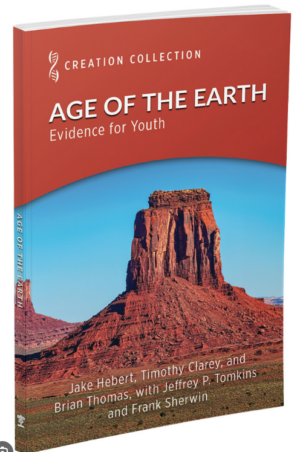
Paperback / $10.00 / 192 Pages / Full colour
Imagine a dinosaur being swept far out to sea. It might seem like a crazy idea, but it appears that such an event happened in many places. The story however becomes even more amazing when we learn that these victims were unusually heavy creatures for their size, the kind that would be expected to sink like a stone once they were in water over their heads. To some, the story may not come as a complete surprise however. Way back in the dark ages, for example in the spring of 1995, an item appeared in Dialogue. In part, it ran as follows…… Read the rest of this entry »
Order Online