

Dinosaurs
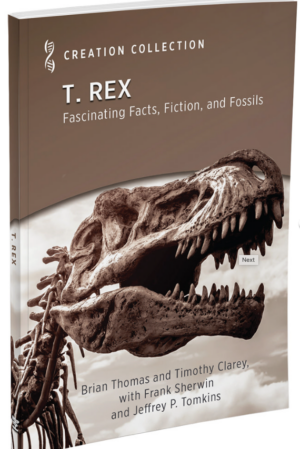

Paperback / $10.00 / 173 Pages / full colour
ICR Creation Collection Series
Many members of the public are fascinated by T. rex, the fossil dinosaur that is large, ugly and rare! Apparently, there is an astonishingly wide variety of studies devoted to this creature. The interesting news is that these studies better fit the creation model and flood geology than any evolutionary speculations. Among the issues discussed are lack of T. rex ancestors (which would be needed for figuring out lines of descent, if any); unfossilized material in their bones (suggesting recent age), no feathers (suggested bird descent from dinosaurs is all wrong); and mixed marine and freshwater sediments connected with T. rex fossils (suggesting flood geology). There are ample illustrations in this booklet which is written for the interested adult.
Order Online
Creation Weekend 2021’s on-line conference with paleontologist Dr. Marcus Ross was so dynamic and interesting that it seemed as if we had heard him in person. I found myself thinking about his return trip to Virginia. But, of course, he never left Virginia. Nevertheless, with the wonders of technology, Dr. Ross was able to present two excellent and very different topics. Since his field of expertise is fossils, his whole first presentation dealt with fossils, specifically some scary marine reptiles called mosasaurs. The second talk dealt with the objectives of creationists in their pursuit of science.
In the Royal Tyrrell Museum’s spooky Bearpaw Sea exhibit, if you look up, you will see the skeletons of massive marine reptiles including mosasaurs. Dr. Ross actually came as a student to study Alberta mosasaurs at the Tyrrell Museum. Read the rest of this entry »

Marcus Ross has loved paleontology, and especially dinosaurs, since he was a kid growing up in Rhode Island. His twin passions of Christianity and science have provided some amazing opportunities along the way!
Marcus began his formal studies in geology at the Pennsylvania State University, where he earned a B.S. in Earth Science. It was there that he also began his early work in creation science, writing articles and leading a student creation club on campus. Following graduation, he continued his studies with a M.S. in Vertebrate Paleontology from the South Dakota School of Mines and Technology and later a Ph.D. in Environmental Science (Geoscience) from the University of Rhode Island. His dissertation research focused on the fossil record of mosasaurs, a group of large marine-dwelling lizards known from upper Cretaceous rocks around the world. Read the rest of this entry »

Have you ever wished that you could rewrite an event in your life? It happens to all of us once in a while, of course. However the results are a little worse when something has been published. It’s harder to imagine that the event never happened. Thus it was in 1999 that some palaeontologists positioned themselves far out on a limb (metaphorically speaking), and in early 2000 somebody cut the branch off. Oooops…… Read the rest of this entry »
Have you heard the sad story of the dinosaurs that succumbed to a watery catastrophe? Most young people in our province have heard the story of the Centrosaurus herd in Dinosaur Provincial Park. No doubt it would take quite some force to sweep huge, four-footed horned dinosaurs off their feet. The Centrosaurus dinosaurs of Alberta were only moderately large compared to some other horned designs such as Triceratops. Centrosaurus, for their part, were about 5 m (16 ft) long and perhaps 2.5 m (8 ft) tall. But they were certainly chunky and heavy. Read the rest of this entry »
Dinosaurs are such showy, dramatic creatures, and their fossils are found in such variety that they have naturally attracted a lot of attention from scientists and the public alike. The question “where did they come from?” has attracted a lot of attention from specialists who seek an evolutionary answer. Nevertheless, a recent article on the topic remarks that relationships (lines of evolutionary descent) between the major groups of dinosaurs have historically been uncertain. Why would that be? Have we seen any improvement in this situation with new analyses? [David Cerny and Ashley L. Simonoff. 2023. Statistical evaluation of character support reveals the instability of higher-level dinosaur phylogeny. Nature https://doi.org/10.1038/s41598-023-35784-3 (2023) 13:9273 open access]
Read the rest of this entry »
We don’t often think that extinct animals might have been examples of wonderful design, but they were! Even if we did reflect on extinct animals which were particularly well designed, we probably would not choose sauropod dinosaurs for that special category. Sauropod dinosaurs, you may remember, were the large plodding, four-footed specimens with long necks and long tails. They were probably the largest animals ever to have lived on land. They all grazed on plants. This was no doubt a good thing, since they probably were too slow to catch anything. So, you may well ask, what could be so special about these awkward looking creatures? Plenty! Read the rest of this entry »
It is interesting how dinosaur artifacts continue to amaze us. For example, in 1961, petroleum geologist R. L. Liscomb discovered a large bone bed on the banks of the Colville River in Alaska, not far from the Arctic Ocean. Since the bones were not perminieralized (fossilized), he assumed they were recent bison bones. He deposited some in a museum and for twenty years nobody gave the bones another thought. Then somebody noticed that these were Edmontosaurus bones (duckbill dinosaur). In 1985 palaeontologist William A. Clemens reported abundant dinosaur bones at the Liscomb site and in 1987 associate Kyle L. Davies described the condition of the dinosaur bones: “The quality of preservation is remarkable. The bones are stained a dark red brown but otherwise display little permineralization, crushing or distortion.” (J. Paleontology 61 #1 p. 198). Could such bones really be millions of years old as many scientists now supposed?

New Tour Guide – Available Now!
Since the early 1990s, CSAA has produced five editions of a Tour Guide to the Royal Tyrrell Museum. Unlike other guides to similar facilities, this guide includes discussion of most exhibits as they are encountered on a trip through the premises. The fifth and last edition was issued in 2014. It clearly is time for a new edition as there have been many changes since then.
Our guide typically begins with interpretive themes which apply to many of the exhibits. This feature will not change in the new edition. What has changed, is discussion of the preliminary exhibits which occupy about half the space available in the museum. The changes include displays up to the Burgess Shale on the mezzanine.
Read the rest of this entry » Order Online
Paperback / $6.00 / 55 Pages
When you visit this museum, be sure to go armed with this booklet. It highlights interesting details and fascinating insights concerning the displays in the museum. All commentary in the booklet is from a creation-based perspective. This guide comes complete with a map of the major exhibits in the museum.
This handy booklet highlights fascinating insights to the displays in the museum. Dinosaurs and
marine reptiles are on display as expected, but there is also a large section which provides
arguments for evolution. This guide provides answers to the arguments and fascinating details
concerning the dinosaurs and other fossils. This guide comes complete with a map of the major
exhibits in the museum.
Shipping cost for one copy is only $2.
Enclosed with this guide is a list of topics you can search on HeadStart our online resource that provides more detailed discussion of some related and important issues such as origin of life arguments, and evolution related topics like the geological column, rock record, fossils (what are they?), Cambrian explosion, extinct Alberta creatures (mostly marine reptiles) and dinosaurs (a separate topic).
Naturally one can only absorb limited amounts of information as one proceeds through the museum. However, the guide also serves as a briefing source of further insights once one has left Drumheller.
The Tour Guide is now available as a free downloadable eBook in epub format.
For those who plan in advance, a paper copy of the Tour Guide is totally reliable, with no concern about your battery life or other distractions!
Order Online
One of the pleasures of staffing a book table are the conversations that happen with people looking at the resources. On many occasions, individuals have requested an introduction to creation. Before responding, I have often inquired what the person’s interests are. If the person is interested in physics and mathematics, or in apologetics, there might be little point in showing them a work on fossils, for example. In the 1970s and 1980s, there were general introductory books like Scientific Creationism and What is Creation Science? But that was then, and this is now. There are many areas of science that were not even contemplated then, but which we have to deal with today. The good news now is that some general introductory works have appeared which can be very helpful to many people seeking insights into the issues. Read the rest of this entry »
Have you ever tried to imagine what a world without grasses would look like? The scenery might well be pretty bleak. Scientists have long declared that there were no grasses present in dinosaur communities. The plant-eating dinosaurs had to make do, we have been assured, with cycads, ferns, horsetails and trees of flowering plants such as palms and magnolias. Read the rest of this entry »
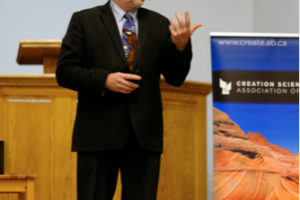
The people who came to Creation Weekend, October 25 and 26, 2024 were greatly impressed by Dr. Kurt Wise’s passion, depth of information and quality of his arguments. His topics ranged firstly from the nature of dinosaur fossils and what these tell us about their lives and fate, and secondly to God’s dealing with His Creation and how this impacts our estimates of the age of the universe, and thirdly how Christians can interact with our modern society. Specifically we have no need to introduce the reality of God to anyone because everyone actually already perceives the existence of the Creator of Heaven and Earth, whether they admit it or not.
Read the rest of this entry »
Sometimes it takes a youngster to come up with an interesting question. The occasion was a lecture on dinosaurs, presented in Edmonton’s Provincial Museum on December 11, 1990. Following the main address by Dr. Philip Currie of the Royal Tyrrell Museum, an excited group of boy scouts was asking most of the questions. “Is it fun to look for fossils?” “How many dinosaurs has Dr. Currie found?” “What is the biggest fossil found in Alberta?” … Dr. Currie patiently fielded all the queries. Then one young boy asked “Did dinosaurs swim?” As Dr. Currie answered the question, it became evident that this really was an interesting topic.
Read the rest of this entry »A tiny news item caught my eye: “Creature liberated from oilsands” (Edmonton Journal November 4, 2000 G1). Apparently a rare marine fossil was found earlier this year near Fort McMurray. The oilsands are making quite a name for themselves as a source of fossils. Besides unfossilized remains of trees, excavators have turned up nine marine reptiles, mostly plesiosaurs, from the oilsands. One of the earlier specimens, like the recent find, was identified as an ichthyosaur. Read the rest of this entry »
FEATURED BOOKS AND DVDS
Paperback / $6.00 / 55 Pages
A tiny news item caught my eye: “Creature liberated from oilsands” (Edmonton Journal November 4, 2000 G1). Apparently a rare marine fossil was found earlier this year near Fort McMurray. The oilsands are making quite a name for themselves as a source of fossils. Besides unfossilized remains of trees, excavators have turned up nine marine reptiles, mostly plesiosaurs, from the oilsands. One of the earlier specimens, like the recent find, was identified as an ichthyosaur. Read the rest of this entry »
Order Online
Paperback / $10.00 / 111 Pages / full colour
A tiny news item caught my eye: “Creature liberated from oilsands” (Edmonton Journal November 4, 2000 G1). Apparently a rare marine fossil was found earlier this year near Fort McMurray. The oilsands are making quite a name for themselves as a source of fossils. Besides unfossilized remains of trees, excavators have turned up nine marine reptiles, mostly plesiosaurs, from the oilsands. One of the earlier specimens, like the recent find, was identified as an ichthyosaur. Read the rest of this entry »
Order Online
Hardcover / $18.00 / 117 Pages / Full colour
A tiny news item caught my eye: “Creature liberated from oilsands” (Edmonton Journal November 4, 2000 G1). Apparently a rare marine fossil was found earlier this year near Fort McMurray. The oilsands are making quite a name for themselves as a source of fossils. Besides unfossilized remains of trees, excavators have turned up nine marine reptiles, mostly plesiosaurs, from the oilsands. One of the earlier specimens, like the recent find, was identified as an ichthyosaur. Read the rest of this entry »
Order Online
Paperback / $10.00 / 192 Pages / Full colour
A tiny news item caught my eye: “Creature liberated from oilsands” (Edmonton Journal November 4, 2000 G1). Apparently a rare marine fossil was found earlier this year near Fort McMurray. The oilsands are making quite a name for themselves as a source of fossils. Besides unfossilized remains of trees, excavators have turned up nine marine reptiles, mostly plesiosaurs, from the oilsands. One of the earlier specimens, like the recent find, was identified as an ichthyosaur. Read the rest of this entry »
Order Online