

Biology


In high school biology courses, it soon became apparent to Angie that among her fellow Christians, there was a diversity of opinions about origins. So, she consulted the HeadStart program about the impact of world views on the relationship between faith and science. She read information on the gap theory, the day age theory, the framework hypothesis, theistic evolution, neo-Darwinism, methodological naturalism, intelligent design and creation. Now she better appreciates why this whole website is devoted to creation.
Read the rest of this entry »

It was a surprise to read in the September 17 issue of Nature1 that fruit flies have some interesting things to teach us in the field of technological applications of extremely thin protective coatings.
For this story, we focus on their beautiful red eyes. Like all insects, fruit flies have compound eyes consisting of multiple miniature light receptors which focus on one spot at the back of the eye. We immediately notice that these compound eyes tend to bulge outward, or at least they are highly exposed. There are no eyelids to protect them from damage and/or to protect them from glare. It was back in the 1960s and 1970s that biologists began to notice that insect eyes seem to have some protection after all. Depending upon the lifestyle of the insect, their eyes seem to have anti-reflective or anti-adhesive protection. An anti-reflective coating allows more light to be transmitted through a transparent layer than would normally occur. And an anti-adhesion coating repels water from such a surface. Read the rest of this entry »
Hippopotamus, called hippos, are monstrous, mostly herbivorous, semiaquatic mammals native to most of Africa. Only in the Sahara Desert are they not found. Their origins have always been a problem for evolution because they are like no other living animal. Only two extant species exist, the Nile hippo (Hippopotamus amphibius), and the pygmy hippopotamus (Choeropisi liberiensis). During the daytime they are aquatic, floating in the water world, and at the nighttime they are land animals consuming mostly grasses, soft plants, and some succulent fruit. (Macdonald,1987, p. 507) They were named from the Greek words for river horse. Read the rest of this entry »

The media are full of accounts of how people have used their unexpected “down time” at home during the COVID pandemic. What we chose, be it bread baking or house-cleaning or crafts or whatever, obviously reflected personal preference. As far as I was concerned, this time was a golden opportunity to do some extra scientific reading. It all began with an article in Nature that promoted an ancestral relationship for red seaweeds with an organism that was the exact opposite of all the features in red seaweeds. Perhaps I lack imagination but I could not believe that this prestigious journal had indeed published such an argument. It seemed hilarious to me. Read the rest of this entry »
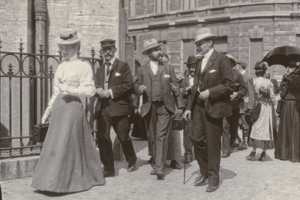
Some scientific words come from what was originally everyday language, but the concept has long been almost forgotten. Take the word ‘chaperone’ for example. Until recent times, a chaperone was a respectable mature lady who needed to be present on any social occasion to ensure that courting couples conducted themselves in a sedate and appropriate fashion. That certainly sounds old fashioned, doesn’t it? There was even a play written, called Charley’s Aunt, by Brandon Thomas (about 1890), that lampooned the efforts of two young Englishmen to entertain some young ladies to tea. In order to do this, they needed a chaperone to be present. They therefore persuaded another male friend to masquerade as a rich aunt from Brazil so that the tea party could take place. Hilarious escapades and disasters followed (including the real aunt showing up).
Read the rest of this entry »
Understanding genetics was so straightforward back in the good old days. I am not sure when those days were, but our picture of control systems in our bodies was easier when obvious stretches of DNA, called genes, were believed to control specific traits like eye colour and blood type. It used to be that we talked about genes and ‘junk DNA’. Now there are genes and there are control systems. It was the use of supercomputers which changed our understanding of how the human genome works.
Read the rest of this entry »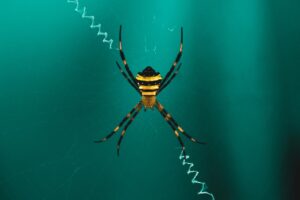
Many people are afraid of spiders, but they are excellent examples of God’s engineering design in nature, especially in the production and use of their silk. Spider silk starts as a “liquid crystal”—a highly concentrated water-based solution containing rod-shaped molecules. This means it both flows like a liquid and has its molecules oriented and ordered like a crystal. The silk solution is produced and stored in a group of silk glands until it is drawn out through the silk ducts for use. Evolutionists cannot decide whether the liquid crystal structure is an “accident of Nature” or a necessary requirement, but they think it may help to control crystallization. If the silk crystallized prematurely, it would block the ducts and kill the spider. (De Luca & Rey) Creationists would call it a design feature.
Read the rest of this entry »
Paperback / $10.00 / 138 Pages
This title is in a new series of small books from ICR entitled Creation Collection. Written at the introductory level, this book not only discusses supposed fossil evidence concerning human ancestors, but also that our DNA differs significantly from apes, is not “junk”, and that human chromosome #2 never came from apes.
Order OnlineImagine that you love solving practical problems like how to build something with straws which will support some weight. No doubt your design will be better than those of your friends and/or siblings!
Well here is a challenge that is fun to think about but difficult to solve. Imagine that you are presented with 600 feet (19000 cm) of shoelace. You are also presented with some small sheets of plastic, each cut into an appropriate shape so that they form a hollow icosahedral container when assembled together. Your assignment is to get the shoe lace into the container! Read the rest of this entry »
One of the most popular mammals is the lovable and cuddly koala. Its appearance has given rise to calling them bears, often teddy bears and, although they are not bears but rather marsupials, the name has stuck. Their fluffy ears, large spoon-shaped nose, round body and bright button eyes make them appealing to everyone. Read the rest of this entry »
“Strange is this little creature, because the whole organisation of his body is extraordinary and strange and because his external appearance, at the first sight, has the closest similarity to a little bear. This also led me to give him the name little water bear” (cited in Greven 2015).
Read the rest of this entry »This is one part nature documentary and one part evolutionary takedown. Illustra Media understand that a great way to expose evolution is to take a close in-depth look at some of the creatures that God has made. In Darwin’s day scientists didn’t have the ability to look inside the cell, and only had a glimmering of how incredibly complex even the simplest living creatures are. Now we know so much more – it turns out that even the simplest cell in our body has astonishingly complex and coordinated inner workings. Some have compared the complexity of a cell to the complexity of an entire city!
During his second lecture at Creation Weekend 2018, Dr. Gordon Wilson stimulated our appreciation of the creation with his presentation entitled “The Magnificence of the Mundane” The words in the title, he pointed out, are actually contradictory. While the word “magnificence” communicates excitement, the term “mundane” suggests that something is boring or dull. But what he wanted to share with us is that God’s work in creation is amazing, displaying God’s wisdom and finesse (Ps. 104:24). And in this context, we are told that King Solomon, full of wisdom, spoke about trees, herbaceous plants, beasts, birds, reptiles and fish (I Kings 4:33). Read the rest of this entry »
Manatees (family Trichechidae, genus Trichechus), often called sea cows, are large, fully aquatic, mostly herbivorous marine mammals. Three living species exist, the Amazonian, West Indian, and the West African manatee. These are huge animals weighing from 400 to 550 kilograms (880 to 1,210 lb), and 2.8 to 3.0 metres (9.2 to 9.8 ft) long. The females tend to be both larger and heavier.
In many ways manatees are unique compared to all other life forms, a fact that poses major problems for evolutionists. It is almost like a designer selected their traits from a wide variety of existing life forms, from reptiles to fish to mammals. For example, manatees feed almost entirely on aquatic plants and that is “unique among living marine mammals” (Berta, 2012. Return to the Sea: The Life and Evolutionary Times of Marine Mammals. University of California Press. Berkeley p. 127). Read the rest of this entry »
There is nothing like problem solving to keep one mentally alert. Some people might say that the study of nature is a form of problem solving and so it is. Collecting information is only half the battle. The real challenge is to try to explain the data. Read the rest of this entry »
FEATURED BOOKS AND DVDS

Paperback / $6.00 / 55 Pages
There is nothing like problem solving to keep one mentally alert. Some people might say that the study of nature is a form of problem solving and so it is. Collecting information is only half the battle. The real challenge is to try to explain the data. Read the rest of this entry »
Order Online

Paperback / $10.00 / 111 Pages / full colour
There is nothing like problem solving to keep one mentally alert. Some people might say that the study of nature is a form of problem solving and so it is. Collecting information is only half the battle. The real challenge is to try to explain the data. Read the rest of this entry »
Order Online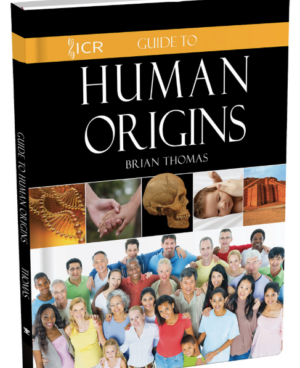
Hardcover / $18.00 / 117 Pages / Full colour
There is nothing like problem solving to keep one mentally alert. Some people might say that the study of nature is a form of problem solving and so it is. Collecting information is only half the battle. The real challenge is to try to explain the data. Read the rest of this entry »
Order Online
Paperback / $10.00 / 192 Pages / Full colour
There is nothing like problem solving to keep one mentally alert. Some people might say that the study of nature is a form of problem solving and so it is. Collecting information is only half the battle. The real challenge is to try to explain the data. Read the rest of this entry »
Order Online