

Astronomy
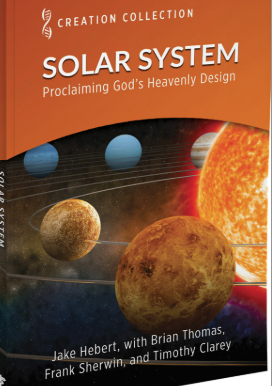

Paperback / $10.00 / 160 Pages / full colour
The solar system is not the simple picturesque grouping of planets around the sun that we like to imagine. There are many complicated details concerning the planets and their moons. At first glance, the solar system appears young. However, many scientists try to explain all this in terms of long ages. Hebert and colleagues however demonstrate how compelling are our conclusions of recent creation. Why not arm yourself with interesting discussions, details and testimony of the Biblical record?
Order Online
Everyone knows that there are amazing phenomena in the natural world which are totally unexpected. Consider, for example, the male horseshoe crab whose eyes are one million times more sensitive to light at night than during the day. Shakespeare referred to such situations when he had Hamlet declare: “There are more things in heaven and earth, Horatio, then are dreamt of in your philosophy.” (Act 1 Scene 5)
In that context, would you believe that there is a night flying moth that migrates long distances using the night sky for its navigation system? Let’s see what that moth would need to achieve this:
Read the rest of this entry »

While secular astronomers and cosmologists agree that the universe is beautiful, they mean something altogether different from mere appearance of celestial objects. What the scientists appreciate is elegant mathematical equations. They care very little about actual bodies out in space. However, the relationship of mathematics to the universe is a matter of assumption. Read the rest of this entry »
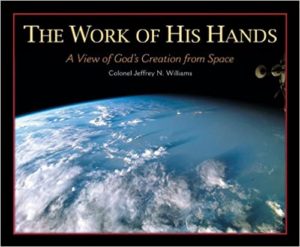
Hardcover / $35.00 / 176 Pages / Full colour
The author describes his six-month tour of duty in the International Space Station in 2006. We learn the
story of Expedition 13 from his perspective as flight engineer. The pictures which he took from the ISS
give us a front row seat on the view below. Enjoy his interesting text and numerous pictures of specific locations on Earth. In this context, Col Williams declares that space itself demonstrates the greatness
and power of God.
It is easy to imagine the excitement astronomers felt when the telescope was invented early in the seventeenth century. Until that time, mankind’s observations had been confined to five bright planets, moving against a starry background. Nevertheless 150 more years passed until another planet was discovered. In England in 1781, German-born musician and telescope maker, Sir William Herschel, announced that he had discovered a new planet. This body was named Uranus after the most ancient of the Greek gods. Read the rest of this entry »
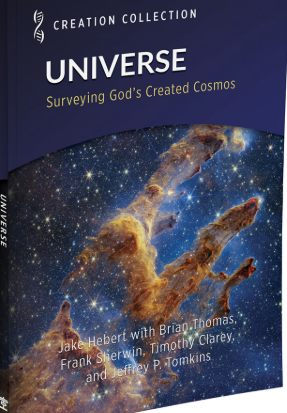
Paperback / $10.00 / 169 Pages / full colour
Creation Collection Series
Scientists use fancy technology to glean information from the night sky. A lot of information has been obtained, and all of it is interpreted in terms of very long ages, but Jake Hebert demonstrates that challenges to the Biblical record are based on questionable interpretations. Dr. Hebert works with impressive data and demonstrates that we should celebrate the wonders of the created universe.
Order Online
One of the pleasures of staffing a book table are the conversations that happen with people looking at the resources. On many occasions, individuals have requested an introduction to creation. Before responding, I have often inquired what the person’s interests are. If the person is interested in physics and mathematics, or in apologetics, there might be little point in showing them a work on fossils, for example. In the 1970s and 1980s, there were general introductory books like Scientific Creationism and What is Creation Science? But that was then, and this is now. There are many areas of science that were not even contemplated then, but which we have to deal with today. The good news now is that some general introductory works have appeared which can be very helpful to many people seeking insights into the issues. Read the rest of this entry »
Launched in 1977, the two Voyager probes have seen some strange and unexpected sights as they cruised through our solar system. After passing the planets, the probes have continued outward towards the farthest reaches of the solar system. In the summer of 2012, Voyager I was now 18.2 billion km away from us, more than three times the distance between the sun and Pluto. The solar system however by definition consists not only of the planets, but of the volume in space to which the sun’s particles extend, or in other words the volume in space which is impacted by the sun. The question everybody was asking, was how long would it take Voyager I to leave the solar system and enter interstellar space? And what would Voyager find when it got to interstellar space? Read the rest of this entry »

It’s a scary place out there. Dangerous rays and strange bodies make deep space a good place to avoid. The Hubble Space Telescope (functioning since late 1993), and other observatory satellites like the Compton Gamma Ray Observatory or CGRO (launched April 5, 1991), and Rossi X-Ray Timing Explorer or XTE (launched December 30, 1995) and Beppo-SAX (launched April 20, 1996), have provided us with an information overload when it comes to the wonders of space. If each type of body in space, such as stars and galaxies, functioned in predictable ways, then astronomers might have a pretty good grasp on what is going on out there. Recent observations made with these fancy new observatories however, have revealed a plethora of unexpected and unexplained phenomena. Vast numbers of objects which should act in similar ways, all seem to be doing their own thing. Read the rest of this entry »
One of the few laws strictly adhered to in modern physics is that the speed of light is, was, and ever shall be 300,000 kilometres per second. Light represents the fastest speed attainable by anything in the universe. It is the universe’s speed limit. Nothing can exceed it. Read the rest of this entry »
Some people actually like numbers and mathematics, and some people don’t. Everybody knows that! Some people however sound positively lyrical on the subject of numbers. Dr. David Berlinsky, for example, in his book infinite ascent: a short history of mathematics (2005) describes the inexhaustible variety of natural numbers and their personalities. (Modern Library Paperback edition p. 5). He lists various demanding disciplines that mathematicians have developed. Beyond the practical and theoretical challenges that mathematics provides however are the insights into nature. As Dr. Kurt Wise pointed out in Faith, Form and Time (2002) “The universe seems to operate with mathematical precision, and natural laws have a mathematical form.” (p. 91) Astronomer Dr. Timothy Ferris elaborates on mathematics in his 1997 book The Whole Shebang: “[M]athematics [is] a codified form of logic that embodies the faith of science that nature works in a rational way.” He adds “Like all scientific theories, relativity is expressed in terms of mathematical equations-” Read the rest of this entry »
Once the heady days of the moon landings had faded into history, many people grew bored with space exploration. Some Christians even concluded that the main objectives were atheistic or evolution-based anyway, so why should we support such endeavours?
It is certainly true that the main objectives for exploration of the solar system are based on evolutionary preconceptions. According to longtime NASA scientist Dr. Robert Jastrow, exploration of the moon initially did not seem very interesting to the NASA planners. In his 1989 book Journey to the Stars, Dr. Jastrow declares that the top people at NASA “were not terribly interested in the moon at that time, in fact, from a scientific point of view they did not know it existed …” (p 12). This was certainly strange when one considers that the mandate for the fledgling organization was to launch the US into space as soon as possible, and to explore what was there. Read the rest of this entry »
It is unusual in science to find most experts anxious to destroy the reigning paradigm. This however is the situation in physics where just about everyone is anxious to “break” the “frustratingly successful standard model” (Nature September 11/08 p. 156). This model “describes every known form of matter, from individual atoms to the farthest galaxies” (p. 156) and also three of the four fundamental forces in nature. The data to develop the Standard Model were collected from fancy particle smashing experiments. One might imagine that these scientists would be pleased with such a successful model, but they are not. The mathematics behind the model does not suit their philosophical assumptions. Read the rest of this entry »
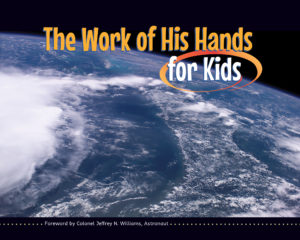
Paperback / $5.00 / 24 Pages / Full colour
Written for kids 3-10, this booklet offers photographs of Earth and space taken by Col. Jeffrey Williams
during his time in the ISS. The accompanying text provides simple sentences and Bible verses that
highlight the gospel message and God’s awesome creation.
FEATURED BOOKS AND DVDS

Paperback / $6.00 / 55 Pages
Written for kids 3-10, this booklet offers photographs of Earth and space taken by Col. Jeffrey Williams
during his time in the ISS. The accompanying text provides simple sentences and Bible verses that
highlight the gospel message and God’s awesome creation.
Paperback / $10.00 / 111 Pages / full colour
Written for kids 3-10, this booklet offers photographs of Earth and space taken by Col. Jeffrey Williams
during his time in the ISS. The accompanying text provides simple sentences and Bible verses that
highlight the gospel message and God’s awesome creation.
Hardcover / $18.00 / 117 Pages / Full colour
Written for kids 3-10, this booklet offers photographs of Earth and space taken by Col. Jeffrey Williams
during his time in the ISS. The accompanying text provides simple sentences and Bible verses that
highlight the gospel message and God’s awesome creation.
Paperback / $10.00 / 192 Pages / Full colour
Written for kids 3-10, this booklet offers photographs of Earth and space taken by Col. Jeffrey Williams
during his time in the ISS. The accompanying text provides simple sentences and Bible verses that
highlight the gospel message and God’s awesome creation.