

Astronomy
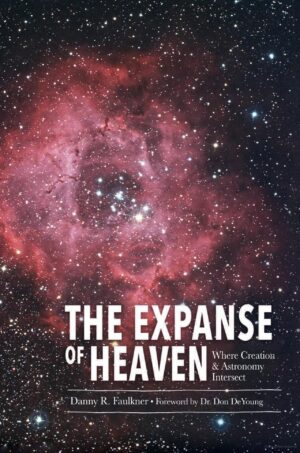

Hardcover / $26.00 / 350 Pages / full colour
The term “expanse” in the title comes from the Hebrew word raqia in Genesis. Dr. Faulkner establishes that this term represents earth’s atmosphere and everything beyond to the farthest reaches of outer space. Cosmology involves a lot of difficult concepts like distances to objects in space, but the author carefully traces the history and meaning of such terms. Readers interested in a Biblical interpretation of modern cosmology, will enjoy this book. Interestingly, he devotes a significant portion of the book to a critique of flat earth theories. Also, the analysis of the Big Bang model may be the most valuable aspect of this work.
Order Online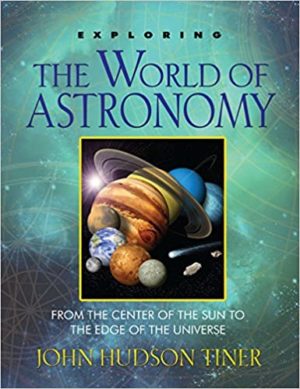

Paperback / $22.00 / 171 Pages / black and white illustrations
This book is thought provoking and interesting, but not too hard. Sometimes discussions on
astronomy involve a lot of abstract theory. Not this book. The details are worth absorbing and
good questions make for wonderful interactive learning, especially geared to junior high
students, grades 7-9.


Dr. John Byl’s keynote lecture at Creation Weekend on the evening of Saturday, October 21, 2017 was entitled “Has Science Killed God? Christianity vs. Naturalism.” Many people in our modern society, Dr. Byl declared, believe that science can explain everything, so that God is not needed. These people accept that physical laws leave no room for God. Well then, said Dr. Byl, let us evaluate this position. He began by informing us that we must distinguish between the actual facts – the observed data – and scientific theories that are constructed to explain facts. Read the rest of this entry »
Most people are at least somewhat interested in artifacts left behind by ancient civilizations. That is why tourists flock to the Mayan ruins in Mexico, or to Greece or Rome, or to Stonehenge in the south of England. Dr. Donald Chittick, a physical chemist, turned his attention to some traces of ancient civilizations and what these artifacts tell us about the people who produced them. His book The Puzzle of Ancient Man (third edition 2006) includes many interesting cases including a mechanism from ancient Greece that was in fact an analog computer. This is defined as “a device for calculating quantitative data by means of moving parts –“ (Jones 2017 p. 25). In keeping with Biblical revelation, it perfectly makes sense that the ancient peoples were very clever and inventive. But just how sophisticated was this early computer? Research conducted for more than a century, since this device was discovered in an ancient shipwreck in 1900, demonstrates that the Antikythera Mechanism was astonishingly sophisticated. (See www.create.ab.ca/ancient-computer-astounds-everybody/#more-460 ) Read the rest of this entry »
It is normal to want to be unique isn’t it? Some people however don’t want to be special. Many astronomers do not like the idea that we live at a special time in the history of the universe or in an especially nice region of space. The reason many scientists do not like any suggestion of special conditions is because such conditions lead to questions about why we live at a special time or in a special place. Special conditions suggest that events are not determined by chance, but by something else such as the supernatural power of God. Many astronomers are most anxious to avoid such suggestions. Read the rest of this entry »
German astronomer and mathematician Johann Kepler (1571 –1630) was a central figure in the 17th century scientific revolution. He was not only the founder of the physical astronomy discipline, “the first astrophysist,” and an outstanding scientist, he was also a committed Christian (Morris, 1998, p. 33; Gingerich, 1993, p. 305). Kepler is best known for discovering the three laws of planetary motion that provided a foundation for Isaac Newton’s theory of universal gravitation (Dao, 2008, p. 8). The problem that motivated the discovery of his three laws was observational astronomy did not support the circular orbit belief, and Kepler was able to determine why. Read the rest of this entry »

Book Review by Alisha Bain
Did you know that Johannes Kepler’s incredible achievements in science were influenced by his Christian faith? I learned this fact from a new book called Johannes Kepler: Exploring the Mysteries of God’s Universe by Michael Stamp and Christy Hardy. This book is in the Heroes of Creation Series and it is produced by ICR (Institute for Creation Research). This title has lots of information about space discoveries made from 1560-1630, and shares about faith and God’s creation.
This book is interesting for many different ages. I would suggest this book is especially good for anyone 9-12 years old. It has some more challenging words, but it also breaks things down and explains words or what something means with definitions throughout the book. Younger kids can read and enjoy this book too, but might need help from a parent or older sibling to understand the big or more difficult words and concepts. As well, older children can enjoy this book because it has lots of facts and cool topics such as optics findings that Kepler made that are important for us today, what Kepler discovered about ice crystals, Kepler’s 3 laws of planetary motion and more!
Read the rest of this entry »Have you ever skipped to the back of a story because you simply could not wait another minute to find out how it all ends? Planetary astronomers, in contrast, must be very patient people. Some of them have worked on a project for years, even decades before they ever begin to collect any information. The good news for curious and impatient people is that this is a particularly good time to learn new details about the planets. Read the rest of this entry »

Sometimes we encounter natural events that leave us amazed and reflecting on how beautiful the creation is that God has provided for us to enjoy. It so happened that some friends were on a plane heading to Hawaii early in June. Two years of planning had come together to allow them to be heading to Maui to celebrate a milestone in their lives. Suddenly out of the plane’s window they spotted two very bright spots of light in the night sky. This was a conjunction (apparent close approach) in the sky of the planets Venus and Jupiter. The planets were incredibly bright, and easily spotted with the naked eye. The smaller planet, Venus is about seven times brighter than Jupiter, but the latter is much larger. What a wonderful sight that was! Our friends were just days away from the best night to view this event.
Read the rest of this entry »As far as our solar system is concerned, astronomers have grown accustomed to expecting the unexpected. Certainly nobody expected liquid water spewing from a small moon of Saturn. Read the rest of this entry »
Mankind has always been fascinated by the night sky. Indeed it seems that some of the earliest recorded observations from nature were astronomical. For example, in the mid nineteenth century, English archaeologists uncovered a huge library of clay tablets in the palace of Assyrian Emperor Sennecherib of Nineveh, who lived about seven hundred years B.C. Among other clay tablets were detailed records concerning the planet Venus. It’s interesting that the pattern of appearances and absences from the sky is different from what we see today. It’s hard to say if the observations were accurate, but we do know that many of these ancients took their studies very seriously. The wise men in the gospels are a good example. Moreover an earlier document, the book of Job, mentions constellations such as the Pleiades. Read the rest of this entry »
Ever since the efforts of mankind at the tower of Babel, when the people sought to construct their own society based on their own agenda, the search for the perfect man-devised society has continued through the centuries. Indeed, since the advent of Enlightenment thinking in Europe in the eighteenth century, secular mankind has placed a particularly high value on his ability, based on reason alone, to find solutions to social problems. Recently we saw an example of this attitude in the pronouncements of Neil deGrasse Tyson, director of the Hayden Planetarium in New York City. This man is the philosophical successor of Carl Sagan who declared: “The universe is all there is, or was, or ever will be” (in his famous Cosmos series on the history of the universe). More recently Dr. Tyson has hosted a remake of Sagan’s Cosmos series for public television. Read the rest of this entry »
It seems almost too amazing to contemplate. Measured from its antennae, Pioneer 10 extends less than 3 m (9 feet) and weighs about 270 kg (570 lb.). Its power comes from four nuclear generators each of which provided only 40 watts at launch, 29 years ago. Now that spacecraft is almost 12 billion km alway (7 billion miles). Despite the immense distance and the tiny onboard power source, a message from Pioneer 10 was successfully detected on April 28/01 by a tracking station in Spain. Some people might wonder how signals from Pioneer 10 are recognized from so far away. Apparently there is a new analytical technique based on chaos theory, which may enable scientists to sift real signals out of background noise. Read the rest of this entry »
According to astronomer/author Timothy Ferris in his new book The Whole Shebang: A State of the Universe(s) Report, cosmologist Andrei Linde considers speculation on ultimate origins an excitingly “dangerous” subject. (1997 published by Simon and Schuster see p. 260) Apparently Dr. Linde sometimes wakes up wracked by doubt. Maybe all the speculations in cosmology are simply myths, with no foundation in reality at all. Author Ferris quotes Linde as remarking “Maybe actually the solution is quite aside from what we’re thinking about. It is a very dangerous feeling, this feeling that you’re not totally secure in what you’re doing.” It is one thing to have tentative views, but why should this scientist consider his to be dangerous? What or whom does he fear? Certainly fellow cosmologists have no similar scruples. A review of Dr. Ferris’ book in Astronomy magazine July 1997 p. 108 claims “His work is a tour de force, a spiral galaxy of thoughts recounted in eloquent and vibrant prose.” We are advised to “Relish its prose, ponder its implications.” Well then let’s do it. Let’s see what the implications of cosmology are for us today. Read the rest of this entry »
Most of us appreciate the word “young”, especially when it is used to describe us. However there is one class of individual that does not particularly like this adjective. These are astronomers. They don’t mind looking young themselves. However they do not want to hear about phenomena in space which appear recent or young. Many astronomers believe that our solar system is billions of years old. There should not be too many phenomena (or any) in space that are of very recent origin. Read the rest of this entry »
FEATURED BOOKS AND DVDS

Paperback / $6.00 / 55 Pages
Most of us appreciate the word “young”, especially when it is used to describe us. However there is one class of individual that does not particularly like this adjective. These are astronomers. They don’t mind looking young themselves. However they do not want to hear about phenomena in space which appear recent or young. Many astronomers believe that our solar system is billions of years old. There should not be too many phenomena (or any) in space that are of very recent origin. Read the rest of this entry »
Order Online
Paperback / $10.00 / 111 Pages / full colour
Most of us appreciate the word “young”, especially when it is used to describe us. However there is one class of individual that does not particularly like this adjective. These are astronomers. They don’t mind looking young themselves. However they do not want to hear about phenomena in space which appear recent or young. Many astronomers believe that our solar system is billions of years old. There should not be too many phenomena (or any) in space that are of very recent origin. Read the rest of this entry »
Order Online
Hardcover / $18.00 / 117 Pages / Full colour
Most of us appreciate the word “young”, especially when it is used to describe us. However there is one class of individual that does not particularly like this adjective. These are astronomers. They don’t mind looking young themselves. However they do not want to hear about phenomena in space which appear recent or young. Many astronomers believe that our solar system is billions of years old. There should not be too many phenomena (or any) in space that are of very recent origin. Read the rest of this entry »
Order Online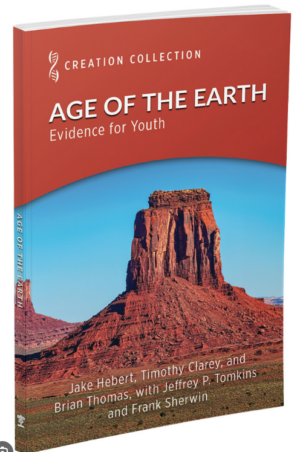
Paperback / $10.00 / 192 Pages / Full colour
Most of us appreciate the word “young”, especially when it is used to describe us. However there is one class of individual that does not particularly like this adjective. These are astronomers. They don’t mind looking young themselves. However they do not want to hear about phenomena in space which appear recent or young. Many astronomers believe that our solar system is billions of years old. There should not be too many phenomena (or any) in space that are of very recent origin. Read the rest of this entry »
Order Online