

Intermediate


The common perception of the Arctic is that it is a frozen, uninhabited wasteland. Truthfully, most of it is. Evolutionists claim it has been like this for millions of years but that there is evidence that it was warmer and wetter in the past. In 1985, Paul Tudge of the Geological Survey of Canada spotted tree stumps on the Canadian Arctic island of Axel Heiberg while conducting a helicopter survey. A year later, a team of geologists, paleobotanists, and graduate students returned and found enormous tree stumps they interpreted as being still rooted in the soil they grew in (Basinger, 1987).
Read the rest of this entry »
The people who came to Creation Weekend, October 25 and 26, 2024 were greatly impressed by Dr. Kurt Wise’s passion, depth of information and quality of his arguments. His topics ranged firstly from the nature of dinosaur fossils and what these tell us about their lives and fate, and secondly to God’s dealing with His Creation and how this impacts our estimates of the age of the universe, and thirdly how Christians can interact with our modern society. Specifically we have no need to introduce the reality of God to anyone because everyone actually already perceives the existence of the Creator of Heaven and Earth, whether they admit it or not.
Read the rest of this entry »

From time to time, CSAA adds relevant new discussions to HeadStart, our amazing information resource (headstart.create.ab.ca). While many online discussions provide definitions and current views on an issue, HeadStart typically provides the history of how this science-related discipline came to be developed and what that means for us today. For example, within the past year we have added new topics related to dinosaurs and fossils, all written at the introductory level. All these items are posted under the Investigate Further banner. These topics include dinosaurs; extinct Alberta creatures (marine reptiles); record in sedimentary rock; geological column; and fossils.
Read the rest of this entry »
Challenges, Motivation and Hope
Featuring
Dr. Brian Thomas
Research Scientist at the Institute for Creation Research, Dallas, Texas
Location:
Providence Canadian Reformed Church
12905 122 Avenue NW Edmonton, AB
SCHEDULE
Friday, Oct 24 @ 7:00 p.m.
Fresh Fossils from Four Continents
(especially family friendly) Have you heard about the blood vessels from dinosaur bones? It turns out that’s just the beginning of fresh features from all kinds of fossils. In this presentation, Dr. Thomas explains how we can know that these proteins are relatively young and how these exciting new finds fit with the Bible’s history of the world.
Saturday, Oct 25 @ 10:00 a.m.
The Beginning of Life
(design features extraordinaire) Using information you won’t find in secular biology textbooks, Dr. Thomas demonstrates the complete failure of natural processes to explain how life began. He critiques evolutionary speculations about the beginning of life and illustrates engineered precision in cellular machines that credit the Creator, not nature, with creating life.
Saturday, Oct 25 @ 11:30 a.m. – 12:15 p.m.
Annual General Meeting
Saturday, Oct 25 @ 12:15 p.m. – 1:15 p.m.
Noon Break
Saturday, Oct 25 @ 1:15 p.m.
How Creatures Adapt
(why Darwin’s explanatons don’t work) New studies into the nuts and bolts of creature adaptation keep refuting Charles Darwin’s old ideas about how creatures change. From finches to fishes, stunning animal adaptations revel new hallmarks of handiwork.
Free Admission
www.create.ab.ca
In the early years of the existence of Creation Science Association of Alberta, CSAA brought in many excellent speakers from the Institute for Creation Research. All these speakers were scientists with excellent experience and credentials. These included biochemist Dr. Duane Gish, geologist Dr. Steve Austin and biologist Dr. Gary Parker. In more recent years, ICR moved from California to Texas and set about becoming established in a new region. Now once again, CSAA is delighted that one of ICR’s research scientists, Dr. Brian Thomas, has agreed to be our featured speaker for Creation Weekend on October 24 and 25, 2025. The sessions are scheduled to take place at Providence Canadian Reformed Church which hosted the event in spectacular fashion in October 2024 (12905 122 Avenue NW in Edmonton).
Read the rest of this entry »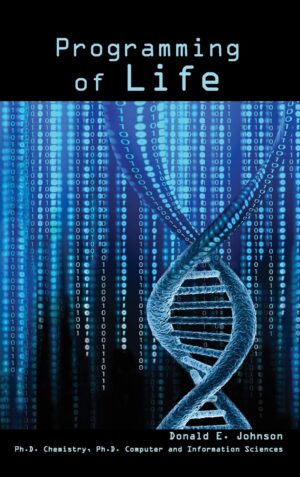
DVD / $16.00 / 44 Minutes
This beautifully illustrated video examines mathematical issues concerning the living cell. We soon discover that information is a critical feature of systems of life. Instructions on how to build and run the living cell, all require information. It really makes us think of computers. High school students, pastors, teachers and others will love these fascinating insights!
Order Online
The importance of the mineral calcium phosphate to living organisms can hardly be overstated. It is used by many organisms, including humans, to build their bones and skeletons. This is especially true for fish, crustaceans, and some brachiopods. Besides that, and even more importantly, phosphate ions are required for major building blocks of life, such as DNA and RNA. It is also required for the production of adenosine triphosphate (ATP)—the molecular fuel of living cells (Brady, Tostevin and Tosca 2022).
Evolutionists struggle to explain how life could have arisen from non-life—a concept known as “abiogenesis” or “spontaneous generation.” One of the problems is the importance of phosphate ions for biological molecules and the prohibitively low concentrations of phosphates in nature for those molecules to form spontaneously. There just isn’t enough phosphate. Phosphate minerals tend to be insoluble under most conditions, so only trace amounts exist as dissolved minerals in seawater. In fact, on average, seawater contains only about 0.071 parts per million of phosphorous (Simandl, Paradis and Fajber 2012).
Read the rest of this entry »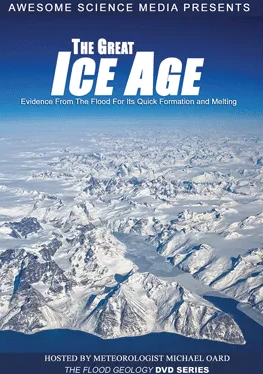
DVD / $15.00 / 97 Minutes
There are multiple evidences of the past action of continent-wide ice blanketing our landscapes. Many wonder how such ice fits into Biblical history. Micael Oard explains how there was one ice age which lasted several hundred years, and not multiple occurrences over millions of years. This single ice age followed the Genesis Flood, and indeed was caused by the aftermath of the Flood. Conventional theories cannot explain what we see in the world today.
Order Online
Understanding genetics was so straightforward back in the good old days. I am not sure when those days were, but our picture of control systems in our bodies was easier when obvious stretches of DNA, called genes, were believed to control specific traits like eye colour and blood type. It used to be that we talked about genes and ‘junk DNA’. Now there are genes and there are control systems. It was the use of supercomputers which changed our understanding of how the human genome works.
Read the rest of this entry »
I joined the Creation Research Society in 2023 because God put a desire in my heart to do research and publish technical papers. My undergraduate science degree has no major, and I’ve received some criticism for that, but the program I enrolled in allowed me to try a bit of everything and get a well-rounded base of scientific knowledge. Then God gave me a job where I have the freedom to do the things I love. I needed some intellectual stimulation, though, so I told God, “I need some science I can sink my teeth into.” In September 2024, He answered by handing me a paleoanthropology assignment and connecting me to a co-author, Carol Adams. We decided to attend the 2025 CRS Conference at the end of July, and Carol suggested that we submit an abstract and present our work.
Read the rest of this entry »
Some years ago, I had occasion to collect a water sample from a small pond south of Lake Manitoba. The fun part was going back to the lab and looking at a drop of the sample under the microscope. I was sampling lakes and ponds every day, but on this occasion I screamed at what I saw. There before my wondering eyes were relatively large, brownish algal cells with fierce looking spines. They were spinning slowly as I watched.
Read the rest of this entry »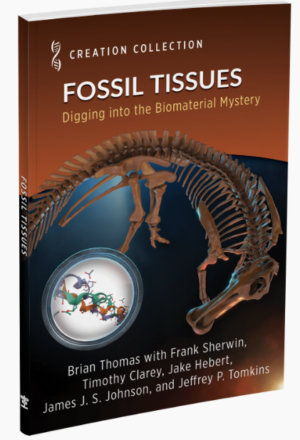
Paperback / $10.00 / 170 Pages / Full colour
Fossil Tissues: Digging into the Biomaterial Mystery
In the Creation Collection Series
During the past two decades, many people who follow scientific news, have been fascinated by accounts of fossils which contain non-fossilized organic material. These remains consist of original biochemical compounds or parts thereof from fossilized specimens of extinct creatures. The first report involved the accidental discovery of soft tissues inside a T. rex bone. Although the scientist who made the discovery was herself a mainstream scientist, there were many critiques of this work since the idea that organic molecules like proteins could resist decay for millions of years, did not seem possible. It still doesn’t.
Brian Thomas of Institute for Creation Research, whose Ph.D. research involved similar research, in this booklet documents the subsequent cascade of discoveries of many fossilized animals and even some plants that still contain undecomposed material.
Dr. Thomas describes explanations used by mainstream scientists to try to explain these highly unexpected results. Over several chapters Dr. Thomas demonstrates that only a short time interval can explain the persistence of these proteins, collagen and other compounds. The remains of DNA is especially surprising since it is such a fragile compound.
If ever there was a stimulating and fun account of the results of research on an origins topic, this is it! (Dr. Thomas discussed this topic at Creation Weekend 2025 but this book was not out yet.)
Order Online
Paperback / $22.00 / 256 Pages
Darwin’s Sandcastle: Evolution’s Failure in the Light of Scripture and the Scientific Evidence
This overview of young earth science shows us that there are many more issues involved in origins than just the fossil record and DNA. Were there always predatory and disease-causing organisms? Do their features demonstrate design too? What does plate tectonics mean? Why do we care about fossils and DNA anyway? This book provides answers on many issues important to Christians.
Order Online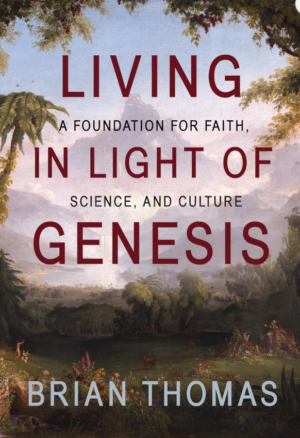
Paperback / $16.00 / 185 Pages / Black and white
This is a personal account of Dr. Brian Thomas’ spiritual and intellectual journey from non-believing science student to Christian conversion, to his intellectual struggle with Genesis, to his later career as a research scientist and communicator of the gospel and wonders of God’s creation. This account takes us to discussions of a wide variety of scientific fields, some less familiar to us than others. It totally broadens our horizons in a non-confrontational way.
Order Online
I collaborated with Carol Adams, a member of the Creation Research Society (CRS), to write a technical paleoanthropology paper, and we presented our research at the CRS Conference in July 2025. Our specific topic was Australopithecus afarensis (Lucy).
Read the rest of this entry »
The Ice Age and Climate Change
Reviewed by Andrea Reitan
Climate change alarmism seems to be a cultural obsession these days, among both Christians and non-Christians alike. Much of the hoopla around climate change stems from the claim that there is a scientific consensus and that we need to change our ways, but is this true? Should Christians jump aboard the climate change crusade? In The Ice Age and Climate Change, Jake Hebert aims to examine the evidence commonly used in climate discussions, arguing that a Young-Earth Creation (YEC) framework leads to different conclusions than the mainstream narrative.
Read the rest of this entry » Order OnlineFEATURED BOOKS AND DVDS
Paperback / $6.00 / 55 Pages
The Ice Age and Climate Change
Reviewed by Andrea Reitan
Climate change alarmism seems to be a cultural obsession these days, among both Christians and non-Christians alike. Much of the hoopla around climate change stems from the claim that there is a scientific consensus and that we need to change our ways, but is this true? Should Christians jump aboard the climate change crusade? In The Ice Age and Climate Change, Jake Hebert aims to examine the evidence commonly used in climate discussions, arguing that a Young-Earth Creation (YEC) framework leads to different conclusions than the mainstream narrative.
Read the rest of this entry » Order Online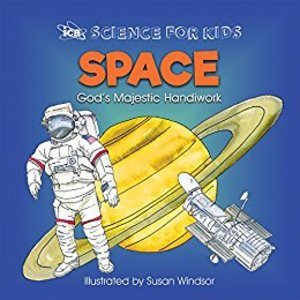

Paperback / $10.00 / 111 Pages / full colour
The Ice Age and Climate Change
Reviewed by Andrea Reitan
Climate change alarmism seems to be a cultural obsession these days, among both Christians and non-Christians alike. Much of the hoopla around climate change stems from the claim that there is a scientific consensus and that we need to change our ways, but is this true? Should Christians jump aboard the climate change crusade? In The Ice Age and Climate Change, Jake Hebert aims to examine the evidence commonly used in climate discussions, arguing that a Young-Earth Creation (YEC) framework leads to different conclusions than the mainstream narrative.
Read the rest of this entry » Order Online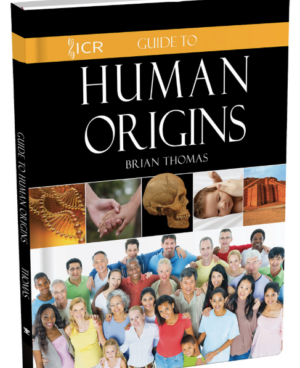
Hardcover / $18.00 / 117 Pages / Full colour
The Ice Age and Climate Change
Reviewed by Andrea Reitan
Climate change alarmism seems to be a cultural obsession these days, among both Christians and non-Christians alike. Much of the hoopla around climate change stems from the claim that there is a scientific consensus and that we need to change our ways, but is this true? Should Christians jump aboard the climate change crusade? In The Ice Age and Climate Change, Jake Hebert aims to examine the evidence commonly used in climate discussions, arguing that a Young-Earth Creation (YEC) framework leads to different conclusions than the mainstream narrative.
Read the rest of this entry » Order Online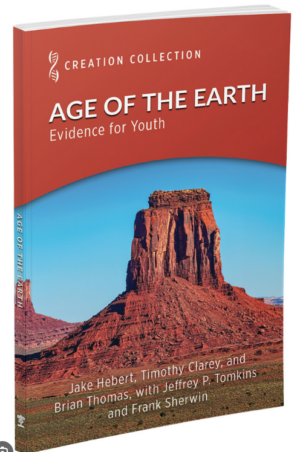
Paperback / $10.00 / 192 Pages / Full colour
The Ice Age and Climate Change
Reviewed by Andrea Reitan
Climate change alarmism seems to be a cultural obsession these days, among both Christians and non-Christians alike. Much of the hoopla around climate change stems from the claim that there is a scientific consensus and that we need to change our ways, but is this true? Should Christians jump aboard the climate change crusade? In The Ice Age and Climate Change, Jake Hebert aims to examine the evidence commonly used in climate discussions, arguing that a Young-Earth Creation (YEC) framework leads to different conclusions than the mainstream narrative.
Read the rest of this entry » Order Online