

Biology
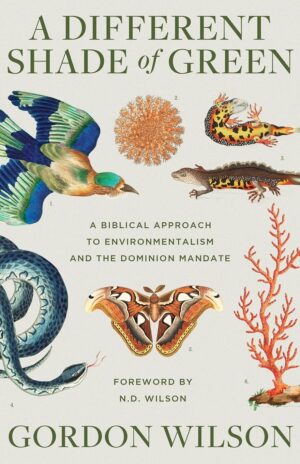

Paperback / $16.00 / 189 Pages / line drawings
In this recent book, written for the concerned Christian, Dr. Wilson seeks to discuss how God’s world works, our place in it, and how to assume leadership and dominion in the world. Written in friendly persuasive fashion, this book is enjoyable and inspirational.
Order Online
The Bible tells us that Moses was instructed in all the wisdom of the Egyptians. He used this training when he was called upon, later in life, to lead the Children of Israel through the desert and to write an account of their history. Obviously, Moses did not adopt the pagan philosophy in which his training in Egypt was couched. He evaluated what he heard.
In similar fashion, young Christians are encouraged to pursue modern learning, according to the talents with which they have been given. Like Moses too, they are expected to evaluate the modern explanations. In the light of the complexity of many modern disciplines however, it is obvious that students need help. They need trusted advisors to help them sort through the onslaught of information.
To this end, Creation Science Association’s Margaret Helder has developed a novel tool to assist students embarking on new courses in biology. Since much of the material taught in these courses is based on studies conducted since the year 2000, there are many new terms and concepts involved.All of them are defined in terms of evolutionary assumptions. The definitions available, on-line, all come from an evolutionary agenda. But the data themselves actually support creation! Read the rest of this entry »


The brand new book Gifted Mind has it all: inspiring message, an exciting story with diverse characters, conflict resolution and a happy ending. This is a book that the reader will be reluctant to put down. Best of all, however, this is a true account of how God worked in the life of the amazing inventor of the magnetic resonance imaging machine (MRI). This machine has only been available since the 1980s, yet it has impacted for good the lives of millions of people.
A tail is a distinct, flexible appendage attached to the torso of the rear section of an animal’s body. It is the body part that corresponds roughly to the coccyx in mammals, reptiles, and birds. Tails are primarily a feature of vertebrates, although some invertebrates, including scorpions and springtails, have tails. Even snails and slugs have tail-like appendages sometimes referred to as tails. Read the rest of this entry »
Most people have a love-hate relationship with rodents. That is, people love to hate them. This is a pity since rodents exhibit various interesting talents. For a start, when we think of rodents, we think of rats. Rats certainly have a bad reputation because they thrive in so many environments where nobody wants them. Nevertheless rats are smart and individually very clean. Most rats live less than a year in the wild. Mama rats however are definitely overachievers. Read the rest of this entry »
Many people claim they are not interested in science, but this is not really true. Perhaps they never really studied nature, but there are few people who do not notice how interesting and beautiful the surrounding countryside is. Did you realize for example that magpies are common in the western half of North America, but not in central Canada? Some people say that these distinctive birds are so common in Edmonton that this is the “magpie capital of Western Canada” (a dubious distinction). Read the rest of this entry »
Armadillos (Spanish for little armoured one) are New World nocturnal mammals covered by a leathery armour shell overlaid by horn. Of all living animals, “few are as amazing … as the armadillos” (Storrs, 1982). Even Carolus Linnaeus, the father of taxonomy, was puzzled about how to classify this “strange-looking mammal” (Smith and Doughty, 1984, p. 2). They are shy, timid mammals that mammalogist David Lamp calls bizarre (1977, p. 36). They look nothing like any other living animal, appearing much more like a fierce miniature dinosaur. These nearly blind and deaf animals must use their keen sense of smell to locate food. Read the rest of this entry »

People who live in rural regions obviously have an enormous advantage in opportunities to observe and enjoy nature. For a start, they may be able to view the night sky much better than their friends in the city whose view of the stars is dimmed by city lights. Secondly of course there are the animals who make a point of visiting the property. There may be waterfowl in the spring, ducks and geese at least, who come to refresh themselves on your pond. And how about the frogs who deafen the night with their cheerful choruses. Read the rest of this entry »

Book Review by Margaret Helder
Dr. Gordon Wilson has written a nice new book, Darwin’s Sandcastle, for Christians who are not scientists but who desire to be informed, but not burdened with details concerning science and origins. Such people understand that they need to keep mentally alert concerning their worldview. This means not shutting themselves off from important topics like the foundations of Christian doctrine and history. The objective of many Christians therefore is to share their worldview with others and not become bowled over by contrary views. While most people do not specialize in science, they can at least familiarize themselves with the basic issues.
Read the rest of this entry » Order OnlineSometimes scientific studies seem more frivolous than serious work. That does not happen too often, of course since scientific research is expensive. However there was one study published in 2005 that did seem “cute rather than deep” (in the words of psychologist Steven Pinker of Harvard University.) Actually the study was intended to demonstrate serious evolutionary implications. As such it was chosen as the cover story for the December 22/29 December 2005 issue of Nature. Thus the caption on the cover featured the expression: “Fascinating Rhythm: Dancing’s Role in Sexual Selection.” However on November 27/13 Nature withdrew this article from its published collection. Read the rest of this entry »
I remember hearing a biologist from Bristol in England. He was talking about his studies on diatoms (algae with glass walls). He described how he set out to study the activities of these cells on the nearby seashore. To collect the diatoms, he said, he used English toilet paper which was scratchy and impervious to water. The English students laughed uproariously at this. The Canadians, sitting straight-faced, did not realize this was a joke! At any rate what he found was that the algae emerged from below the sand surface during low tide in the day, but they then moved back under the sand before the tides returned at a different time every day. This is the kind of timekeeping ability in organisms that biologists were beginning to study. There were studies on people living alone in dark caves, studies on algae that glow in the dark, and fruit flies that emerge from the pupa at a certain time of day. How do they keep track of time? Read the rest of this entry »

There is a reason why people walk down the street with their eyes glued to their cell phones. They want to find out the latest news! It is indeed true that everyone is curious and likes a good story, and especially the ending to a good story. Many stories however actually are never ending. They may start in a very simple fashion, but as time goes on, the details become more and more complicated.
Many stories or interpretations in science, for example, are like this. At first the idea is straightforward, but as more studies are conducted, the story becomes more difficult to follow. Consider, for example, Darwin’s proposals about evolution. He observed that individuals in a population of organisms differed in various small details. He then argued that those individuals which were better endowed, would be the ones to leave more offspring. This was the simple story that Darwin developed to explain evolution. There were many people who did not think that this scenario of changing proportions of traits in the population could explain the appearance of new body plans. The process might explain why there were more big or small individuals (or whatever) in the population, but it could not explain the appearance of new body plans (such as insect or fish) which require a lot of new information compared to that found in other kinds of creature. But no matter, Darwin’s scenario became the basis for evolution theory in the years to come.
Read the rest of this entry »SCIENCE FROM A CHRISTIAN PERSPECTIVE
by Margaret Helder
Reviewed by: Jonathan Dykstra (Editor, Reformed Perspective)
From the title onward, No Christian Silence on Science is a clarion call to Bible-believing, six-day creation upholding Christians to stand up and be counted. It’s much more than that too. The author, Margaret Helder, has written for the Creation Science Dialogue and Reformed Perspective (the magazine I edit) for years, and if you’ve read her there, then you know Dr. Helder approaches God and His creation with awe, and teaches us how to tackle evolution without fear. This book is very much an outgrowth of that work. This, then, is intended to equip us, so we will be able to give a ready defense of our faith, and fortify us, so we will continue to trust in God, even when we face the attacks that will come in this predominantly Darwinist and secular field. Read the rest of this entry »
Order OnlineEvery family, whether into science of not, should obtain a copy of this book for the sake of their children (upper elementary through high school). This deluxe book, The World of Animals, is a wonderful reference book which describes anatomy and ecological significance of the main groups of animals. Read the rest of this entry »

Back in the days when television was new to North American society, there was a show called Perry Mason. This featured a lawyer who specialized in courtroom drama. In predictable fashion, Mr. Mason set out to defend an accused person, but the facts of the case looked very discouraging for the defendant. However, thanks to great sleuthing by Perry Mason’s two assistants, some important new details were discovered. In the courtroom, as the show drew toward a close, Mr. Mason triumphantly asked a witness, “Isn’t it true that ….?” And some new facts were revealed which changed the whole story. Everyone was all smiles when the defendant was exonerated. The point is that partial information can lead to wrong conclusions.
Read the rest of this entry »FEATURED BOOKS AND DVDS
Paperback / $6.00 / 55 Pages
Back in the days when television was new to North American society, there was a show called Perry Mason. This featured a lawyer who specialized in courtroom drama. In predictable fashion, Mr. Mason set out to defend an accused person, but the facts of the case looked very discouraging for the defendant. However, thanks to great sleuthing by Perry Mason’s two assistants, some important new details were discovered. In the courtroom, as the show drew toward a close, Mr. Mason triumphantly asked a witness, “Isn’t it true that ….?” And some new facts were revealed which changed the whole story. Everyone was all smiles when the defendant was exonerated. The point is that partial information can lead to wrong conclusions.
Read the rest of this entry » Order Online
Paperback / $10.00 / 111 Pages / full colour
Back in the days when television was new to North American society, there was a show called Perry Mason. This featured a lawyer who specialized in courtroom drama. In predictable fashion, Mr. Mason set out to defend an accused person, but the facts of the case looked very discouraging for the defendant. However, thanks to great sleuthing by Perry Mason’s two assistants, some important new details were discovered. In the courtroom, as the show drew toward a close, Mr. Mason triumphantly asked a witness, “Isn’t it true that ….?” And some new facts were revealed which changed the whole story. Everyone was all smiles when the defendant was exonerated. The point is that partial information can lead to wrong conclusions.
Read the rest of this entry » Order Online
Hardcover / $18.00 / 117 Pages / Full colour
Back in the days when television was new to North American society, there was a show called Perry Mason. This featured a lawyer who specialized in courtroom drama. In predictable fashion, Mr. Mason set out to defend an accused person, but the facts of the case looked very discouraging for the defendant. However, thanks to great sleuthing by Perry Mason’s two assistants, some important new details were discovered. In the courtroom, as the show drew toward a close, Mr. Mason triumphantly asked a witness, “Isn’t it true that ….?” And some new facts were revealed which changed the whole story. Everyone was all smiles when the defendant was exonerated. The point is that partial information can lead to wrong conclusions.
Read the rest of this entry » Order Online
Paperback / $10.00 / 192 Pages / Full colour
Back in the days when television was new to North American society, there was a show called Perry Mason. This featured a lawyer who specialized in courtroom drama. In predictable fashion, Mr. Mason set out to defend an accused person, but the facts of the case looked very discouraging for the defendant. However, thanks to great sleuthing by Perry Mason’s two assistants, some important new details were discovered. In the courtroom, as the show drew toward a close, Mr. Mason triumphantly asked a witness, “Isn’t it true that ….?” And some new facts were revealed which changed the whole story. Everyone was all smiles when the defendant was exonerated. The point is that partial information can lead to wrong conclusions.
Read the rest of this entry » Order Online