

Intermediate


/ Pages
Jerry Bergman (2017) Joshua Press pp. 312
The best books are those that carry a compelling message and are interesting to read. Dr. Jerry Bergman’s new book How Darwinism Corrodes Morality is such a document. It carries the reader along from story to story. His discussion demonstrates how, in the early twentieth century, certain individuals who were consumed with a passion for Darwinism, managed to transform the values and customs of society from morals based on Judeo-Christian thought to a rejection of standards of any sort. Read the rest of this entry »
This is a very welcome new book. Our catalogues provide beautifully illustrated books on fossils for young students of the junior high variety, but little for interested adults that is not highly technical. Here we find a nicely illustrated book with discussion at an adult, but not overwhelmingly technical level. On each topic, the authors firstly present the evolutionary argument and then they show how this conclusion does not actually represent the fossil description, location in the rocks and comparison with other fossils. Read the rest of this entry »

Among living creatures, it does not take a specialist to realize that jellyfish are not dainty delights of the deep. Although they may be beautiful in appearance, jellyfish are successful predators. Read the rest of this entry »
Paperback / $16.00 / 260 Pages / black and white illustrations
A great discussion on the significance of design, from the wonders of some marvelous creatures, to intricate biochemical systems, and the issues connected to predators and disease. Recommended for interested adults and all who enjoy fascinating details of the creation.
Order OnlineIn science, the word “serendipity” refers to an unexpected, but happy discovery. Typically what is meant, is a discovery which was not sought but which leads to significant advances in knowledge or technology. Penicillin, for example was a serendipitous discovery by Sir Alexander Fleming in 1928. What he was trying to do, was grow cultures of common bacteria (germs). But what was that pesky mold doing growing in the culture? When Sir Alexander realized that the mold seemed to discourage the growth of the bacteria…. well the rest is history. However, I am not sure that the unlooked for discovery of gigantic sand waves in the Juan de Fuca Strait near Victoria, BC would qualify as serendipitous or not. While they seem to be the biggest and best sand waves known, scientists are apparently not curious enough to study the phenomenon further. Read the rest of this entry »
If you have followed the adventures of scientists who collect fossils for a living, you may have noticed that travel to distant lands is often part of their profession. One such account by Derek Ager, published posthumously in 1993 (The New Catastrophism.Cambridge University Press) contains insights garnered from his travels and experiences during the course of a long career in palaeontology. Read the rest of this entry »
The 2017 award of the Nobel Prize in physiology and medicine to three Americans, Michael Rosbash, Jeffrey Hall and Michael Young, has served to stimulate our interest in a phenomenon that is actually well-known. We all know why people get hungry about the same time of day, or wake up about the same time, or suffer from jet-lag. It is because of biological clocks. So what was so special about the work of these three scientists? The story actually goes back to 1729! Read the rest of this entry »
Can you imagine a trip to England without a visit to the white cliffs along the south east coast? We couldn’t, so we went. There we stood at the foot of an awe inspiring cliff of sparkling white chalk. Coarse looking, but flat bedding planes divided the towering wall above into endless horizontal layers or strata. It seemed strange however that the shore was covered with hard, rounded pebbles as well as some shiny black fragments with sharp edges rather than white chalk. Closer inspection indicated that the shiny black chunks and the grayish rounded pebbles were of the same material — only the pebbles were rounded and worn by wave action. Now where did these pebbles of hard material come from? When you come to think of it — where did the chalk above come from too? Read the rest of this entry »
I remember suggesting to one of my professors, when I was at university, that a certain course would be a waste of my time since I had already studied that topic. He suggested that there might be more to learn and he was right, of course. In fact, there is always more to learn on any topic. That is why we hear so much about life-long learning. We don’t want to atrophy (dry up) mentally or physically. It is important to keep developing our skills.
Naturally in everything we learn, we have to be cautious. We don’t want to plant desert-loving plants in a wet area of the garden, or do stretches the wrong way, nor do we want to acquiesce to wrong interpretations in science, or history or philosophy or whatever. This does not mean we stop reading! What it means is that we apply critical thinking skills to our various pursuits. Read the rest of this entry »
As a rule, scientists seek answers. They want to answer the “why” questions. Why, for example, are plants green? Why is blood red? These are very simple queries compared to the biggies like why does quantum physics work. Nevertheless, believe it or not , we are as far from answering why chlorophyll is green, and blood cells are red, as we are from explaining quantum mechanics. Two commentators in fact recently termed the reason blood is red a “visual pun of molecular wit.” (Morrison and Morrison. 1998. Scientific American. March p. 106) The explanation for colour in chlorophyll is similarly obscure. The situation becomes even more interesting when we discover that chlorophyll and the heme component of hemoglobin are chemically extremely similar . Read the rest of this entry »
Hardcover / $25.00 / 300 Pages
This semi-technical book discusses the sequence of events from the creation to New Testament times. The author shows that the Scriptural account is accurate and reliable. It includes a CD and many pages of charts, graphs and diagrams. This book is also compatible with James Ussher’s “Annals of the World”.
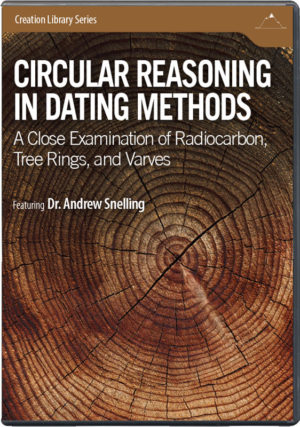
DVD / $15.00 / 74 Minutes
A Close Examination of Radiocarbon, Tree Rings and Varves – Most people think about C14 (carbon fourteen) dating when they wonder about radiometric dating methods. Since the issues with carbon fourteen dating are different from issues in dating rocks, this DVD presents a timely discussion of carbon dating which can involve how long-ago certain creatures lived.
Order OnlineHave you ever read The Enormous Crocodile by Roald Dahl? It is such a fun story! Even grown ups laugh about this nasty scheming reptile who keeps devising new and ingenious ways to catch children for his supper. He describes his schemes as “secret plans and clever tricks.” Various jungle animals however foil each sneaky plan and the nasty croc eventually gets launched by an elephant into outer space. Read the rest of this entry »
Margaret Helder has developed a guide to enhance the learning opportunities and appreciation of the message in her book (which is to encourage everyone to critically evaluate scientific pronouncements). For each chapter there is a brief overview statement. Brief paragraphs follow for each subsection in each chapter with key concepts introduced. There follows for each chapter a list of questions, many of them involving the key concepts. The next section provides detailed answers for each question. A sure to be popular section follows on resources. These are provided under topical headings. Books, articles (all obtainable) and especially video clips on-line, are certain to be useful for any biological studies, not just for this book. Lastly for each chapter, a section on extension is provided. This booklet of about 60 pages, will be available on line (free download) and in hard copy. Inquire through our website for your copy as soon as it is available.
Paperback / $15.00 / 486 Pages
This is a scholarly volume which provides a welcome defence of a straightforward reading of the early chapters of Genesis. This volume is particularly interesting as it demonstrates how the concept of long ages affects our understanding of the whole Bible. Written for academics and seminary students, but of interest to people like you and me.
FEATURED BOOKS AND DVDS
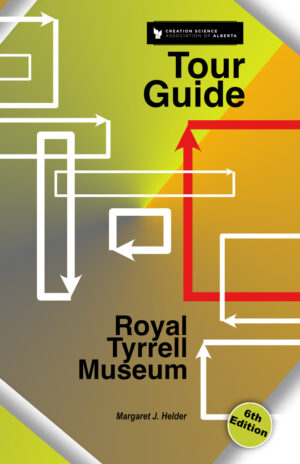
Paperback / $6.00 / 55 Pages
This is a scholarly volume which provides a welcome defence of a straightforward reading of the early chapters of Genesis. This volume is particularly interesting as it demonstrates how the concept of long ages affects our understanding of the whole Bible. Written for academics and seminary students, but of interest to people like you and me.
Order Online

Paperback / $10.00 / 111 Pages / full colour
This is a scholarly volume which provides a welcome defence of a straightforward reading of the early chapters of Genesis. This volume is particularly interesting as it demonstrates how the concept of long ages affects our understanding of the whole Bible. Written for academics and seminary students, but of interest to people like you and me.
Order Online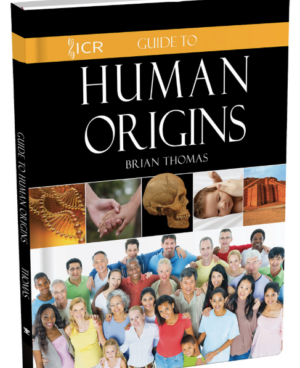
Hardcover / $18.00 / 117 Pages / Full colour
This is a scholarly volume which provides a welcome defence of a straightforward reading of the early chapters of Genesis. This volume is particularly interesting as it demonstrates how the concept of long ages affects our understanding of the whole Bible. Written for academics and seminary students, but of interest to people like you and me.
Order Online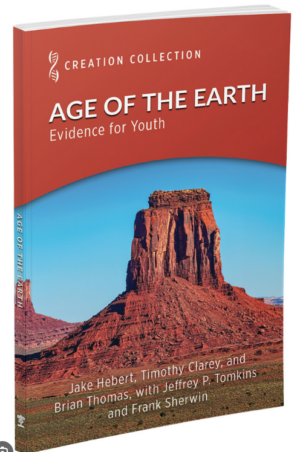
Paperback / $10.00 / 192 Pages / Full colour
This is a scholarly volume which provides a welcome defence of a straightforward reading of the early chapters of Genesis. This volume is particularly interesting as it demonstrates how the concept of long ages affects our understanding of the whole Bible. Written for academics and seminary students, but of interest to people like you and me.
Order Online